

Parks are the hardest lighting environment to wire. Pathways curve through lawns. Gardens shift with seasonal planting. Benches sit under trees far from any electrical junction box. Running underground cable to every fixture location in a 5-hectare park costs more than the fixtures themselves — and every future layout change means digging again.
We manufacture solar landscape lights that eliminate this problem entirely. Each fixture is self-contained: solar panel, lithium-ion battery, LED, light sensor, and remote control in a single weatherproof aluminum and PC housing. No trenching, no conduit, no electricity bills. We have deployed these across municipal park projects in 30+ countries since 2013.
This guide covers which model fits which park zone, how many units per hectare, layout design for safety and aesthetics, and procurement and maintenance at municipal scale.
Why Solar Is the Natural Choice for Park Landscape Lighting
Zero trenching preserves established landscapes. Parks contain mature trees, underground irrigation, and drainage infrastructure. Trenching for electrical cable risks damaging all of these. Solar lawn lights install on the surface — bolt to a concrete pad or push a stake into the soil — leaving everything underneath untouched.
Modular deployment matches organic park layouts. Paths curve, gardens evolve, new benches appear. A wired layout is rigid — moving a fixture means re-running cable. Solar fixtures relocate in minutes.
Zero electricity cost at any scale. A 5-hectare park deploying 300-500 landscape lights generates a permanent utility bill. Solar reduces it to zero. The light sensor activates each fixture at dusk and deactivates at dawn automatically.
No central point of failure. Each solar fixture operates independently. If one unit has a depleted battery, the other 299 continue operating. This distributed resilience is what public safety demands.
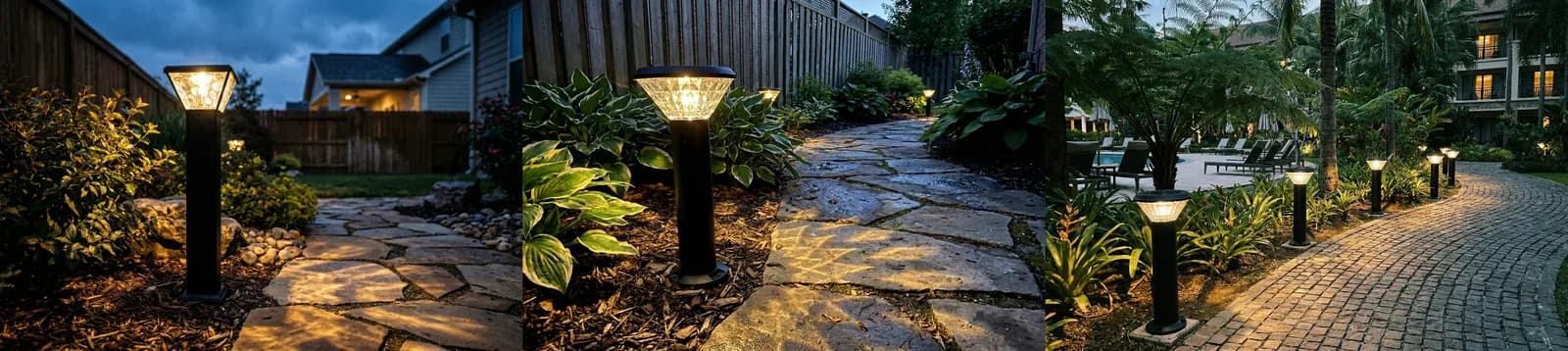
Understanding Park Lighting Requirements
Public parks impose six requirements that residential gardens do not:
- Decorative aesthetic — fixtures must complement landscape architecture, not just function
- Vandal resistance — withstand kicking, pulling, and theft attempts in unsupervised public spaces
- Pedestrian safety — consistent path illumination that prevents trips and guides navigation after dark
- Low light pollution — downward-directed illumination that does not disturb neighboring residents
- Weather durability — IP65 minimum, operating year-round through rain, snow, UV, and freeze-thaw cycles
- Easy bulk replacement — standardized models so a failed unit swaps out in 5 minutes from maintenance shed inventory
Our Solar Landscape Light Range: 4 Models for Every Park Zone
We manufacture four solar landscape light models. Two shapes — square and round. Two mounting methods — base-mount and ground-stake. The combination of shape and mounting method covers every park application.
All models share the same core platform: aluminum + PC + PC lens construction, polycrystalline solar panels, 3.7V lithium-ion batteries (18650 cells), remote control, and automatic light sensor. IP65 rated. CE certified.
Square Models: BF-SGL-18-S1 and BF-SGL-18-S2
Clean geometric lines. Modern architectural presence. These are the right choice for contemporary urban parks, plaza renovations, and commercial landscape projects where the design language is linear and precise.
| Spec | BF-SGL-18-S1 (Base-Mount) | BF-SGL-18-S2 (Ground-Stake) |
|---|---|---|
| Dimensions | 225 x 225 x H700 mm | 185 x 185 x H680 mm |
| Solar Panel | Polycrystalline 3.7V / 5W | Polycrystalline 3.7V / 5W |
| Battery | 3.7V / 4,400 mAh Li-ion | 3.7V / 2,200 mAh Li-ion |
| Control | Remote + light sensor | Remote + light sensor |
| Material | Aluminum + PC + PC lens | Aluminum + PC + PC lens |
Round Models: BF-SGL-18-R1 and BF-SGL-18-R2
Soft organic silhouette. Traditional garden character. The round profile fits natural park settings, botanical gardens, resort landscapes, and any environment where the design priority is visual warmth over geometric precision.
| Spec | BF-SGL-18-R1 (Base-Mount) | BF-SGL-18-R2 (Ground-Stake) |
|---|---|---|
| Dimensions | O245 x H690 mm | O200 x H680 mm |
| Solar Panel | Polycrystalline 3.7V / 5W | Polycrystalline 3.7V / 3.5W |
| Battery | 3.7V / 4,400 mAh Li-ion | 3.7V / 2,200 mAh Li-ion |
| Control | Remote + light sensor | Remote + light sensor |
| Material | Aluminum + PC + PC lens | Aluminum + PC + PC lens |
The pattern is deliberate: base-mount models carry 4,400 mAh batteries and 5W panels for permanent high-traffic locations that demand all-night runtime. Ground-stake models are lighter, repositionable, with 2,200 mAh batteries optimized for flexible placement where full-night operation is less critical.
Base-Mount vs Ground-Stake: The Critical Decision for Park Projects
This is the first question every park project must answer, and most large parks answer it with both. The choice depends on the surface, the permanence requirement, and the vandalism risk of each specific zone.
| Factor | Base-Mount (BF-SGL-18-S1 / BF-SGL-18-R1) | Ground-Stake (BF-SGL-18-S2 / BF-SGL-18-R2) |
|---|---|---|
| Installation surface | Concrete, stone, pavers, tile | Soil, grass, garden beds, gravel |
| Installation method | Drill and bolt to hard surface | Push into soft ground |
| Stability | Very high — bolted, vandal-resistant | Moderate — can be pulled out or knocked over |
| Battery capacity | 4,400 mAh — longer runtime | 2,200 mAh — standard runtime |
| Best park zones | Main walkways, plazas, permanent paths, monument areas | Garden beds, lawn borders, seasonal displays, temporary event areas |
| Relocation | Difficult — requires unbolting | Easy — pull up and replant |
| Vandal resistance | High — requires tools to remove | Low — hand-removable |
Our recommendation for municipal parks: Base-mount along primary pathways, entrances, monuments, and plazas. Ground-stake in garden beds, lawn areas, and secondary paths. The 60/40 split is common in our park projects: 60% base-mount on permanent hardscape, 40% ground-stake in soft landscape areas.
Square vs Round: Choosing the Right Aesthetic
Shape is design language. The wrong shape in the right location creates visual dissonance.
Square (BF-SGL-18-S1 / BF-SGL-18-S2): Contemporary urban parks, commercial plazas, modern renewal projects. Complements geometric architecture — steel, concrete, clean edges, straight pathways.
Round (BF-SGL-18-R1 / BF-SGL-18-R2): Traditional gardens, botanical parks, resort landscapes, heritage settings. Complements organic design — stone, wood, flowing lines, curving paths.
When to mix: Use one shape per zone. Square models in the formal entrance plaza, round models in the naturalistic garden. The transition between shapes should coincide with a transition between park zones.
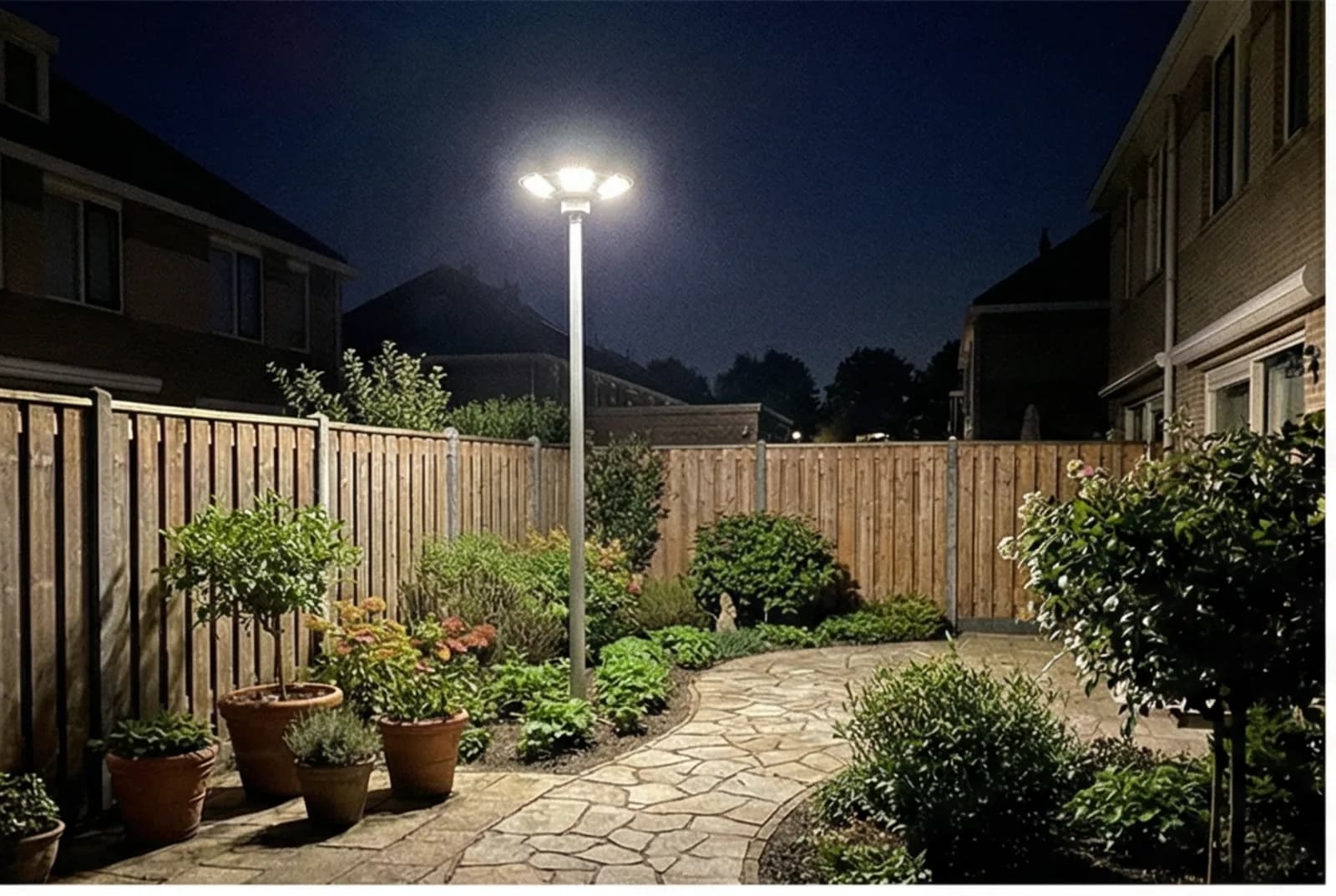
Park Layout Design: Where to Place Solar Lawn Lights
Placement strategy determines whether a park feels safely illuminated or randomly scattered with lights. Three placement categories cover the entire park.
Category 1 — Pathway Lighting
The backbone of park illumination. Every pedestrian route needs consistent light to prevent trips and guide navigation after dark.
Spacing: Place fixtures every 3-5 meters along both sides of primary pathways. For secondary paths, one side is sufficient at 3-5 meter intervals. Stagger left and right fixtures for even coverage rather than placing them directly opposite each other.
Placement rule: Position fixtures 30-50 cm from the path edge, inside the garden bed or lawn strip adjacent to the path. This keeps the light source close enough for effective path illumination while protecting fixtures from foot traffic and maintenance vehicles.
Category 2 — Accent Lighting
Accent lights mark features where people pause or make decisions:
- Park benches — one fixture within 2 meters of each seating area
- Signage and wayfinding posts — illuminate from below or beside
- Garden features — sculptures, specimen trees, water features
- Path intersections — mark the decision point with additional fixtures
- Entrance gates — clustered placement creates a welcoming threshold
Category 3 — Zone Definition
Line the border between distinct park zones (play area, reading garden, event lawn) with fixtures at 2-3 meter intervals. The light line creates a visual boundary that is obvious after dark and subtle during daylight — more elegant than fencing and more effective than signage.
Quantity Estimation: How Many Solar Lawn Lights Does Your Park Need?
This is the question every procurement officer asks first. The answer depends on what level of coverage the park design requires.
Comprehensive coverage (pathways + accents + zone borders): Plan for approximately 200 units per hectare. This delivers a fully illuminated park where every pathway, feature, and zone transition is lit. It is the standard for high-profile municipal projects and tourism-oriented parks.
Pathway-only coverage: Plan for 50-80 units per hectare. This illuminates walking routes while leaving garden interiors and secondary areas in ambient darkness. Suitable for neighborhood parks with tighter budgets where pedestrian safety along main routes is the priority.
Quick estimation formula: Total pathway length (meters) / 4 (average spacing) x 2 (both sides) x 1.15 (accent fixtures) = total units. Example: an 800 m pathway park needs roughly 460 fixtures.
For precise calculations tailored to your park layout, send us a site plan and our engineering team will provide a fixture schedule within 48 hours.
Municipal Procurement: Buying Solar Park Lights at Scale
Standardize on one or two models. Select one base-mount and one ground-stake model for the entire park system. This unlocks bulk pricing, simplifies spare inventory (one SKU covers all replacements), and delivers visual consistency across the park.
Maintain 5-10% spare inventory. For a 400-unit installation, keep 20-40 spares in the maintenance facility. A failed unit swaps out in 5 minutes — no procurement cycle, no waiting for international shipping.
Plan battery replacement cycles. Our lights use standard 3.7V 18650 lithium-ion cells with 2-3 year cycle life. Order replacement batteries in bulk at year 2-3. A crew replaces each battery in under 10 minutes without removing the fixture.
Pair with higher-power fixtures where needed. Solar lawn lights handle pathways and gardens (roughly 80% of fixtures). For main park roads, add solar street lights. For sports courts and event areas, add solar flood lights. This layered approach delivers both aesthetic quality and functional safety.
Installation and Maintenance at Park Scale
Base-mount (BF-SGL-18-S1 / BF-SGL-18-R1): Drill, anchor, bolt. 10-15 minutes per unit. A two-person crew installs 30-40 units per day. Ground-stake (BF-SGL-18-S2 / BF-SGL-18-R2): Push into soil. 2 minutes per unit. One person installs 100+ per day. No electrician required — the tool list is a drill, a rubber mallet, and a tape measure.
| Task | Frequency | Time per Unit |
|---|---|---|
| Solar panel cleaning | Quarterly | 30 seconds |
| Visual inspection | Monthly | 10 seconds |
| Battery replacement | Every 3-4 years | 10 minutes |
| Full fixture replacement | As needed | 5-15 minutes |
The maintenance philosophy is replacement, not repair. Swap a failed unit with a spare from inventory. The failed unit goes back to the shop — battery replacement fixes 90% of issues.
FAQ
Start Your Park Lighting Project
Whether you are designing a new municipal park, upgrading an aging wired system, or expanding an existing solar installation — we manufacture the fixtures and provide the layout guidance to make it work.
Two ways to start:
- Send a site plan for a detailed fixture schedule with model recommendations, quantities, and placement coordinates. Our engineering team responds within 48 hours.
- Order samples to evaluate on-site before committing to a bulk purchase. 1-4 units, Dispatched within 7 days, cost credited to your first order.
Explore our complete solar landscape light range for full specifications. For residential development projects, see our residential solar lighting solution. For parks that also need road lighting and sports area illumination, browse our solar street lights and solar flood lights.