


We manufacture three models of frequency-vibration solar insect killer lights at our Fujian factory. These are not residential mosquito zappers. They are agricultural and commercial pest control devices engineered to attract and trap a wide range of crop-damaging insects using calibrated light wavelengths and pulse frequencies.
Every unit runs entirely on solar power with LiFePO4 batteries — no grid connection, no chemical pesticides, no ongoing consumable costs. Mount it on a pole in your field, orchard, or park, and it works autonomously from dusk to dawn, season after season. We have supplied farms, agricultural cooperatives, government pest control programs, and commercial green spaces across 30+ countries since 2013.
Solar Insect Killer Light Specifications: Complete Model Comparison
All three models use frequency-vibration insect attraction technology and LiFePO4 (lithium iron phosphate) batteries. The core difference is the solar panel configuration and light spectrum coverage.
BF-SIK-16-30W — Large Frequency-Vibration
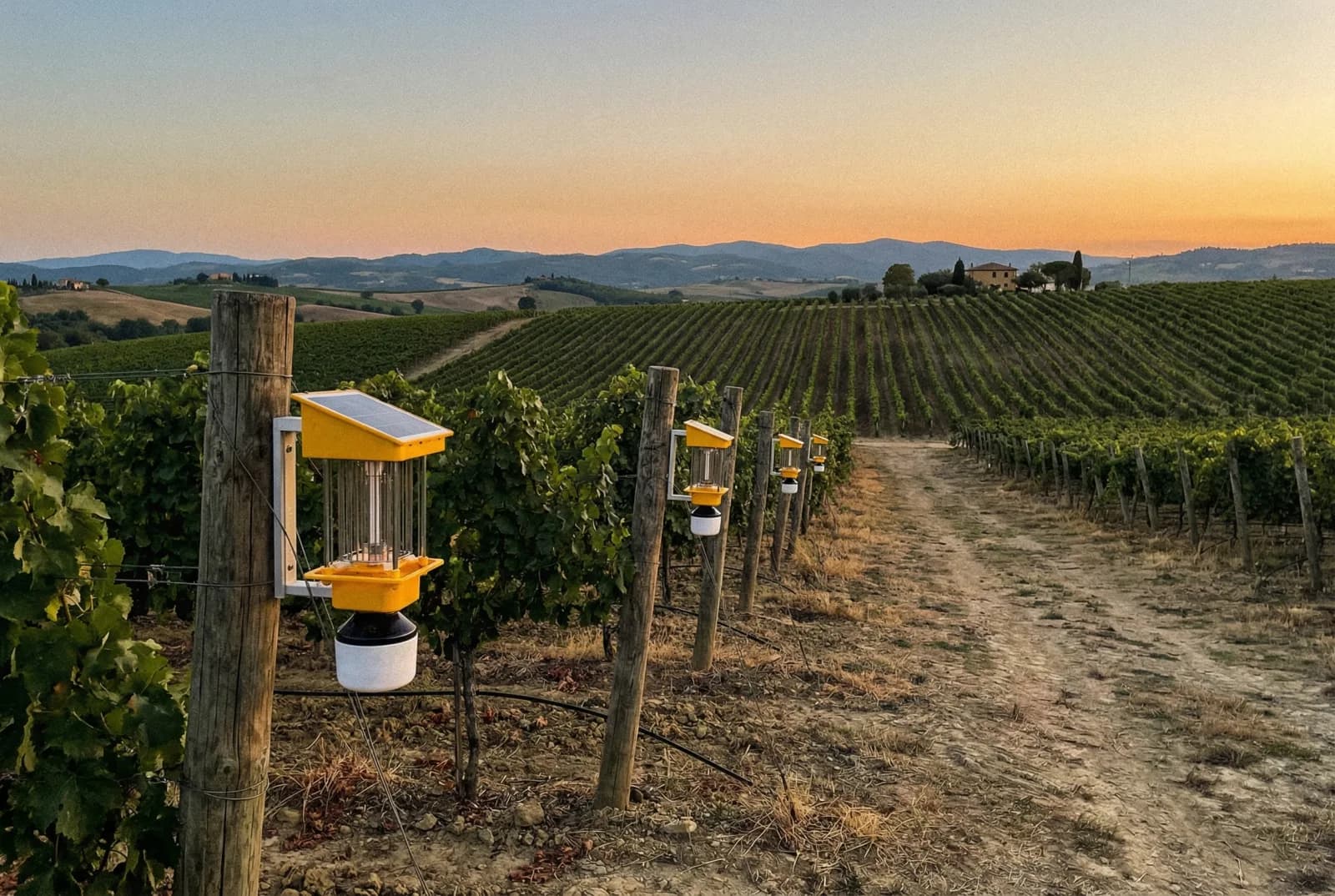
The workhorse model for single-crop agriculture. Separate high-wattage solar panel for maximum energy harvest. Best suited for rice paddies, wheat fields, and grain crops with predictable pest profiles.
| Spec | BF-SIK-16-30W |
|---|---|
| Type | Large Frequency-Vibration |
| Light Source | 18W Frequency-Vibration Lamp |
| Light Source Type | Frequency-vibration insect attraction |
| Dimensions | 400 × 400 × 600mm |
| Solar Panel Power | 30W (505 × 430mm, separate) |
| Battery | 25Ah LiFePO4 |
| Operating Time | 6-12 hours / night |
| IP Rating | IP65 |
BF-SIK-16-25W — Multi-Spectrum Frequency-Vibration

Our premium agricultural model. The multi-spectrum light source emits across a broader wavelength range, attracting pest species that single-wavelength units miss. The 40W separate solar panel ensures reliable charging even in shorter winter days. Recommended for orchards, vineyards, mixed-crop operations, and areas with diverse pest populations.
| Spec | BF-SIK-16-25W |
|---|---|
| Type | Multi-Spectrum Frequency-Vibration |
| Light Source | 25W Multi-Spectrum Lamp |
| Light Source Type | Multi-spectrum insect attraction |
| Dimensions | 350 × 350 × 720mm |
| Solar Panel Power | 40W (670 × 425mm, separate) |
| Battery | 30Ah LiFePO4 |
| Operating Time | 6-12 hours / night |
| IP Rating | IP65 |
BF-SIK-16-18W — All-in-One Frequency-Vibration
Integrated solar panel built into the unit housing — no separate panel, no cable, no extra mounting hardware. Ideal for remote installations, scattered deployment across large areas, and commercial applications (parks, golf courses, resorts) where clean aesthetics matter. The smaller battery suits regions with consistent sunshine.
| Spec | BF-SIK-16-18W |
|---|---|
| Type | All-in-One Frequency-Vibration |
| Light Source | 18W Frequency-Vibration Lamp |
| Light Source Type | Frequency-vibration insect attraction |
| Dimensions | 360 × 370 × 770mm |
| Solar Panel Power | 18W (integrated) |
| Battery | 15Ah LiFePO4 |
| Operating Time | 6-12 hours / night |
| IP Rating | IP65 |
All models use light-sensing auto on/off, waterproof collection bags for easy pest monitoring, and standard pole-mount brackets (60mm diameter).
A note on the model numbers. Naming in this range is not consistent, so read the specifications rather than the model number. On the BF-SIK-16-30W the figure is the panel (30W panel, 18W lamp); on the BF-SIK-16-25W it is the lamp (25W lamp, 40W panel); on the BF-SIK-16-18W both happen to be 18W. The "Light Source" and "Solar Panel Power" rows in each table above give both figures for every model. Our street and flood light ranges follow the usual solar-lighting convention, where the model number refers to the panel.
Why Frequency-Vibration Beats UV-Only Insect Killers
Most solar bug zappers on the market use a single UV wavelength and a high-voltage electric grid. This approach has three fundamental problems for agricultural pest control:
| Parameter | Frequency-Vibration (Ours) | UV-Only Bug Zapper |
|---|---|---|
| Wavelength Coverage | Multi-spectrum (multi-band) | Single band |
| Pest Species Attracted | Broad range (multi-band coverage) | Limited (single-band only) |
| Attraction Method | Calibrated pulse frequency + light | Static UV light only |
| Kill Method | Collection bag (monitoring-ready) | High-voltage grid |
| Beneficial Insect Impact | Low (tuned for pest wavelengths) | High (indiscriminate attraction) |
| Pest Population Data | Yes (bag contents analyzable) | No (insects destroyed on grid) |
| Maintenance | Empty bag periodically | Clean grid + replace burnt elements |
| Agricultural Certification | Designed for crop protection | Consumer/residential design |
| Target Market | Farms, orchards, cooperatives | Backyards, patios, restaurants |
The key insight: Agricultural pest control is not about killing every flying insect near a light. It is about selectively attracting crop-damaging species using their specific phototactic responses while minimizing beneficial insect bycatch. Frequency-vibration technology was developed specifically for this purpose by agricultural research institutions, and we have refined it for solar-powered field deployment.
For a detailed technical guide on solar insect killer technology, read: Solar Insect Killer Buying Guide: What Agricultural Buyers Need to Know.
Which Model Fits Your Application?
We designed three models for different deployment scenarios. Use this table to find your starting point — then contact our team for a free site layout.
| Application | Recommended Model | Why This Model |
|---|---|---|
| Rice paddies, grain fields | BF-SIK-16-30W (Large) | Standard spectrum covers major rice and grain pests, large panel for reliable solar harvest |
| Orchards, vineyards | BF-SIK-16-25W (Multi-Spectrum) | Broader wavelength range attracts fruit-tree pests that single-spectrum units miss |
| Vegetable farms, greenhouses (perimeter) | BF-SIK-16-25W (Multi-Spectrum) | Diverse pest species in vegetable cultivation require multi-spectrum coverage |
| Tea plantations | BF-SIK-16-30W (Large) | Tea pests respond well to standard frequency-vibration; high panel wattage handles hilly terrain shadows |
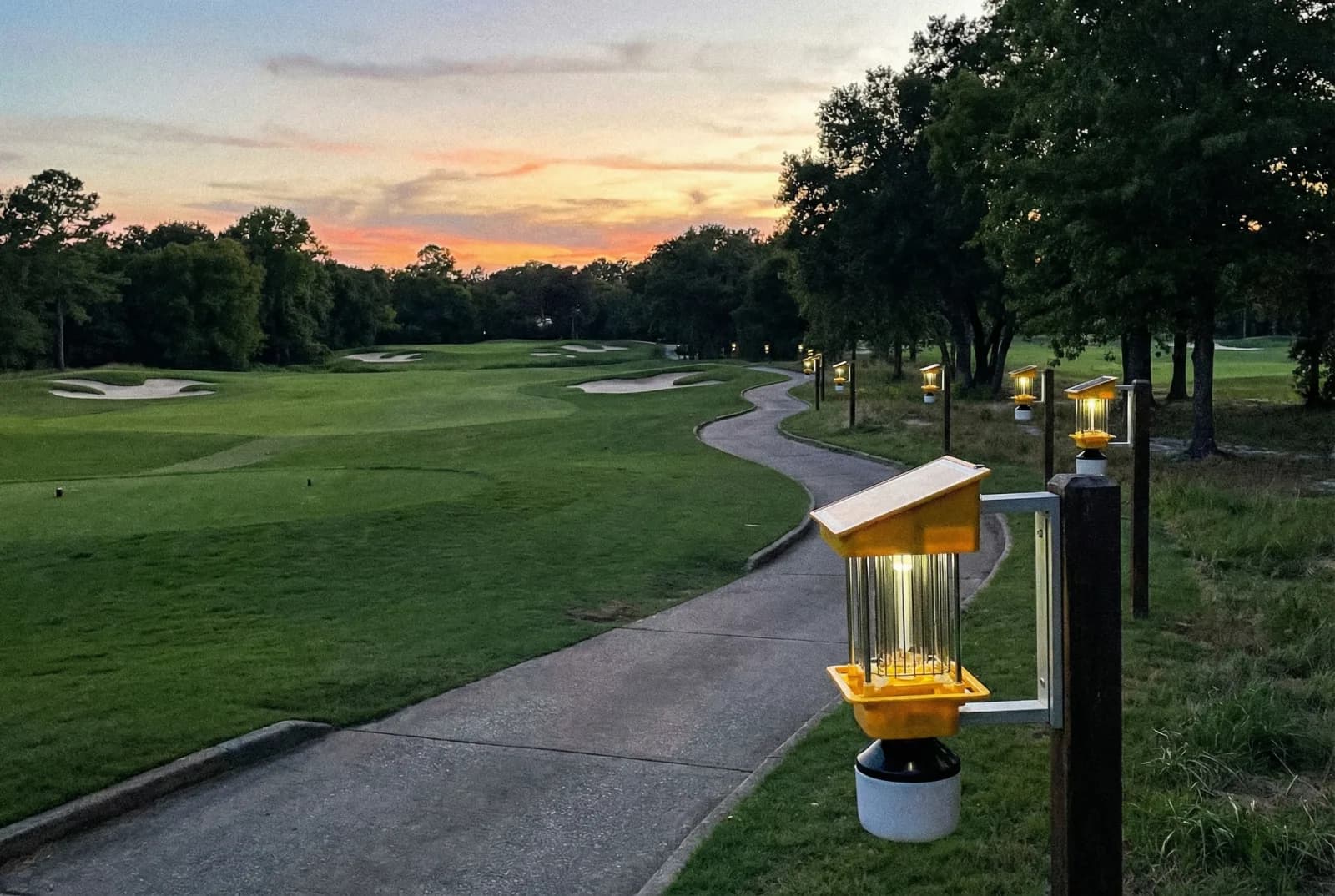
| Golf courses, resort grounds | BF-SIK-16-18W (All-in-One) | Clean integrated design, no separate panel or cables, aesthetics-friendly |
| Public parks, green spaces | BF-SIK-16-18W (All-in-One) | Easy installation across scattered locations, minimal visual impact |
| Government pest control programs | BF-SIK-16-25W (Multi-Spectrum) | Maximum species coverage for regional pest monitoring and control |
| Agricultural cooperatives (bulk) | BF-SIK-16-30W or BF-SIK-16-25W | Volume pricing, mixed-model orders welcome, layout planning included |
Coverage Planning
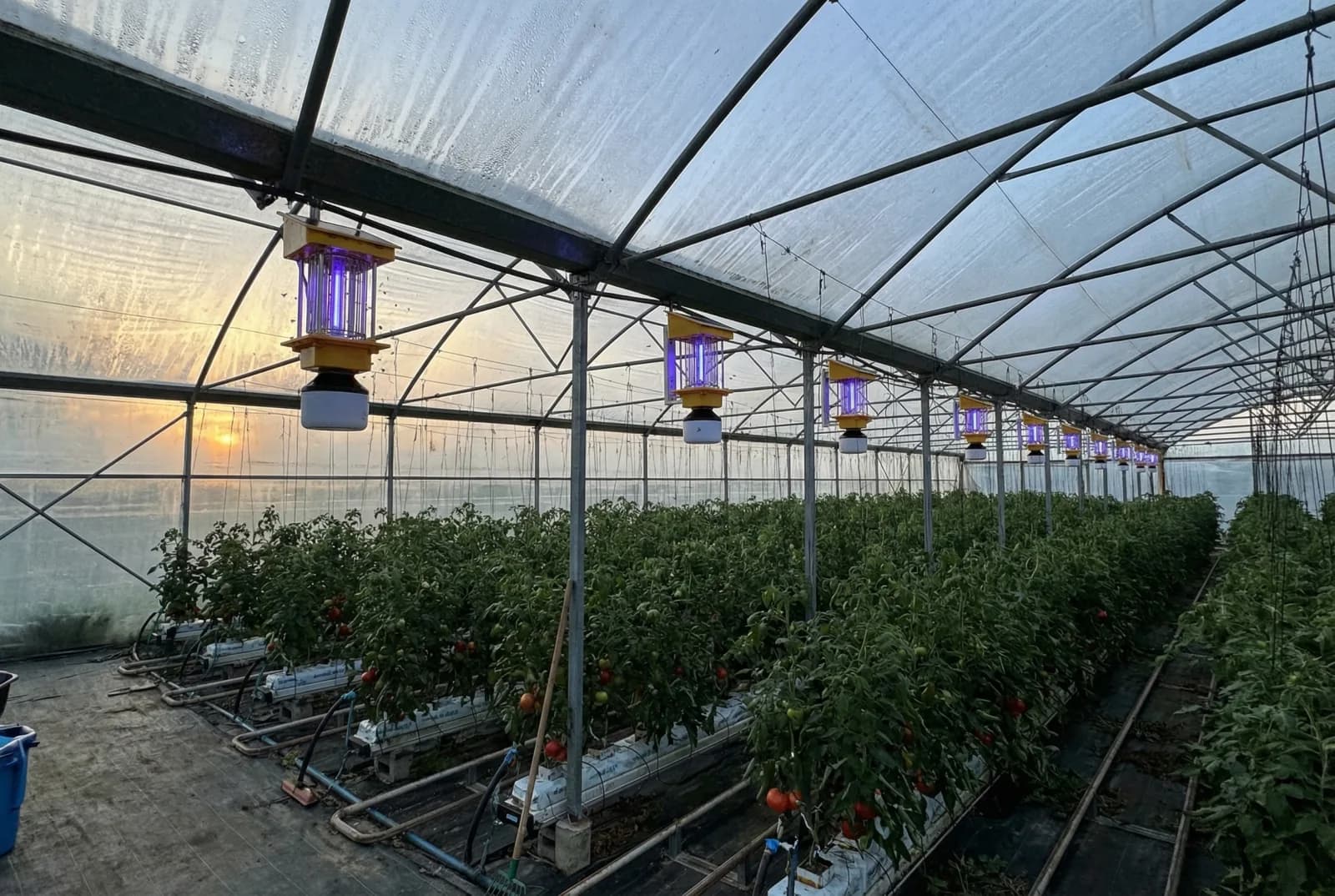
For large-scale deployments, proper spacing is critical to effective pest control:
- Open fields (rice, wheat, corn): Grid pattern, 150-200m spacing, poles at 2.5-3m height
- Orchards and vineyards: Perimeter + internal grid, 100-150m spacing, poles at 3m height above canopy
- Parks and golf courses: Perimeter placement near vegetation boundaries, 150-200m spacing
We provide free AutoCAD layout planning for orders above 20 units. Send us your site dimensions and crop type, and our agricultural engineering team will recommend the optimal unit count and placement.
Need a solution for a scenario not listed here? Browse our farm solar lighting solutions or get a project consultation.
Certifications and Quality Assurance
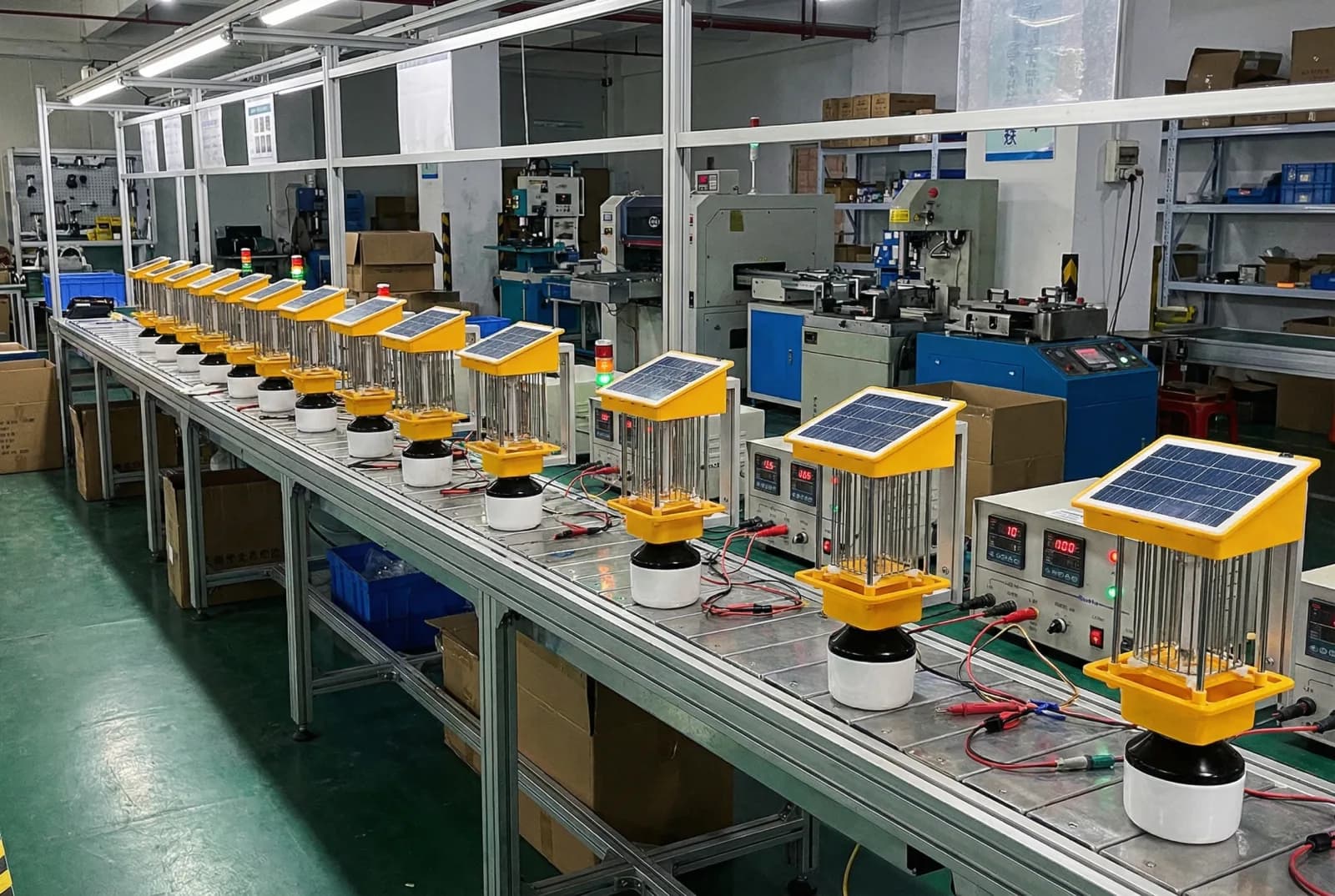
Every production batch undergoes full functional testing — light spectrum verification, battery cycle test, and waterproof integrity check before shipment.
Certifications held:
- CE (European Conformity)
- IP65 Ingress Protection (dust-tight, water jet resistant)
- RoHS (Environmental Compliance)
- UN38.3 (Battery Transport Safety)
Quality process:
- Incoming material inspection — LED spectrum binning, LiFePO4 cell capacity test, solar panel flash test
- Assembly QC — waterproof seal integrity, wiring harness pull test, bracket load test
- Spectrum verification — wavelength output confirmed against specification using spectrometer
- 48-hour burn-in test — every unit operates through two full charge/discharge cycles before packing
- Collection bag fit test — bag attachment, removal, and drainage verified for field usability
Production and export data:
- Manufacturing solar pest control devices since 2013
- Deployed across 30+ countries on 5 continents
- 90% repeat order rate from agricultural B2B customers
- Active government procurement contracts in Southeast Asia and Africa
How to Order: From Inquiry to Field Deployment
Whether you need 5 samples for field testing or 500 units for a regional pest control program, here is our standard process:
Step 1: Project Consultation
Tell us your crop type, field dimensions, and target pest species. Our agricultural engineering team recommends the optimal model, quantity, and placement layout. Response time: within 24 hours.
Step 2: Sample and Field Test (Optional)
Order 1-3 sample units to test in your actual growing conditions. Monitor the collection bag contents for 2-4 weeks to verify pest capture effectiveness for your specific pest profile. Sample dispatch: shipped worldwide via DHL/FedEx. Sample cost is deducted from your first bulk order.
Step 3: Bulk Order and Production
Confirm model, quantity, and any OEM customization. We issue a proforma invoice. Production lead time: 15-35 days for standard models, 25-55 days for OEM/custom orders. Lead time depends on order specifications and quantity. Payment: T/T 40% deposit, 60% balance before shipment (or as agreed in the contract).
Step 4: Quality Inspection and Shipping
48-hour burn-in test on your production batch. QC photos and videos sent before packing. FOB, or CIF/DDP to your port. Professional crate packing for container loads. We handle export customs clearance and provide all shipping documents.
OEM/ODM Customization
| Customizable Item | Options | MOQ |
|---|---|---|
| Housing Color | Any RAL color | 30 pcs |
| Solar Panel Wattage | Upgrade available per model | 30 pcs |
| Battery Capacity | Standard or upgraded LiFePO4 | 30 pcs |
| Logo / Branding | Laser engraving or silkscreen | 30 pcs |
| Packaging | Custom box with your brand | 30 pcs |
| Collection Bag Material | Standard or reinforced mesh | 30 pcs |
| Pole and Bracket | Custom height, diameter, material | 30 pcs |
for custom specifications. DFM (Design for Manufacturability) review included in the quotation process.
Start Your Solar Pest Control Project
Whether you are planning a farm pest management upgrade, supplying agricultural cooperatives, or deploying chemical-free insect control for public green spaces — we are ready to support.
Ready to start?
- Get a quote: Tell us your crop type, field size, and target pests. We respond within 24 hours with model recommendation, layout plan, and pricing.
- Download datasheet: Product Datasheet (PDF) — full specifications, dimensions, and certifications.
Related Resources
Industry Solutions
- Solar Lighting for Farms — Complete solar infrastructure for agricultural operations including pest control and field lighting
Technical Guides
- Solar Insect Killer Buying Guide: What Agricultural Buyers Need to Know — Frequency-vibration technology explained, model selection criteria, and deployment best practices