When the grid fails during a hurricane, earthquake, or flood, the first 72 hours determine outcomes. Medical devices need uninterrupted power. Emergency communications must stay online. Shelter residents need light, charged phones, and functioning refrigeration for insulin and medications. A diesel generator solves some of these problems while creating new ones — carbon monoxide in enclosed spaces, deafening noise in hospital corridors, and a fuel supply chain that collapses precisely when disaster strikes.
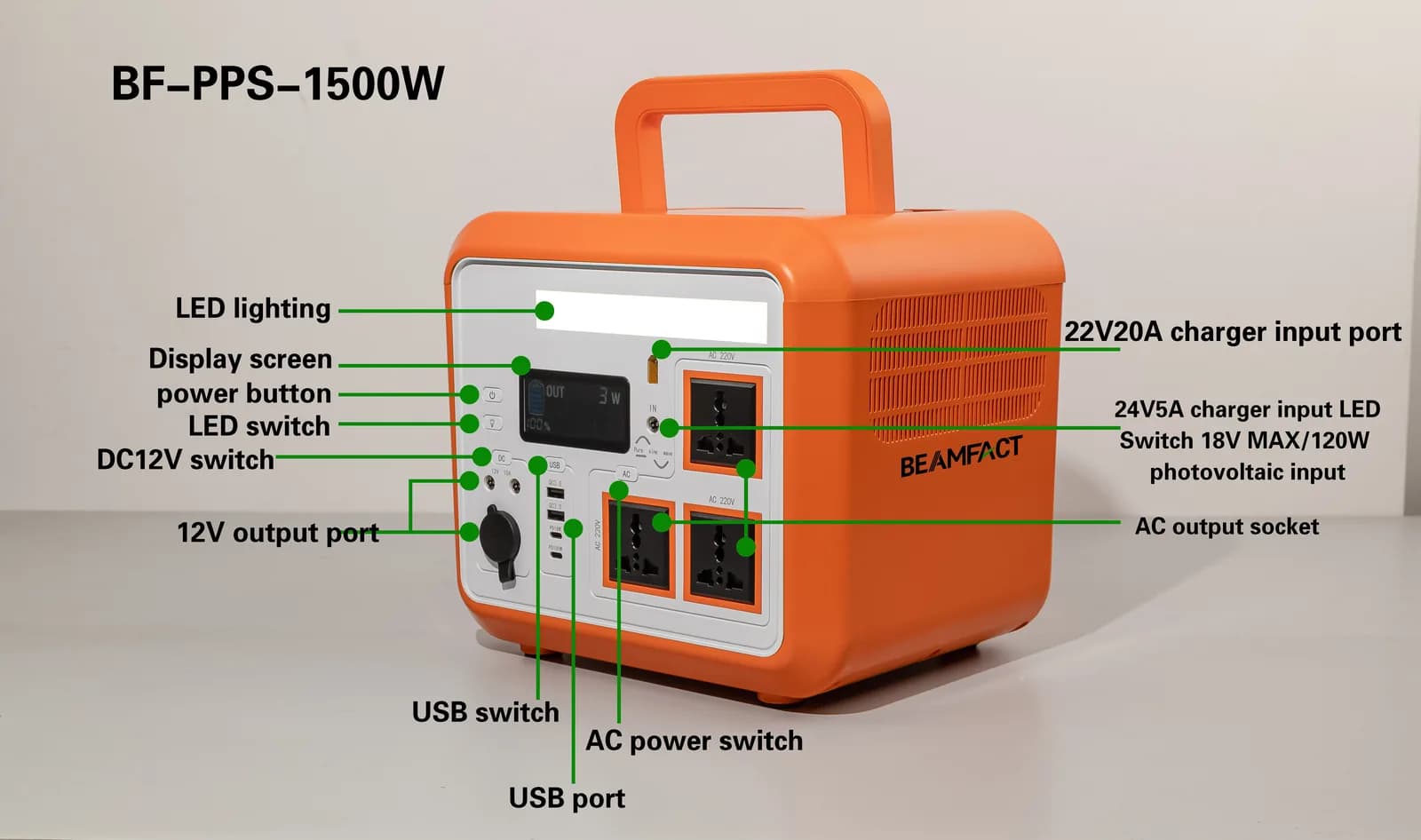
We build LiFePO4 portable power stations at our factory in Fujian, China — purpose-engineered for the exact conditions where backup power matters most. Two models serve the emergency preparedness market: a 1500W unit (1152Wh) for household and field medical use, and a 3000W wheeled trolley (3045Wh) for shelter-scale and multi-station deployment. Pure sine wave output on both. Zero emissions. Zero noise. Solar-rechargeable for indefinite off-grid operation.
This page covers how our power stations solve the specific challenges of emergency backup and disaster preparedness — which configurations fit which scenarios, what the real runtime numbers are, and why procurement managers at NGOs and government agencies are replacing generator-dependent supply chains with distributed portable power.
Why Emergency Backup Power Is a Different Engineering Problem
Emergency power is not "portable power for camping." The failure modes, deployment constraints, and consequences of getting it wrong are fundamentally different.
Grid Dependency During Natural Disasters
Hurricanes knock out power for weeks, not hours. The 2025 hurricane season left 4.5 million customers without electricity, some for over 30 days. Earthquakes sever underground transmission lines that take months to repair. Floods submerge substations. The grid is not just unavailable during disasters — it is the first infrastructure to fail and the last to recover. Any emergency plan that assumes "power will come back soon" is not an emergency plan.
Generator Fumes Kill People Indoors
The CDC estimates over 900 carbon monoxide poisoning deaths per year from portable generators, with the majority occurring during power outages. Generators cannot operate inside buildings, shelters, hospitals, or any enclosed space where people are present. During a hurricane, when people are sheltering indoors and windows must stay closed, a generator running outside may be flooded, stolen, or simply too far from the equipment that needs power. This is not a convenience problem — it is a lethal design constraint.
Fuel Supply Chains Break When You Need Them Most
Diesel and gasoline supply chains depend on the same infrastructure that disasters destroy: roads, bridges, fuel depots, and electrical pumps at gas stations. After Hurricane Maria, parts of Puerto Rico went months without reliable fuel delivery. A backup power solution that depends on fuel resupply is a backup power solution that fails exactly when the primary power fails. The dependency chain is circular.
Medical Device Power Continuity
CPAP machines (40-60W), oxygen concentrators (300-600W), nebulizers (100-200W), insulin refrigeration (60-100W), and powered wheelchair chargers (200-400W) — these are not conveniences. They are life-sustaining equipment that cannot tolerate power interruption. Modified sine wave inverters damage CPAP motor controllers. Voltage sags cause oxygen concentrator alarms. Dirty power from cheap generators destroys sensitive medical electronics. Emergency medical power requires pure sine wave output, stable voltage, and instant-on availability.
Communication Infrastructure Collapse
WiFi routers (15W), cellular signal boosters (20-40W), satellite phones (charging at 10-20W), two-way radios (5-10W charging), and emergency laptops (60-100W) — the entire communication chain runs on modest wattage but cannot tolerate interruption. When cell towers switch to battery backup and eventually fail, local communication infrastructure becomes the only link to the outside world. Keeping a router, a phone, and a radio powered is often more critical than keeping the lights on.
Shelf Life and Readiness Decay
Emergency equipment that sits unused for years must work the moment it is needed. Lead-acid batteries lose 5-15% charge per month and sulfate permanently if left discharged. NMC lithium-ion loses 4-8% per month and degrades if stored at full charge. A backup power system purchased after the last disaster and forgotten in a warehouse may be dead when the next disaster arrives. Emergency readiness demands a battery chemistry that maintains charge for months without maintenance.
How We Solve It: Distributed, Indoor-Safe, Self-Sustaining Power
Every pain point above maps to a specific engineering decision in our portable power station lineup.
Zero Emissions, Zero Noise — Safe for Any Indoor Space
Our power stations produce no combustion byproducts. No carbon monoxide. No exhaust. No fumes of any kind. They operate at near-silent levels — no 65-85 dB generator roar echoing through a hospital corridor or shelter dormitory. Place them directly beside the medical equipment, communication hub, or charging station they serve. No extension cords running to an outdoor generator through a cracked window. No ventilation requirements. No CO detector anxiety.
Solar Recharging Eliminates Fuel Dependency
Both models accept solar panel input — 120W for the BF-PPS-1500W and up to 500W for the BF-PPS-3000W. During an extended outage, a single solar panel turns each unit into a self-sustaining power cycle: draw power at night, recharge during the day. No fuel trucks. No gasoline hoarding. No supply chain dependency. For disaster zones where grid restoration takes weeks, solar recharging is the difference between a 3-day backup plan and an indefinite one.
Pure Sine Wave Protects Sensitive Equipment
Every model outputs pure sine wave AC — the same clean waveform as grid electricity. This is non-negotiable for medical devices. CPAP machines, oxygen concentrators, nebulizers, and powered medical equipment require stable, clean AC power. Our 1500W model provides 3 AC outlets; the 3000W model provides 2 AC outlets. Both handle the startup surge of motor-driven medical devices without voltage sag.
LiFePO4 Shelf Stability for Emergency Readiness
Our LiFePO4 cells self-discharge at under 3% per month. A fully charged unit retains over 85% capacity after 6 months in storage — no maintenance charging, no trickle charger, no monthly check-ups. Charge it, store it, forget it, and it works when the emergency arrives. Combined with 2000+ charge cycle lifespan, these units remain deployment-ready for years, not months.
Distributed Architecture Eliminates Single Points of Failure
Each unit is a completely independent power station. Deploy 10 units across a shelter — one per medical station, one per communications hub, one per device charging zone. If one unit fails, the other nine continue operating. This is the fundamental architectural advantage over a single generator: no single point of failure, no shared fuel line, no distribution panel, no master switch that takes everything down at once.
BMS Protection Suite for Unattended Operation
Every unit includes a Battery Management System protecting against overcharge, over-discharge, overcurrent, short circuit, and over-temperature conditions. In emergency deployments where trained technicians may not be present, this protection layer prevents the cascading failures that unmonitored electrical equipment can cause. The PC/V0 flame-retardant housing on the BF-PPS-1500W and industrial sheet metal housing on the BF-PPS-3000W add physical protection.
Recommended Configurations by Emergency Scenario
We have standardized three deployment tiers based on the emergency scenarios our bulk buyers most commonly supply.
Tier 1: Family / Household Emergency Kit
Individual household preparedness — sustaining medical devices, communications, and essential lighting through a 24-72 hour outage.
| Parameter | Specification |
|---|---|
| Recommended Model | BF-PPS-1500W |
| Battery Capacity | 1152Wh (LiFePO4) |
| AC Output | 3 outlets, 1500W pure sine wave |
| Typical Load | CPAP (40W) + router (15W) + phone charger (20W) + LED light (10W) = 85W |
| Runtime at Typical Load | ~11.5 hours per charge |
| Solar Panel | BF-PV-P150W (18V 150W glass) or BF-PV-F100W (18V 100W foldable) |
| Solar Recharge Time | 10-12 hours (direct sun) |
| Weight | 11.22 kg (portable by one person) |
| Dimensions | 280 × 245 × 250 mm |
| Housing | PC/V0 flame retardant |
| Certifications | CE, MSDS, UN38.3, Maritime Transport Report |
| Units per Household | 1 (covers 24-72 hour outage with daily solar recharge) |
Tier 2: Community Shelter / Field Medical Station
Disaster shelters, temporary medical facilities, and emergency operations centers — multiple stations serving 50-200 people.
| Parameter | Specification |
|---|---|
| Primary Model | BF-PPS-3000W |
| Secondary Model | BF-PPS-1500W (for distributed charging zones) |
| Battery Capacity | 3045Wh (primary) / 1152Wh (secondary) |
| AC Output | 2 outlets, 3000W pure sine wave (primary) |
| Typical Load per Station | Oxygen concentrator (500W) + lighting (100W) + comms equipment (50W) = 650W |
| Runtime at Typical Load | ~4 hours per station per charge (primary) |
| Solar Panel | BF-PV-P250W ×2 (parallel) (36V 500W total) or BF-PV-F400W foldable, for primary |
| Solar Recharge Time | 7-8 hours (primary, direct sun) |
| Weight | 31.85 kg (trolley with wheels) |
| Dimensions | 350 × 300 × 430 mm (handle retracted) |
| Recommended Deployment | 3-5 BF-PPS-3000W (medical/comms) + 5-10 BF-PPS-1500W (charging zones) |
| Total Capacity per Shelter | 12-25 kWh across all units |
Tier 3: Disaster Response Base / Multi-Building Coverage
Government disaster relief staging areas, NGO field headquarters, multi-building refugee facilities — covering power needs across an entire compound.
| Parameter | Specification |
|---|---|
| Primary Model | BF-PPS-3000W × 10-20 units |
| Secondary Model | BF-PPS-1500W × 20-50 units |
| Total Capacity | 50-120 kWh across all deployed units |
| Solar Infrastructure | BF-PV-P250W ×2 in parallel (per 3000W unit) + BF-PV-P150W or BF-PV-F100W (per 1500W unit) |
| Deployment Model | 3000W units at medical tents, command posts, and kitchen facilities. 1500W units distributed to dormitories, registration desks, and perimeter security posts |
| Logistics | 20ft container holds ~80 BF-PPS-1500W or ~40 BF-PPS-3000W (mixed loads common) |
| Recharging Rotation | Day shift: solar recharge idle units. Night shift: deploy fully charged units |
| Estimated Equipment Cost | $50,000 - $150,000 FOB (quantity and model mix dependent) |
| Deployment Time | 1-2 days for full site coverage (untrained personnel, no electrician) |
All configurations use LiFePO4 cells (2000+ charge cycles), include BMS protection (overcharge, over-discharge, overcurrent, short circuit, over-temperature), and feature under 3% monthly self-discharge for long-term storage readiness.
Need a deployment plan for your scenario? Send us your shelter capacity, medical equipment inventory, and expected outage duration. We will provide a unit count recommendation, solar panel configuration, recharging rotation schedule, and FOB pricing for your order volume. Request Emergency Power Procurement Quote.
Safety Credentials and Emergency Readiness Data
Emergency procurement requires documented evidence, not marketing claims. Here is what we provide.
LiFePO4 Battery Safety:
- Zero thermal runaway risk — LiFePO4 chemistry does not enter thermal runaway under abuse conditions (overcharge, puncture, crush). In shelters and hospitals where fire would be catastrophic, this is the single most important battery specification
- Operating temperature: -20°C to 60°C discharge range — covers warehouse storage through desert deployment
- Self-discharge: under 3% per month — a fully charged unit retains over 85% capacity after 6 months of shelf storage with no maintenance
- Cycle life: 2000+ cycles at 80% depth of discharge — 5-8 years of daily emergency use before capacity drops to 80%
BMS Protection Suite (both models):
- Overcharge protection
- Over-discharge protection
- Overcurrent protection
- Short circuit protection
- Over-temperature protection
Certifications (BF-PPS-1500W):
- CE (European Conformity)
- MSDS (Material Safety Data Sheet)
- UN38.3 (Battery Transport Safety — required for international air and sea freight)
- Maritime Transport Report (sea freight compliance)
Certifications (BF-PPS-3000W):
- Pending — CE, MSDS, and UN38.3 recommended for government procurement. We arrange testing upon order confirmation and include certification costs in bulk order pricing.
Housing Safety:
- BF-PPS-1500W: PC/V0 flame-retardant plastic — UL 94 V-0 rating (self-extinguishing)
- BF-PPS-3000W: Industrial sheet metal — inherently non-combustible
We provide full test reports, MSDS documentation, and certificate packages with every quotation. For government tenders requiring specific documentation formats, our export team prepares submission-ready compliance packages.
For a comprehensive guide to portable power station certifications, read: Portable Power Station Certification Guide.
Emergency Backup Comparison: Portable Power Station vs Diesel Generator vs UPS
Three technologies compete for emergency backup power. Each has a valid use case — and clear limitations.
| Factor | Portable Power Station (Ours) | Diesel Generator | UPS (Battery Backup) |
|---|---|---|---|
| Indoor operation | Yes — zero emissions | No — CO poisoning risk | Yes |
| Noise level | Near-silent | 65-85 dB | Silent |
| Output capacity | 1500-3000W | 2000-50,000W+ | 500-3000W |
| Runtime (single charge) | 4-37 hours (load dependent) | Unlimited (with fuel) | 15-60 minutes |
| Solar rechargeable | Yes (120-500W input) | No | No (most models) |
| Fuel dependency | None | Diesel/gasoline — fails during supply chain disruption | None |
| Shelf readiness (6 months unused) | 85%+ capacity retained | Requires fuel stabilizer + monthly start-up | Battery degradation (lead-acid UPS loses 30-50%) |
| Portability | 11-32 kg, carry or roll | 50-500 kg, requires vehicle | 10-50 kg, stationary design |
| Medical device safe (pure sine wave) | Yes — all models | Varies — many produce dirty power | Yes — line-interactive and online models |
| Maintenance | Zero | Oil changes, filter replacement, fuel treatment | Battery replacement every 2-3 years |
| Single point of failure | No — each unit independent | Yes — generator fails, all power fails | No — per-device protection |
| Upfront cost (per kWh capacity) | $$$ | $$ | $$$$ |
| 5-year operating cost | Near-zero | Fuel + maintenance = 3-5x purchase price | Battery replacement cycles |
Verdict: For emergency loads under 3000W — medical devices, communications, lighting, device charging — portable power stations are the superior solution. They operate indoors where people actually shelter during disasters, eliminate the fuel dependency that collapses during the disasters themselves, and deploy as distributed independent units with no single point of failure. UPS systems provide instant switchover but lack the capacity and solar recharging for multi-day outages. Diesel generators remain necessary for sustained loads above 3000W (water pumps, large HVAC, industrial equipment) but should never be deployed as the sole backup for personnel-facing emergency services.
The practical procurement strategy for disaster preparedness agencies: generators for infrastructure, portable power stations for people.
Get Emergency Power Procurement Quote
Tell us about your emergency preparedness requirements and we deliver:
- Deployment configuration — model mix, unit quantities, and solar panel pairing sized to your scenario (household kits, shelter deployment, or disaster response base)
- Runtime calculations — verified runtime tables for your specific device inventory (medical equipment, communications, lighting)
- Logistics plan — packaging, container loading, shipping route, and landed cost to your warehouse or staging facility
- Certification package — CE, MSDS, UN38.3, and Maritime Transport documentation formatted for government procurement tenders or NGO grant submissions
- Bulk pricing — FOB pricing with volume breaks for 50, 100, 200, and 500+ unit orders
Two ways to start:
- Send us your deployment requirements — shelter capacity, medical equipment list, expected outage duration — for a custom configuration and quote (response within 48 hours)
- Request spec sheets — download complete product specifications for the BF-PPS-1500W and BF-PPS-3000W for your procurement evaluation