

Choosing the wrong portable power station manufacturer delivers units with batteries that degrade in months, inverters that damage connected devices, and certification gaps that get your Amazon listings removed. We know because we compete against these suppliers daily — and we onboard their former customers after the first shipment fails.
This guide is the portable power station version of our solar street light manufacturer evaluation checklist. We are a portable power station manufacturer in Fujian, China, building four models from 300W to 3000W. Every evaluation point applies to us. We encourage you to use this framework on Beamfact and on every other supplier you are considering.
Why the Portable Power Station Market Has a Quality Problem
The portable power station market exploded after 2020 — COVID-era power outages, the outdoor recreation boom, and the rise of vanlife culture drove demand faster than manufacturing quality standards could keep up. The result is a flooded market where three types of suppliers coexist:
Real manufacturers design their own BMS circuits, source cells from tier-1 suppliers, engineer pure sine wave inverters, and hold the certifications their target markets require. They have production lines, QC equipment, and engineering teams.
Assemblers purchase off-the-shelf BMS boards, generic battery packs, and commodity inverter modules from component suppliers, then package everything in a plastic housing. They offer the lowest prices because they bear no engineering cost — and no engineering accountability when things fail.
Trading companies do not even assemble. They source from whichever factory is cheapest that month, add their logo, and resell at margin. They have sales teams, not production lines.
The six evaluation points below separate the first category from the other two.
The 6-Point Manufacturer Evaluation
1. Cell Brand Transparency
The battery cells are the most expensive component, the primary safety concern, and the number one determinant of product lifespan. A manufacturer's willingness to disclose cell sourcing reveals everything about their quality philosophy.
What to demand:
- Name the cell brand. Tier-1 LiFePO4 cell manufacturers include CATL, EVE Energy, BYD, and other publicly listed battery companies. These manufacturers publish datasheets and provide batch traceability. If a supplier says "we use high-quality Chinese LiFePO4 cells" without naming the brand, they are using whatever is cheapest that month.
- Provide the cell datasheet. The datasheet includes rated capacity, cycle life curves at specific test conditions, operating temperature range, internal resistance, and dimensional specifications. No datasheet means no traceability.
- Explain the supply relationship. Does the manufacturer buy directly from the cell manufacturer, or through distributors? Direct purchasing relationships provide better pricing, supply stability, and access to technical support when issues arise.
Why we use tier-1 LiFePO4 cells: We source LiFePO4 cells directly from a tier-1 Chinese battery manufacturer for all four BF-PPS models. Our cell supplier is a publicly listed company with 17 GWh annual production capacity, supplying cells to Volkswagen, Bosch, and grid-scale energy storage projects. Our buyers can independently verify the supplier's specifications — they do not have to take our word for it. For more on why we chose LiFePO4 over NMC, read our LiFePO4 vs lithium-ion comparison.
2. Pure Sine Wave vs Modified Sine Wave
The inverter converts DC battery power to AC mains power. The waveform quality determines what devices the power station can safely run. This is the single fastest way to distinguish a quality manufacturer from a cost-cutter.
Pure sine wave produces a smooth, continuous waveform identical to grid electricity. Every device designed for wall outlet power works correctly.
Modified sine wave produces a stepped approximation of a sine wave. It causes:
- Buzzing and humming in audio equipment and transformers
- Overheating in motor-driven devices (fans, compressors, power tools with brushed motors)
- Interference with sensitive electronics (CPAP machines, laptops, phone chargers, printers)
- Inaccurate readings on digital clocks, timers, and measurement tools
- Reduced efficiency and excess heat generation in many AC adapters
The test: Ask the supplier to send an oscilloscope reading of the AC output waveform under load. A pure sine wave shows a smooth curve. A modified sine wave shows a blocky step pattern. Any manufacturer who cannot provide this measurement does not have the test equipment to verify their own output quality.
Our position: All four BF-PPS models use pure sine wave inverters. We verify waveform quality under load as part of our production QC process. Modified sine wave has no place in a product that costs hundreds of dollars and is marketed as a universal power source.
3. BMS Quality
The Battery Management System (BMS) is the brain of the battery pack. It protects against every failure mode that can damage the cells, harm the user, or destroy connected equipment. The BMS separates a safe product from a dangerous one.
Minimum BMS protections (non-negotiable):
| Protection | What It Prevents | What Happens Without It |
|---|---|---|
| Overcharge | Cells exceeding maximum voltage (3.65V per LiFePO4 cell) | Cell swelling, capacity loss, potential thermal event |
| Over-discharge | Cells dropping below minimum voltage (2.5V per LiFePO4 cell) | Permanent capacity damage, cell death |
| Overcurrent | Current draw exceeding cell or wire ratings | Wire overheating, connector melting, fire risk |
| Short circuit | External or internal short circuit across terminals | Immediate high-current discharge, fire, explosion |
| Over-temperature | Cells or electronics exceeding safe operating temperature | Accelerated degradation, thermal event, housing damage |
| Low-temperature charge lockout | Charging below 0°C | Lithium plating on anode, permanent cell damage |
| Cell balancing | Voltage drift between series-connected cells | Premature capacity loss, uneven aging, reduced pack life |
How to evaluate BMS quality:
- Ask for the BMS IC brand. Quality BMS boards use ICs from Texas Instruments, NXP, Analog Devices, or equivalent. Generic unbranded BMS ICs are the electronic equivalent of no-name battery cells.
- Request the BMS specification sheet. It should list every protection threshold, response time, and recovery condition. If the supplier cannot provide this document, the BMS is a generic off-the-shelf board with no customization for the specific battery configuration.
- Ask about cell balancing method. Active balancing (transferring charge between cells) is superior to passive balancing (dissipating excess charge as heat). Active balancing costs more but extends pack life by keeping cells evenly aged.
Our BMS design: Every BF-PPS model includes overcharge, over-discharge, overcurrent, short circuit, over-temperature, and low-temperature charge protection. BMS specifications are available upon request for any model.
4. Certification Portfolio
Certifications are the legal infrastructure of international trade. A manufacturer's certification status reveals their commitment to market access and product safety validation.
The minimum stack:
| Certification | Why It Is Non-Negotiable |
|---|---|
| UN38.3 | Without it, the product cannot be legally shipped by sea or air. Period. |
| MSDS | Without it, customs clearance is delayed or denied in most countries. |
| Maritime Transport Report | Without it, shipping lines reject the cargo booking. |
Market-specific requirements:
| Target Market | Additional Required |
|---|---|
| EU / UK | CE (EMC + LVD + RoHS) |
| USA (Amazon) | UL 2056 or UL 2743 + FCC Part 15 |
| Australia / NZ | SAA/RCM |
Red flag: A manufacturer that offers to "get any certification you need" but does not currently hold at least UN38.3 is telling you they have never shipped internationally. Certification is a process that takes months and costs thousands — it is not something you add to an order like a gift box. For a complete breakdown, read our portable power station certification guide.
Our certification status: UN38.3, MSDS, and Maritime Transport Report across all four models. CE certification on the BF-PPS-1500W, with remaining models in progress. UL/FCC on roadmap for US market entry.
5. Product Range Depth
The breadth of a manufacturer's product line reveals the depth of their engineering capability. This is one of the most reliable signals for distinguishing real manufacturers from assemblers and trading companies.
What a full range indicates:
- Multiple wattage tiers (300W, 600W, 1500W, 3000W) means the manufacturer can design different inverter circuits, battery configurations, and thermal management systems. Each tier requires different engineering — it is not just scaling up the same design.
- Different battery architectures (4S, 6S, 8S cell configurations) means the manufacturer understands BMS design across voltage platforms, not just one fixed configuration.
- Matched accessories (solar panels, carrying cases, parallel cables) means the manufacturer thinks in systems, not isolated products.
What a single SKU indicates: A supplier offering exactly one model — typically a 600W unit in the most competitive price segment — is almost certainly an assembler or trading company. They purchased one design from a contract manufacturer and are reselling it. They cannot customize, they cannot troubleshoot at the component level, and they will not have spare parts when the model is discontinued.
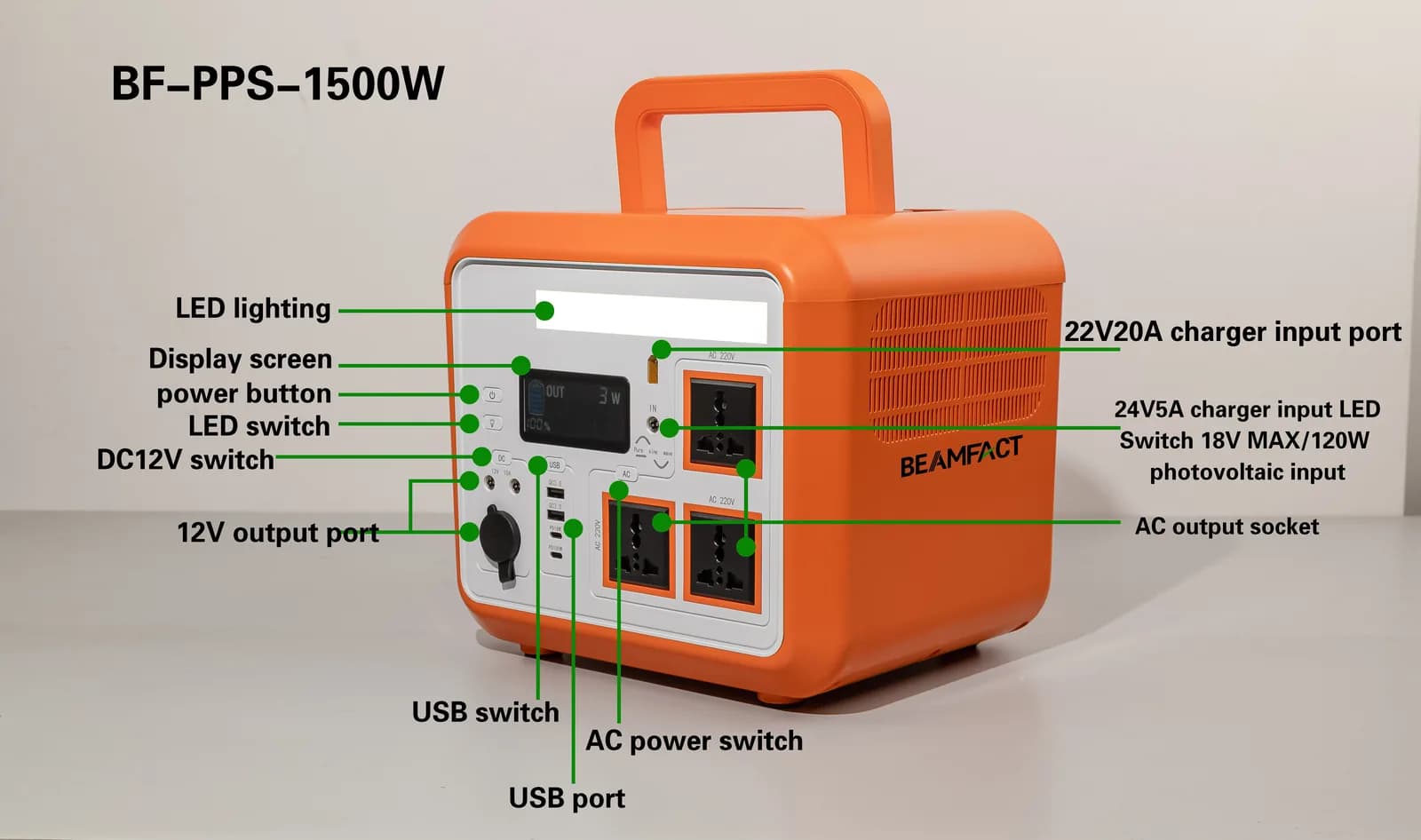
Our range: Four models spanning 300W (192Wh, 2.6 kg) to 3000W (3045Wh, 31.85 kg) with matched BF-PV series solar panels for each (BF-PV-P glass / BF-PV-F foldable). The 300W and 3000W represent fundamentally different engineering challenges — the 300W optimizes for minimum weight, while the 3000W requires industrial-grade sheet metal construction, a trolley mechanism, and a 600W AC charger. Building both ends of the spectrum demonstrates engineering depth that a single-SKU operation cannot match.
6. Solar Panel Compatibility: MPPT vs PWM
Most portable power stations accept solar panel input for off-grid charging. The charge controller technology determines how efficiently solar energy converts to stored battery charge — and it reveals the manufacturer's engineering priorities.
MPPT (Maximum Power Point Tracking) continuously adjusts the input voltage and current to extract maximum power from the solar panel under varying sunlight conditions. Efficiency: 95-99%. MPPT captures 20-30% more energy than PWM from the same panel, especially in partial shade or non-optimal panel angles.
PWM (Pulse Width Modulation) directly connects the panel to the battery with simple voltage regulation. Efficiency: 70-80%. Cheaper to implement, but wastes 20-30% of available solar energy.
The evaluation question: Ask the manufacturer which charge controller technology they use for solar input and request the MPPT tracking efficiency specification. If they cannot answer confidently, the unit likely uses PWM — or worse, no intelligent charge control at all.
Our approach: Our BF-PPS models accept solar panel input through dedicated DC ports with voltage-matched panel recommendations. Solar charge specifications are published for each model in our product catalog. We recommend our matched BF-PV series panels (BF-PV-P glass for permanent install, BF-PV-F foldable for portable use) for optimal voltage compatibility and charge speed.
Red Flags That Should Stop You Immediately
These patterns predict sourcing failure. We see them repeatedly when buyers come to us after a bad experience with another supplier.
Factory vs Trading Company: The Power Station Edition
The factory-versus-trading-company distinction is even more critical for portable power stations than for simpler products like solar lights. Here is why:
| Factor | Factory | Trading Company |
|---|---|---|
| BMS customization | Can modify protection thresholds for specific use cases | Cannot — uses whatever BMS the source factory provides |
| Component traceability | Cell brand, BMS IC, inverter chipset all documented | Often unknown — sourced from cheapest available supplier |
| Waveform verification | Tests AC output quality on every unit | Relies on source factory's claimed specifications |
| Certification ownership | Holds certifications under their own name | May use the source factory's certificates — which may not transfer legally |
| Warranty support | Can diagnose and repair at the component level | Can only swap entire units — if they even maintain stock |
| Product evolution | Can improve designs based on field feedback | Locked to whatever the source factory produces |
| Price stability | Consistent pricing based on own production costs | Pricing fluctuates with whichever factory they source from |
For a deeper dive into this distinction across all our product categories, read our factory vs trading company guide.
Full Transparency: Beamfact's Position
We wrote this guide knowing every evaluation point applies to us. Here is what we offer against each checkpoint:
1. Cell transparency: LiFePO4 cells in all four models. Cell datasheets available upon request. Direct procurement relationship — no intermediary distributors.
2. Pure sine wave: All four models. We verify waveform quality under load during production QC. Oscilloscope readings available for buyer verification.
3. BMS quality: Full protection suite (overcharge, over-discharge, overcurrent, short circuit, over-temperature, low-temperature charge lockout) on every model. BMS specifications documented and available.
4. Certifications: UN38.3 + MSDS + Maritime Transport Report on all four models. CE on BF-PPS-1500W. UL/FCC on the roadmap.
5. Product range: Four models from 300W/192Wh (2.6 kg compact) to 3000W/3045Wh (31.85 kg trolley). Matched BF-PV solar panels (BF-PV-P glass / BF-PV-F foldable) for each tier. Engineering capability demonstrated across fundamentally different product architectures.
6. Solar compatibility: Voltage-matched solar panel recommendations for each model. Solar charge specifications published and tested.
Customization scope: branding, packaging, color, AC outlet type, and voltage/frequency configuration are standard OEM options. Architectural changes go through engineering review first, so you get a feasibility answer before committing to tooling.
Pricing: our quotes reflect tier-1 LiFePO4 cells, pure sine wave inverters, and a full-protection BMS. The difference against generic-component units is what buys cycle life and warranty coverage.
We do not ask you to trust our claims. We ask you to verify them using the same six-point framework above.
Browse our portable power station catalog to see specifications for all four models, or contact our export team to schedule a factory video tour and begin your evaluation.