
When you search for solar street lights on Alibaba or Made-in-China, you see hundreds of suppliers. What you do not see is that roughly half of them have never manufactured a single unit. They are trading companies — sourcing from factories like ours and reselling at a markup. The other half are actual manufacturers with production lines, raw material warehouses, and QC equipment.
Both supplier types can deliver working solar lights to your door. But the experience, cost, risk, and long-term value differ in ways that most buyers only discover after their first order goes wrong. We process orders from both direct buyers and trading company intermediaries every week. This article documents what we observe from the factory floor.
The Core Comparison: Factory vs Trading Company
This table summarizes the ten dimensions where factory-direct and trading company sourcing diverge. Every data point below comes from our direct experience fulfilling orders through both channels.
| Dimension | Factory (Manufacturer) | Trading Company |
|---|---|---|
| Price | Factory-direct, no middleman markup (15-30% lower) | Middleman markup included — you pay for their margin |
| Customization | Full OEM/ODM capability — can modify PCB, housing, panel, firmware | Limited to what existing factory partners offer |
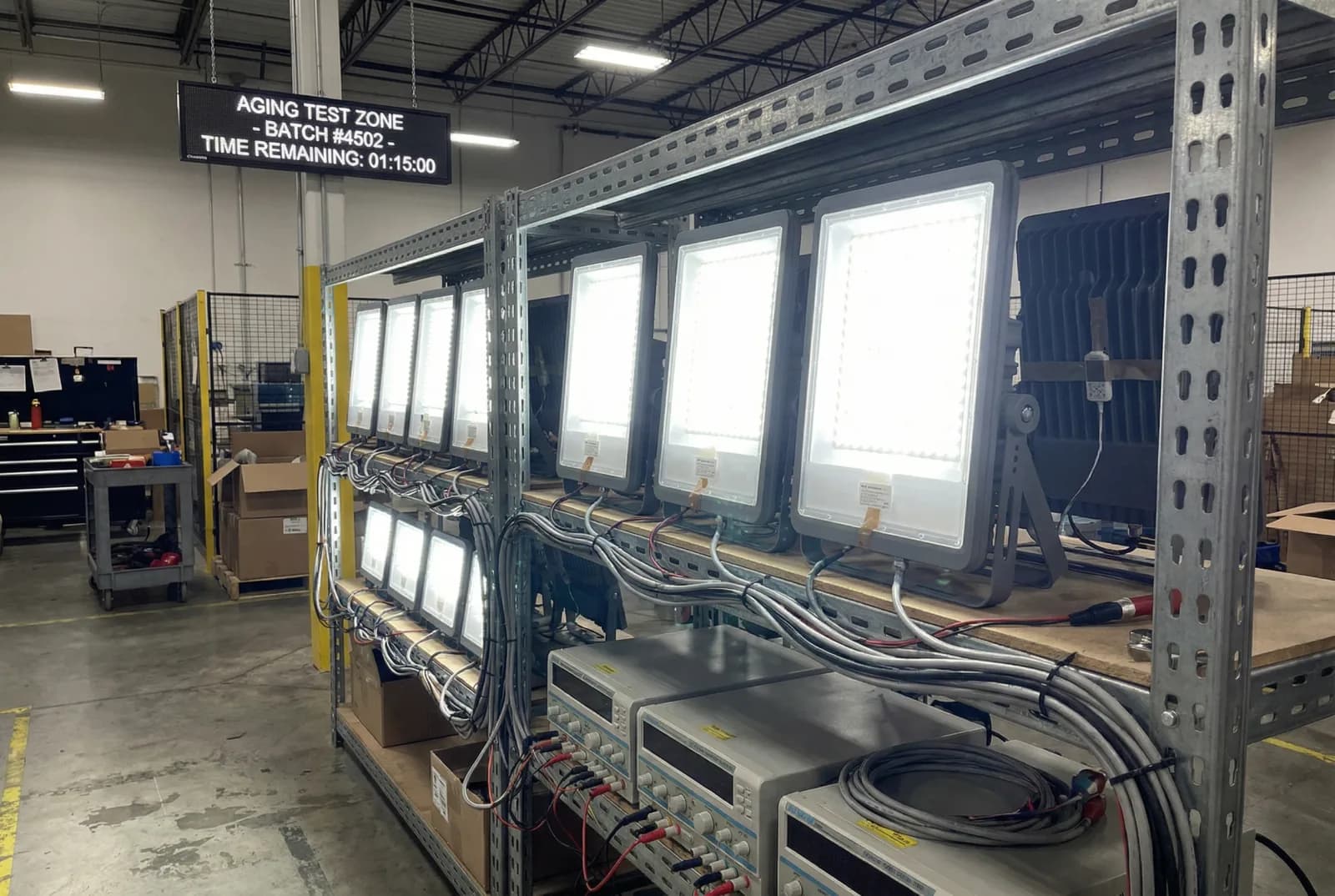
| Quality Control | Direct QC on production line with in-house test equipment | Relies on factory QC, limited independent oversight |
| Lead Time | Direct control of production schedule (15-25 days typical) | Adds coordination time — typically +5-7 days on top |
| MOQ | May require higher MOQ for custom orders (100-500 pcs) | Often lower MOQ by aggregating small orders from multiple buyers |
| Communication | May need to navigate language/technical barriers | Often better English, smoother initial communication |
| After-Sales | Direct warranty, spare parts from the source | May struggle with warranty claims if factory relationship changes |
| Product Knowledge | Deep technical knowledge — engineers available for spec discussions | Surface-level product knowledge, may not understand component trade-offs |
| Sample Speed | Direct from production line (3-7 days) | Needs to source from factory first (7-14 days) |
| Risk Profile | Higher if factory has limited export experience | Higher if trader switches factories without informing you |
The price column deserves emphasis. When a trading company quotes you $85 for a 30 W solar street light, $12-25 of that is their margin. Our cost breakdown guide details the actual BOM-to-FOB economics — knowing these numbers helps you immediately sense when a quote includes middleman markup.
When a Trading Company Actually Makes Sense
We are a factory, and we are telling you honestly: there are scenarios where a trading company serves you better than going direct.
Very small orders (under 50 units). Many factories, including ours, have MOQ thresholds that make sub-50-unit orders impractical for custom specifications. Trading companies aggregate small orders from multiple buyers into a single factory run. If your total order is 20 solar garden lights, 15 flood lights, and 10 street lights, a trader can bundle this efficiently.
Multi-product, one-stop sourcing. If your project requires solar street lights, conventional LED fixtures, cables, poles, and mounting hardware from four different factories, a trading company coordinates that supply chain. You get one invoice, one shipment, one point of contact. The convenience premium may be worth the 15-30% markup.
Language and cultural navigation. Some trading companies employ multilingual staff with export expertise. If your team has no experience with Chinese business practices, a well-connected trader handles translation, negotiation, and logistics coordination. Miscommunication during production has killed orders — this value is real.
First-time buyers testing the market. A responsive trading company with good English reduces your learning curve on a first trial order. Use that order to learn the process, then go direct for volume.
When You MUST Go Direct to a Factory
For the following scenarios, buying through a trading company introduces unnecessary cost and risk:
Custom OEM/ODM orders. If you need your logo on the housing, a specific color temperature, modified solar panel angle, or custom firmware — you need direct factory access. Trading companies cannot modify what they do not manufacture. Every customization request goes through an extra communication layer, introducing delays and misunderstandings. Our engineers sit 20 meters from the production line — when a buyer requests a modified bracket, the engineer checks feasibility on the CNC machine and responds the same day.
Large volume orders (500+ units). At scale, the 15-30% trading company margin becomes a significant dollar amount. On a 1,000-unit order of 40 W solar street lights at $120 FOB each, that margin represents $18,000-36,000 in unnecessary cost. Direct factory pricing at volume is non-negotiable for serious projects.
Quality-critical applications. Government highway lighting, critical infrastructure, or installations where failure carries safety or liability consequences demand direct QC oversight. You need to know which battery cells went into your units, which LED chips, which controller IC. A trading company often cannot trace components to this level. Our 9-point quality checklist explains what to verify — and verification is only possible with factory cooperation.
Long-term supply relationships. If you plan to buy solar lights repeatedly over years, building a direct factory relationship gives you price stability, priority production scheduling, and consistent quality. Trading companies switch their factory sources based on whoever offers them the lowest price this quarter — your product quality may shift without warning.
Technical support needs. If your installations face extreme heat, coastal salt air, or Saharan dust, you need engineers who understand the thermal and sealing design of the product. A trading company salesperson cannot advise on whether the IP65 gasket material handles 60 C continuous ambient. Our engineering team can, because they selected that material.
How to Tell a Factory from a Trading Company: 5 Verification Methods
This is the practical core of this guide. The Chinese solar light market is full of trading companies presenting themselves as factories. Here are five methods we recommend to every buyer — including buyers evaluating us. For a broader supplier evaluation framework, see our manufacturer selection checklist.
Method 1: Business License Check
Every Chinese company has a business license (营业执照) with a registered business scope. Request it and look for specific language:
- Factory indicator: The scope includes terms like "manufacturing" (生产), "production" (制造), or "processing" (加工). The registered address matches a factory/industrial zone.
- Trader indicator: The scope shows only "sales" (销售), "trading" (贸易), or "import/export" (进出口). The registered address is an office building.
Ask for a photo of the physical license hanging in their office — not a digitally edited version. Cross-reference the company name and registration number on China's National Enterprise Credit Information System (国家企业信用信息公示系统).
Method 2: Live Factory Video Call
Request a live video tour — not a pre-recorded marketing video. A real factory can show you:
- Raw material warehouse with actual inventory
- Production lines with workers assembling units
- QC testing equipment (battery cycler, IP test chamber, lumen sphere)
- Finished goods warehouse with packed inventory
Schedule the call during working hours (9 AM - 5 PM China time). Ask the guide to walk you through the facility in real time. A trading company operating from an office cannot produce a production floor on demand.
Method 3: Production Line Photos with Date Stamps
Ask for photos of your specific inquiry's relevant product being manufactured — with a handwritten date stamp on paper visible in the photo. This is a standard verification practice in Chinese B2B trade. A factory can produce these within hours. A trading company needs to coordinate with their actual supplier, which takes days and often results in excuses.
Method 4: R&D Team Verification
Ask technical questions that only an engineer would answer confidently:
- What MPPT controller IC do you use, and what is its peak conversion efficiency?
- What is the cycle life spec of your LiFePO4 cells at 80% depth of discharge?
- What is the wind resistance rating of your mounting bracket, and how was it tested?
A factory's sales engineer answers these from memory or with a quick check. A trading company's salesperson says "let me check with the factory" — which is the answer itself.
Method 5: Satellite View of Factory Address
Copy the supplier's registered address and search it on Google Maps satellite view. A factory sits in an industrial zone with visible building footprint, loading docks, and possibly raw material storage areas. A trading company's address resolves to an office tower or commercial building. This 30-second check filters out a significant portion of traders posing as manufacturers.
The Hidden Risk Most Buyers Miss
The most dangerous scenario is not choosing a trading company — it is choosing one that pretends to be a factory.
When you knowingly work with a trader, expectations are set. You accept the markup for convenience. The relationship is transparent.
When a trader poses as a factory, you lose traceability. Quality drops on your third order because the trader quietly switched to a cheaper factory source. Your warranty claims go to a middleman who blames the unnamed factory. The unnamed factory has no relationship with you.
We see this pattern repeatedly. Buyers come to us after orders with a "factory" that turned out to be a trader — inconsistent quality between batches, customization requests poorly executed, warranty claims unanswered. Verification matters more than the factory-vs-trader choice itself. If you work with a trading company, make that choice deliberately, not by deception.
Our Position: Factory-Direct with Open Doors
Beamfact is a factory-direct manufacturer. We design, engineer, and produce solar street lights and solar flood lights in our Fujian facility. We maintain in-house R&D, injection molding, SMT assembly, and a QC lab equipped with battery cyclers, IP test chambers, and lumen measurement systems.
We welcome verification:
- Business license: Available on request, registered scope includes manufacturing
- Video factory tours: Live tours available by appointment for international buyers
- Production floor visits: Our facility is open to buyers year-round — we will arrange pickup from Guangzhou airport
- Technical Q&A: Our sales engineers answer component-level questions directly
Two things to know before you enquire. Fully custom OEM orders start at 100 units per model — brand-direct purchases start at one unit. And we specialize in solar outdoor lighting and portable power: that focus is why our engineers can answer component-level questions directly, and it is where our pricing and lead times are strongest.
For buyers ready to source direct, our complete China sourcing guide walks through the process from first contact to delivered goods.
Making Your Decision: A Simple Framework
Use these three questions to determine which supplier type fits your situation:
1. What is your order volume? Below 50 units with no customization — a trader may offer better terms. Above 100 units or any OEM requirement — go factory-direct.
2. How important is quality traceability? If your application is critical infrastructure, government projects, or installations where failure has safety consequences — factory-direct is non-negotiable. For decorative garden lighting or low-risk residential use — the stakes are lower.
3. What is your sourcing experience level? First order from China with no local agent — a reputable trader reduces friction. Experienced buyer with established logistics — factory-direct maximizes value.
If you are reading this article, you are already doing more research than 90% of solar light buyers. That research habit is your best protection regardless of which supplier type you choose. Verify claims, request evidence, test samples, and build relationships incrementally.