Your village has no electricity grid. Extending power lines costs $8,000-15,000 per kilometer, and even if the budget existed, the timeline stretches into years. Meanwhile, roads are dark after sunset, accidents happen on unlit paths, market activity stops at dusk, and community safety deteriorates.
We manufacture solar street lights specifically for this reality. Each fixture is a self-contained power station — solar panel, battery, LED, controller — that installs on a pole in 30 minutes and lights up that same night. No wiring. No grid. No electrician. We have shipped container loads to 500+ village projects across Sub-Saharan Africa, South Asia, and Latin America.
This page covers exactly how to light your village with solar: which fixtures, how many, how they are installed, and what it costs compared to the alternative.
Why Village Lighting Is a Different Problem
Village lighting is not a scaled-down version of urban street lighting. It has constraints that fundamentally change the engineering requirements:
Zero Grid Infrastructure
Urban projects choose solar to save on electricity bills. Villages choose solar because there is no electricity to connect to. This is not an optimization — it is the only option. Every fixture must be 100% energy-independent with enough battery reserve to survive consecutive cloudy or rainy days without dimming to nothing.
Community Safety Is the Primary Driver
Unlit village roads are where accidents, snakebites, and crime concentrate after dark. The World Bank estimates that adequate community lighting reduces nighttime incidents by 50-70% in rural settlements. This is not about aesthetics — it is about preventing people from getting hurt on the walk home.
Government and NGO Budget Constraints
Village lighting projects are typically funded through government rural development programs, international development agencies, or NGO initiatives. Budgets are fixed, accountability is strict, and every dollar must be justified. The solution needs to deliver maximum coverage per dollar, not maximum features per fixture.
Harsh Rural Conditions
Villages in Sub-Saharan Africa face extreme heat and dust. Villages in South Asia face monsoon flooding. Villages in Latin America face tropical humidity. The fixtures must survive all of this without maintenance visits, because the nearest technician may be 100 kilometers away.
No Skilled Labor for Installation or Maintenance
There are no licensed electricians in most off-grid villages. Installation must be simple enough for local workers with basic hand tools. Maintenance must be rare enough that the community can forget the lights exist for years at a time.
How We Solve It: Simple, Tough, Autonomous
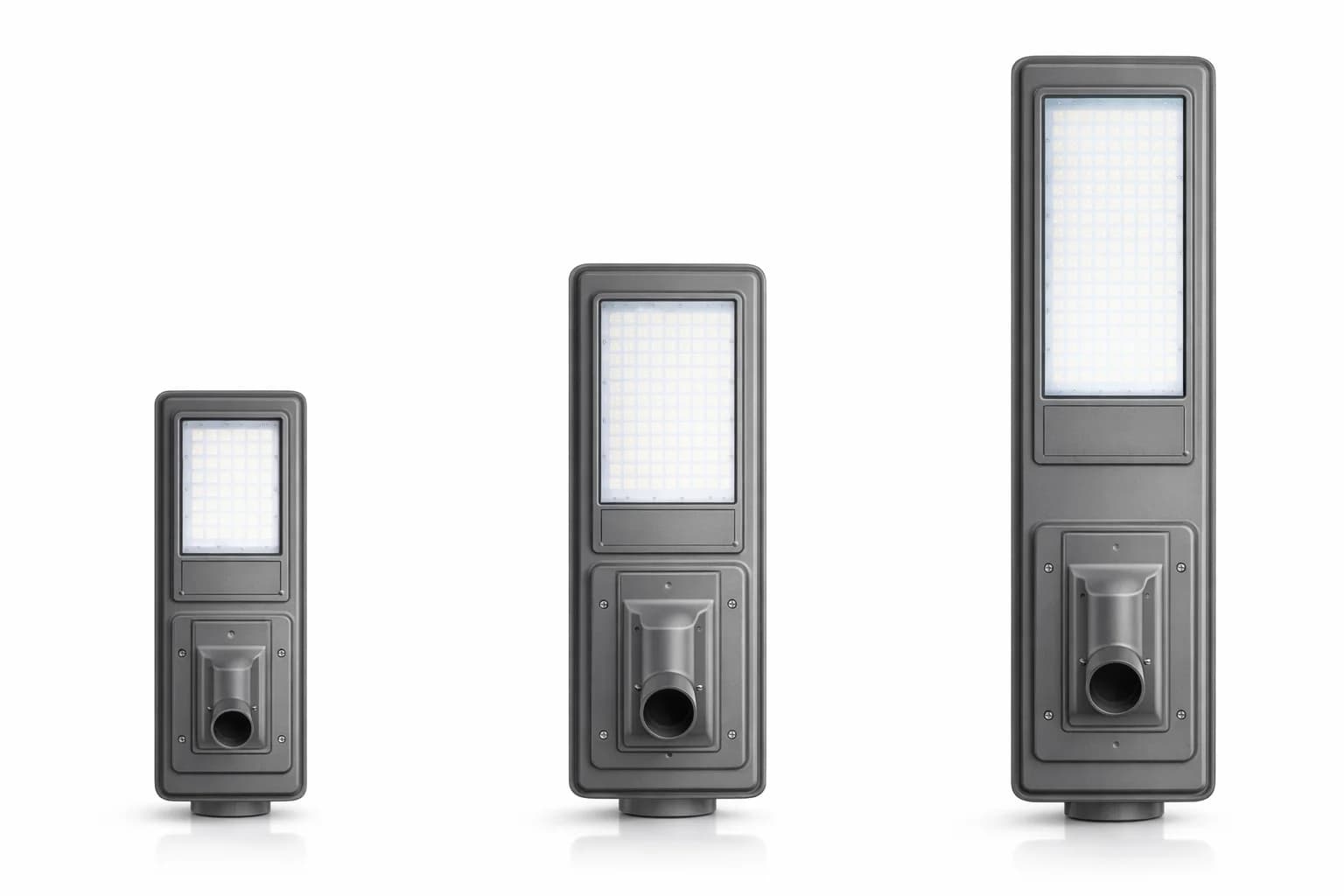
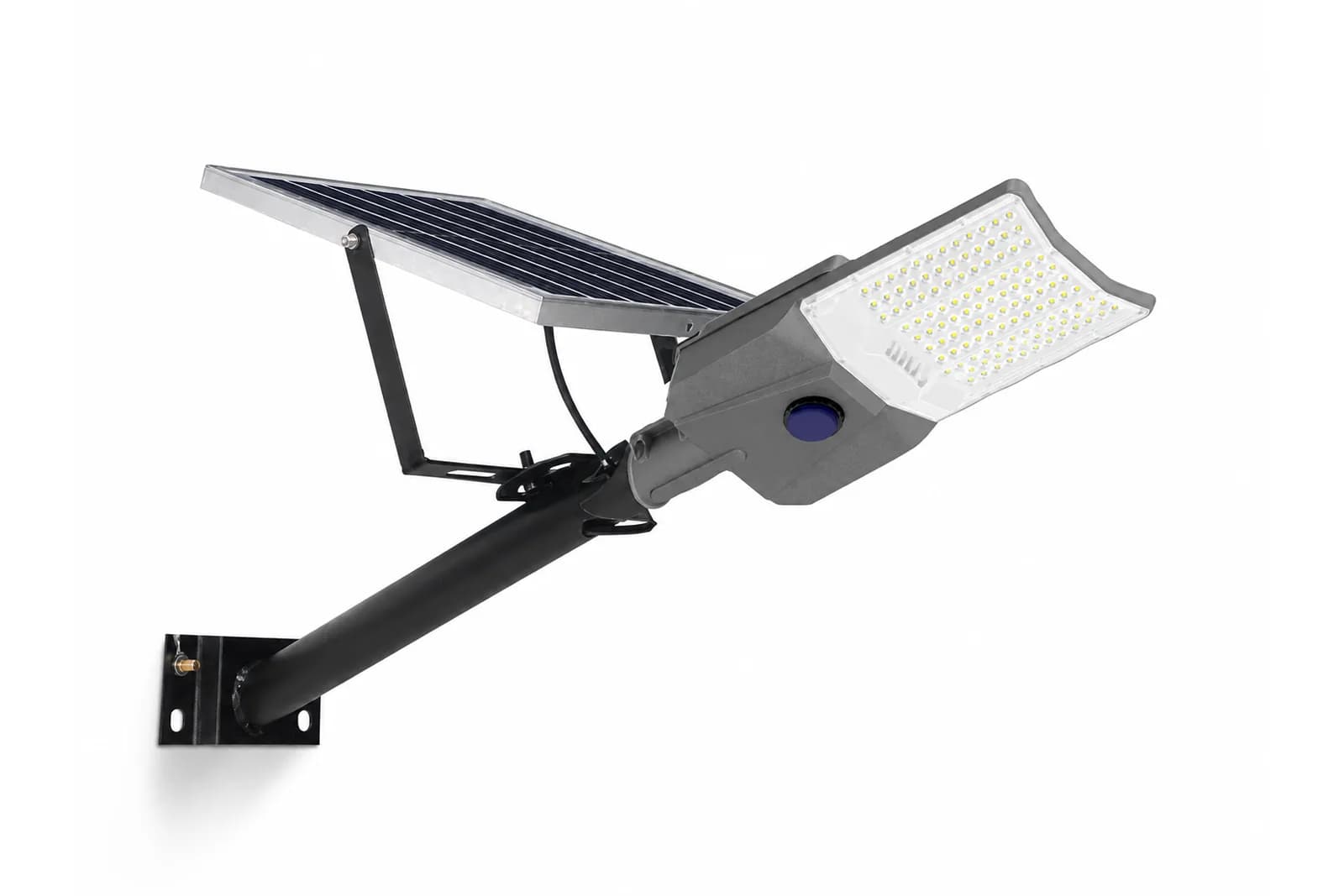
Every Beamfact village solar street light is an all-in-one system: monocrystalline solar panel, LiFePO4 battery, MPPT charge controller, and commercial-grade LED module integrated into a single sealed housing. One unit, one pole, one installation — done.
LiFePO4 for Extreme Temperatures
We use lithium iron phosphate (LiFePO4) batteries exclusively for village projects. Unlike ternary lithium, LiFePO4 tolerates extreme heat without thermal runaway risk, maintains performance from -20 to 60 degrees Celsius, and delivers 2,000+ charge cycles (5-7 years of nightly operation). In a village where nobody is monitoring battery health, this chemistry is the only responsible choice.
Light + Time Control Without Complex Programming
Our village configurations use a pre-programmed 3-mode lighting profile:
| Time Period | Mode | Output | Purpose |
|---|---|---|---|
| Sunset - 11 PM | Full Power | 100% | Peak activity hours |
| 11 PM - 5 AM | Economy | 30-50% | Low activity, conserve battery |
| Motion Detected | Radar Boost | 100% (30 sec) | Security response |
For low-traffic village side paths where full-night full-brightness is unnecessary, our motion sensor solar street lights (BF-MSS-23 Series/BF-MSS-24 Series) dim to 30% between motion events and boost to 100% on motion detection — extending battery autonomy significantly while still providing instant visibility when someone walks by.
No app, no Bluetooth, no programming required. The controller is pre-set at the factory based on your latitude. For projects that need custom timing, we adjust profiles before shipping — the village never needs to touch a setting.
Vandal-Resistant by Design
Village installations face theft and vandalism risks that urban fixtures do not. Our design responses:
- Tamper-proof fasteners — standard tools cannot remove the fixture from the pole
- Integrated battery — no external battery box to steal; everything is inside the sealed housing
- Elevated mounting — all-in-one design at 5-7 meters puts every component out of reach
- No exposed wiring — nothing to cut, pull, or repurpose
Recommended Configurations by Village Size
We have standardized three village lighting packages based on project scale. Each configuration has been deployed in real village projects and refined based on field performance data.
Small Village (20 homes, 8-12 paths)
| Parameter | Specification |
|---|---|
| Recommended Fixture | BF-SSL-20-65W |
| Luminous Output | 3,800 LM per unit |
| Mounting Height | 4-5M |
| Pole Spacing | 15-18M |
| Fixtures Needed | 15-20 units |
| Coverage | Main paths + community center |
| Estimated Project Cost | $3,000 - $5,000 |
| Installation Time | 1-2 days (local crew) |
Medium Village (50 homes, 15-25 paths + market area)
| Parameter | Specification |
|---|---|
| Recommended Fixture | BF-SSL-20-65W (paths) + BF-SSL-20-90W (market) |
| Luminous Output | 3,800 / 5,700 LM per unit |
| Mounting Height | 5-6M |
| Pole Spacing | 15-18M (paths) / 12-15M (market) |
| Fixtures Needed | 35-50 units |
| Coverage | All paths + market + school + health center |
| Estimated Project Cost | $7,000 - $12,500 |
| Installation Time | 3-5 days (local crew) |
Large Village (100+ homes, road network + public facilities)
| Parameter | Specification |
|---|---|
| Recommended Fixture | BF-SSL-20-65W (paths) + BF-SSL-21-90W (main roads) |
| Luminous Output | 3,800 / 5,700 LM per unit |
| Mounting Height | 5M (paths) / 6-7M (main roads) |
| Pole Spacing | 15-18M (paths) / 18-22M (main roads) |
| Fixtures Needed | 80-120 units |
| Coverage | Full road network + all public facilities |
| Estimated Project Cost | $16,000 - $30,000 |
| Installation Time | 1-2 weeks (local crew) |
All configurations include LiFePO4 batteries with 3-5 rainy day autonomy and pre-programmed light+time control.
Need a precise layout? Send us your village map or satellite image and we provide a complete lighting plan — fixture positions, spacing, wattage per zone, and total project budget — at no charge. Request your free village lighting plan.
When the Panel Cannot Face the Sun
Village paths often run under tree canopy or along walls where the pole cannot be oriented to the sun. For those runs, the split solar street lights (BF-SSL-ST, 40-100W panel) keep the lamp on the path and put the panel a few meters away in the open. See the all-in-one vs split comparison for when each design wins.
Field-Proven Performance
We track performance data from village installations to ensure our recommendations hold up in real conditions, not just on paper.
From our village project installations:
- Average maintained lux on village paths: 8-12 lux at ground level (sufficient for safe pedestrian movement)
- Battery health after 3 years in Sahel conditions (45+ degrees Celsius daily): 88-93% original capacity
- Zero-blackout rate across installations with 3+ day autonomy configuration
- Average installation time per unit by untrained local crew: 45 minutes (including pole erection)
Certifications applicable to village projects:
- CE (European Conformity)
- IP65 (dust and water ingress protection)
- RoHS (Environmental Compliance)
- UN38.3 (Battery Transport Safety)
- ISO 9001 / ISO 14001 (Quality and Environmental management)
We provide all test reports and certificates with your quotation. For projects requiring specific country certifications (SONCAP for Nigeria, BIS for India, etc.), we arrange testing on request.
For an independent quality assessment methodology, see: 9-Point Quality Checklist for Buying Solar Lights from China.
5-Year Cost Comparison: Solar vs Diesel Generator Lighting
For off-grid villages, the realistic alternative to solar is diesel generator-powered lighting. We calculated total cost of ownership for a medium village (50 units) over 5 years:
| Cost Item | Diesel Generator + Grid Lights | Solar (Ours) |
|---|---|---|
| Generator (15kVA) | $3,000 - $5,000 | $0 |
| Fixtures (50 units) | $2,500 - $4,000 | $7,000 - $12,500 |
| Wiring + Poles | $4,000 - $8,000 | $0 (each unit is independent) |
| Installation (electrician) | $2,000 - $3,500 | $500 - $1,000 (local labor) |
| Upfront Total | $11,500 - $20,500 | $7,500 - $13,500 |
| Diesel fuel (per year) | $3,600 - $7,200 | $0 |
| Generator maintenance (per year) | $800 - $1,500 | $0 |
| Bulb/fixture replacement (per year) | $300 - $600 | $0 |
| 5-Year Running Cost | $23,500 - $46,500 | $0 - $500 |
| 5-Year Grand Total | $35,000 - $67,000 | $7,500 - $14,000 |
| Savings with Solar | — | $27,500 - $53,000 (75-80%) |
Verdict: Solar is not just cheaper — it eliminates the operational nightmare of diesel. No fuel supply chain to maintain. No generator breakdowns at midnight. No monthly fuel budget to fight over. No noise. No emissions. The entire 5-year cost of solar is less than 2 years of diesel operation.
And diesel prices only go up. Solar running cost stays at zero forever.
For a detailed breakdown of solar street light component costs, read: Solar Street Light Cost Breakdown: From BOM to FOB Price.
Get Your Village Lighting Project Quote
Tell us about your village and we deliver:
- Lighting layout — fixture positions mapped to your village roads and public spaces
- Bill of materials — exact fixture models, quantities, poles, and accessories
- Project budget — unit costs, bulk pricing tiers, shipping, and total landed cost
- Funding documentation — certificates and specifications formatted for development agency tender submission
Two ways to start:
- Send us your village map or satellite screenshot for a custom lighting plan (response within 48 hours)
- Tell us the number of homes and road length and we provide a standard configuration quote