Extending the electrical grid to rural areas costs $10,000-50,000 per kilometer. Even where budgets exist, the timeline stretches into years of permits, surveys, pole installation, and transformer procurement. Meanwhile, roads are dark, accidents multiply after sunset, clinics are unreachable at night, children cannot study after dusk, and evening commerce stops entirely.
We manufacture solar street lights that eliminate grid dependency. Each unit is a self-contained system — solar panel, LiFePO4 battery, LED module, MPPT controller — that mounts on a pole in 15 minutes and lights up the same night. No wiring between poles. No transformer. No electrician. No electricity bill, ever.
This page covers the engineering, economics, and logistics of lighting rural roads and communities with solar: which fixtures, how many, what they cost compared to the alternatives, and how to deploy at scale.
Why Rural Lighting Is a Fundamentally Different Problem
Rural lighting is not a budget-constrained version of urban street lighting. It operates under constraints that change every engineering and procurement decision.
The Grid Is Not Coming
In urban areas, solar is an alternative to grid power. In rural areas, the grid does not exist, and the economics of extending it make no sense for dispersed communities. At $10,000-50,000 per kilometer of power line construction — including poles, transformers, cabling, permits, and labor — connecting a 5 km rural road to the nearest grid point costs $50,000-250,000 before a single light turns on. Every fixture must be 100% energy-independent with enough battery reserve to survive consecutive rainy days.
Safety Is Measured in Lives
Unlit rural roads are where accidents, animal encounters, and crime concentrate after dark. The WHO estimates that adequate road lighting reduces nighttime traffic fatalities by 30-45% in rural settings. Unlit paths to clinics mean medical emergencies after dark become life-threatening delays. This is not about convenience — it is about people getting home alive.
Education and Commerce Stop at Sunset
Without lighting, children study by kerosene lamp or not at all. UNESCO data shows that communities with public lighting see study hours increase by 1-2 hours per day. Market activity, street vendors, and small businesses shut down at dusk. Evening economic activity — which can represent 20-30% of local commerce — simply does not exist without light.
Extreme Conditions, Zero Maintenance Infrastructure
Rural installations face the harshest conditions: Sahel heat and dust, monsoon flooding, tropical humidity, high-altitude UV exposure. The nearest technician may be 100+ kilometers away. Fixtures must survive years of unattended operation. Every component that can fail eventually will — the engineering question is how to make that timeline as long as possible and the replacement as simple as possible.
Installation Must Be Unskilled-Labor Simple
There are no licensed electricians in most off-grid rural communities. Installation must be achievable by local workers with basic hand tools and a pictorial instruction sheet. Complex installation procedures do not just increase cost — they make deployment impossible.
How We Solve It: Autonomous, Tough, Simple
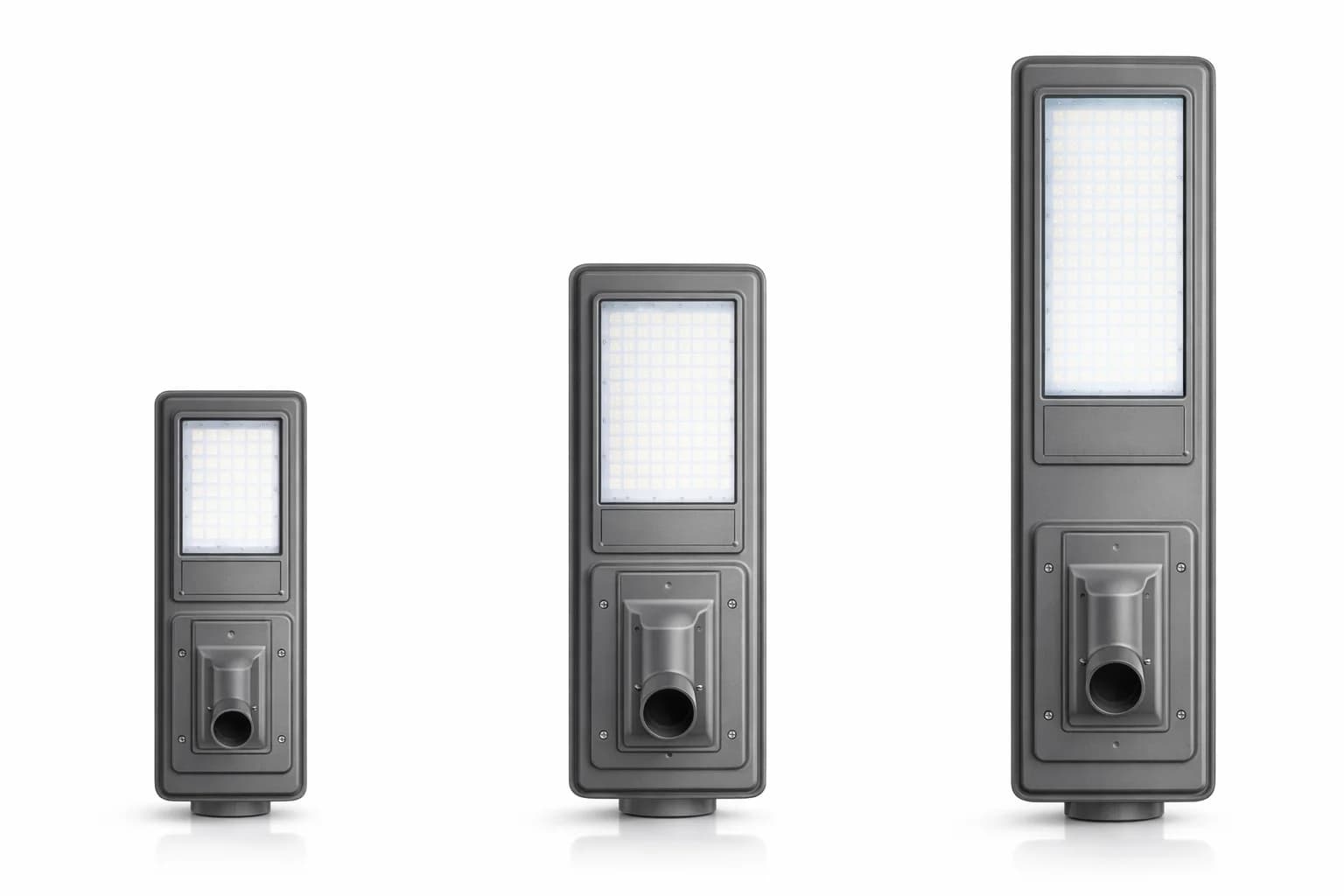
Every Beamfact rural solar street light is an all-in-one system: monocrystalline solar panel, LiFePO4 battery, MPPT charge controller, and commercial-grade LED integrated into a single sealed housing. One unit, one pole, one installation — operational from night one.
LiFePO4 for Temperature Extremes
We use lithium iron phosphate (LiFePO4) batteries exclusively for rural projects. LiFePO4 tolerates operating temperatures from -20 to 60 degrees Celsius without thermal runaway risk, delivers 2,000+ charge cycles (5-7 years of nightly operation), and eliminates the cobalt supply chain and toxicity concerns of NMC lithium. In a rural deployment where nobody monitors battery health, LiFePO4 is the only responsible chemistry.
Light + Time Control Without Programming
Our rural configurations use a pre-programmed 3-mode lighting profile:
| Time Period | Mode | Output | Purpose |
|---|---|---|---|
| Sunset - 11 PM | Full Power | 100% | Peak movement hours — road safety |
| 11 PM - 5 AM | Economy | 30-50% | Low activity — conserve battery reserve |
| Motion Detected | Radar Boost | 100% (30 sec) | Security response on demand |
The controller is pre-set at our factory based on your project latitude. No app, no Bluetooth, no on-site programming. For projects that need custom timing, we adjust profiles before shipping — the community never touches a setting.
Vandal-Resistant Die-Cast Aluminum Design
Rural installations face theft and vandalism risks. Our design responses:
- Tamper-proof fasteners — standard tools cannot remove the fixture from the pole
- Integrated battery — no external battery box to steal; everything is sealed inside the housing
- Elevated mounting — all-in-one design at 4-8 meters keeps every component out of reach
- No exposed wiring — zero cables between poles, nothing to cut or repurpose
- Die-cast aluminum housing — impact-resistant, corrosion-proof, built for decades outdoors
15-Minute Installation by Local Labor
Each unit mounts on a standard pole (60mm diameter) with 4 bolts. No wiring, no conduit, no trenching, no junction boxes. We provide pictorial installation guides designed for crews with no electrical training — diagram-based instructions with minimal text. Average installation time: 15 minutes per unit once the pole is in place.
Recommended Configurations by Project Scale
We have standardized three deployment packages based on project scope. Each configuration uses real product specifications and has been refined through field deployments.
Scale 1: Single Road Segment (500m, ~25 lights)
The entry-level rural lighting project — one main road through a settlement or a connector road between communities.
| Parameter | Specification |
|---|---|
| Recommended Fixture | BF-SSL-20-45W |
| Luminous Output | 2,280 LM per unit |
| Mounting Height | 4-5M poles |
| Pole Spacing | 15-18M |
| Fixtures Needed | ~25 units (500m road) |
| Battery Autonomy | 3 rainy days |
| Coverage | Both sides of a single rural road |
| Installation Time | 1 day (2-person local crew) |
| Estimated Budget | $4,000 - $6,500 (fixtures + poles + shipping) |
Scale 2: Community Hub — Market, School, Clinic (~40-60 lights)
A medium deployment covering the core community infrastructure: main road, market area, school grounds, health clinic access path, and community gathering space.
| Parameter | Specification |
|---|---|
| Road Fixtures | BF-SSL-20-65W — 30-40 units |
| Road Output | 3,800 LM per unit |
| Road Mounting | 5-6M poles, 18-22M spacing |
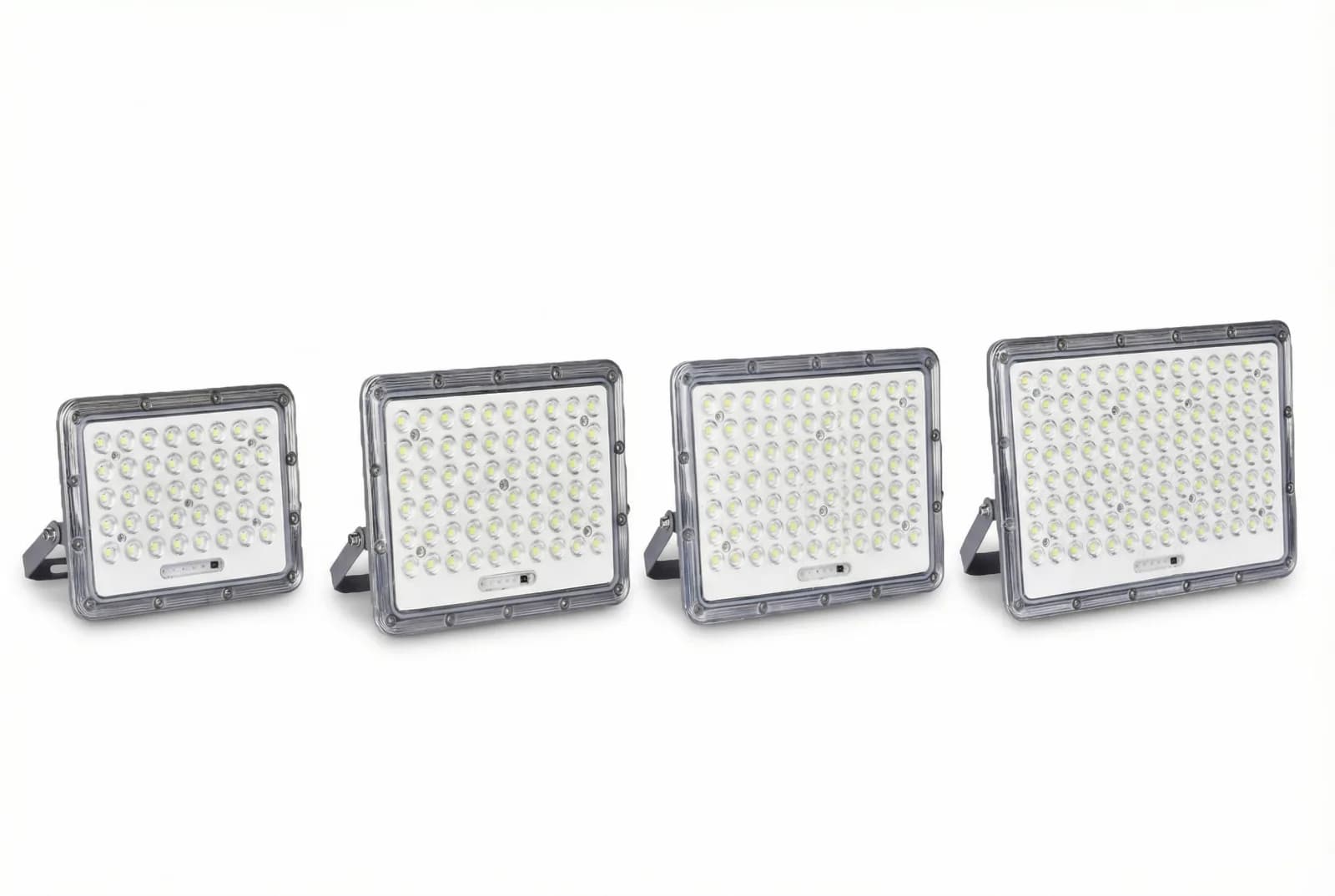
| Public Space Floods | BF-SFL-26-40W / BF-SFL-26-50W — 4-6 units |
| Flood Output | 3,420-3,800 LM per unit |
| Flood Mounting | Wall-mount or 4M pole at market, school, clinic |
| Total Fixtures | 34-46 units (street lights) + 4-6 units (flood lights) |
| Coverage | Main roads + market square + school + clinic + community center |
| Installation Time | 3-5 days (4-person local crew) |
| Estimated Budget | $8,000 - $15,000 (all fixtures + poles + shipping) |
Scale 3: Regional Program (10+ Villages, Container-Load Deployment)
A government or development agency program lighting multiple communities under a single procurement. Container-load logistics, dedicated project management, phased delivery.
| Parameter | Specification |
|---|---|
| Road Fixtures | BF-SSL-20-45W / BF-SSL-20-65W — 250-500+ units |
| Public Space Fixtures | BF-SSL-20-90W + BF-SFL-26-50W — 40-100 units |
| Total Fixtures | 300-600+ units across 10+ villages |
| Packing | 20ft container holds ~400 street light units |
| Delivery | Phased by village cluster, aligned with deployment schedule |
| Project Support | Dedicated project manager, installation training for local crews, remote technical support |
| Pricing | Container-load volume pricing (15-20% below small-batch) |
| Documentation | Full tender/grant package: certificates, BOMs, photometric reports, maintenance schedules |
| Estimated Budget | $45,000 - $120,000+ depending on scale and configuration |
| Timeline | 4-6 weeks production + phased shipping over 3-12 months |
All configurations include LiFePO4 batteries with 3-5 rainy day autonomy, pre-programmed light+time control, and IP65 sealed housings.
Need a precise layout? Send us your road measurements, satellite image, or community map. We provide a complete lighting plan — fixture positions, spacing, wattage per zone, and total project budget — at no charge. Request your free rural lighting plan.
Split-Type for Shaded or Awkward Pole Positions
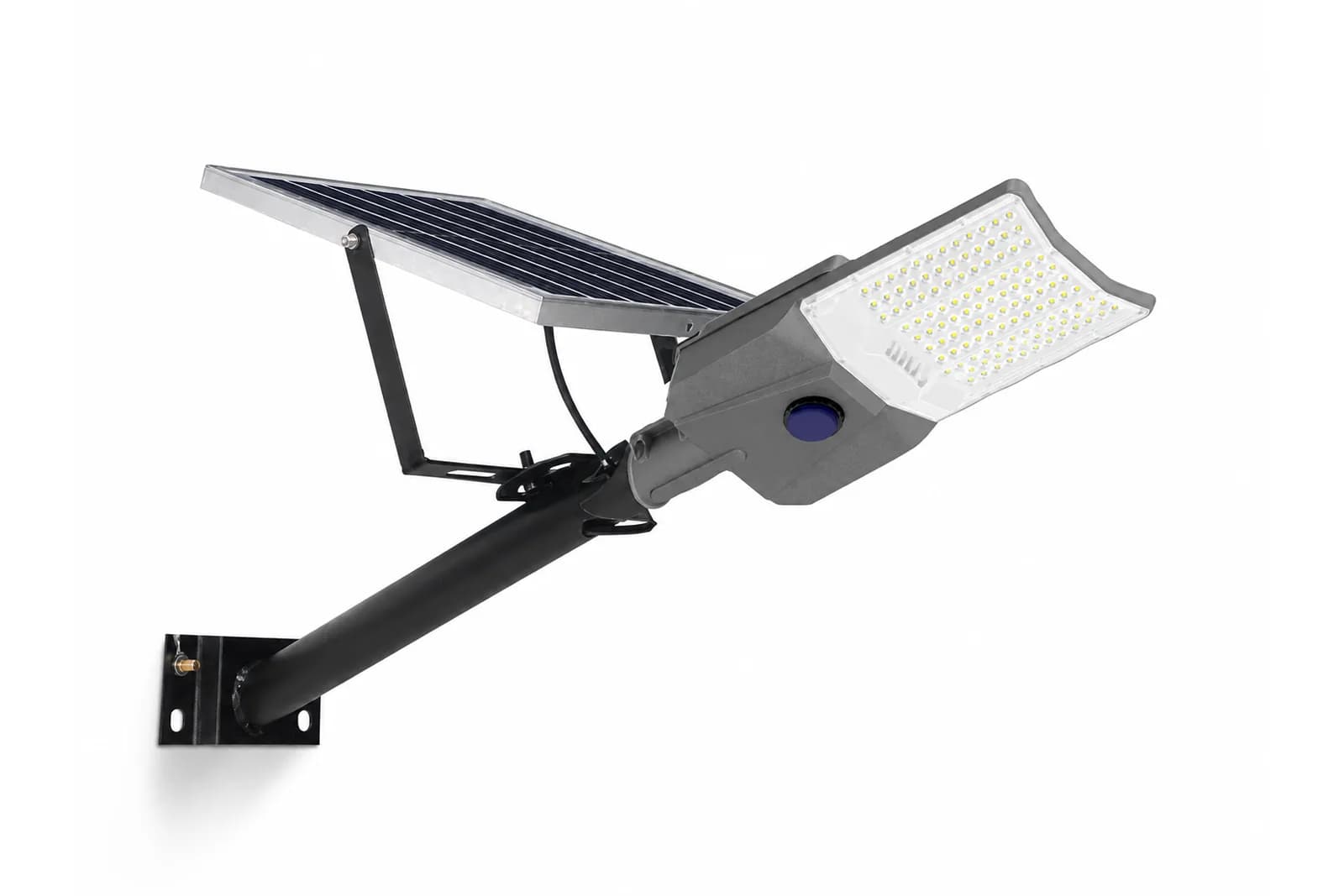
Where a road segment runs under tree cover or the pole must face away from the sun, use the split solar street lights (BF-SSL-ST, 40-100W panel) for that segment only: the panel is mounted separately in the open and the lamp body stays over the road, with installation still handled by local labor.
Impact: What Happens When Rural Roads Get Light
We track deployment outcomes across our rural installations. These are not theoretical projections — they are patterns observed in communities before and after solar street light installation.
Safety
- WHO data: adequate road lighting reduces nighttime traffic fatalities by 30-45% in rural areas
- Unlit rural roads have 3x the accident rate of lit roads during nighttime hours
- Community-reported crime incidents drop 50-70% in the first year after lighting installation (World Bank rural electrification data)
Education
- UNESCO data: public lighting extends average daily study time by 1-2 hours in off-grid communities
- Schools with compound lighting report 15-25% improvement in evening program attendance
Economic Activity
- Evening market hours extend by 2-3 hours in lit communities
- Small business revenue increases 10-20% when evening commerce becomes viable
- Street vendor density increases measurably within weeks of installation
Healthcare Access
- Lit paths to clinics enable nighttime emergency access — a direct impact on maternal health and acute care outcomes
- Health workers report increased willingness to conduct evening outreach in lit communities
Certifications applicable to rural projects:
- CE (European Conformity)
- IP65 (dust and water ingress protection)
- RoHS (Environmental Compliance)
- UN38.3 (Battery Transport Safety)
- ISO 9001 / ISO 14001 (Quality and Environmental management)
We provide all test reports and certificates with your quotation. For projects requiring country-specific certifications (SONCAP for Nigeria, BIS for India, etc.), we arrange testing on request.
For an independent quality assessment methodology, see: 9-Point Quality Checklist for Buying Solar Lights from China.
Cost Comparison: Solar vs Grid Extension vs Diesel Generator
For rural areas, the realistic alternatives to solar are grid extension and diesel generator lighting. We calculated total cost of ownership for a 1 km rural road (~50 lights) over 5 years.
Solar vs Grid Extension per Kilometer
| Cost Item | Grid Extension | Solar (Ours) |
|---|---|---|
| Infrastructure (poles, cables, transformer) | $10,000 - $50,000 | $0 |
| Fixtures (50 units) | $2,000 - $4,000 | $6,000 - $12,000 |
| Poles | Shared with grid poles | $2,000 - $4,000 |
| Installation (electrician required) | $3,000 - $6,000 | $500 - $1,000 (local labor) |
| Upfront Total | $15,000 - $60,000 | $8,500 - $17,000 |
| Electricity (per year) | $1,200 - $3,000 | $0 |
| Maintenance (per year) | $500 - $1,500 | $0 - $200 |
| 5-Year Running Cost | $8,500 - $22,500 | $0 - $1,000 |
| 5-Year Grand Total | $23,500 - $82,500 | $8,500 - $18,000 |
Breakeven distance: 2 km. For any road segment more than 2 km from the nearest grid connection point, solar is cheaper on day one. At 5 km distance, grid extension costs 3-5x more than solar. At 10 km, the comparison is not worth calculating.
Solar vs Diesel Generator Annual Cost
| Cost Item | Diesel Generator | Solar (Ours) |
|---|---|---|
| Generator (15kVA) | $3,000 - $5,000 | $0 |
| Fuel (per year, 6hrs/night) | $3,600 - $7,200 | $0 |
| Generator maintenance (per year) | $800 - $1,500 | $0 |
| Fuel transport to remote site (per year) | $500 - $2,000 | $0 |
| Annual Operating Cost | $4,900 - $10,700 | $0 |
| Noise pollution | Yes | None |
| CO2 emissions | 5-10 tons/year | None |
| Fuel supply chain dependency | Critical | None |
Verdict: Solar eliminates three cost categories that only increase over time: fuel, generator maintenance, and fuel logistics. The entire 5-year cost of a solar installation is less than 2 years of diesel operation. And diesel prices only go up. Solar running cost stays at zero permanently.
For a detailed breakdown of solar street light component costs, read: Solar Street Light Cost Breakdown: From BOM to FOB Price.
Get Your Rural Electrification Project Quote
Tell us about your rural lighting project and we deliver:
- Lighting layout — fixture positions mapped to your roads and community spaces
- Bill of materials — exact fixture models, quantities, poles, and accessories
- Project budget — unit costs, volume pricing tiers, shipping, and total landed cost
- Funding documentation — certificates and specifications formatted for development agency, government, or NGO tender submissions
Two ways to start:
- Send us your site map or satellite screenshot for a custom lighting plan (response within 48 hours)
- Tell us the road length and number of communities and we provide a standard configuration quote