

You received a quote for a solar street light. It says $200. What are you actually paying for? Which components eat the budget? Where do factories cut corners to hit a lower number? This guide answers those questions by opening the bill of materials for a typical 30 W all-in-one solar street light — component by component, dollar by dollar.
This is not a lifecycle cost analysis. If you need to calculate total cost over 10 years, read our TCO guide. If you need to compare solar versus grid lighting, see our solar vs. traditional cost comparison. This article is about what is physically inside the unit you buy, and what each piece costs.
Why Comparing Unit Prices Alone Fails
Most buyers collect three quotes, line them up by unit price, and pick the lowest number. The problem: a "$150 solar street light" and a "$250 solar street light" can both be labeled "30 W, LiFePO4, MPPT, all-in-one" while containing fundamentally different components. The spec sheet looks identical. The BOM is not.
Price comparison without component understanding is like comparing cars by horsepower alone. A 200 hp engine in a car with drum brakes and no airbags is a different product than a 200 hp engine in a car with ABS and side curtains. The headline number matches. The product does not.
The only way to compare solar street light quotes meaningfully is to understand what each dollar buys at the component level.
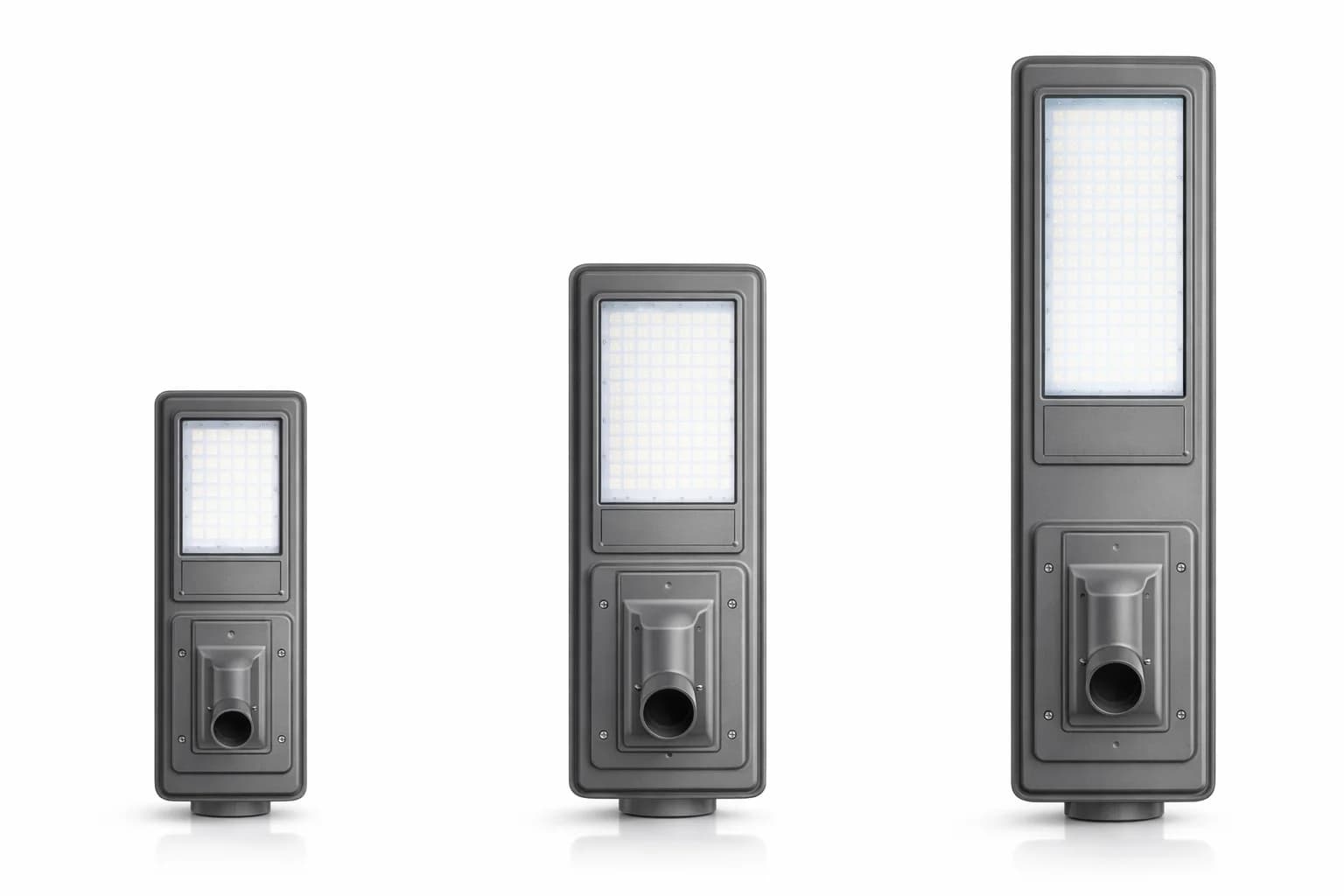
BOM Breakdown: Anatomy of a 30 W Solar Street Light
The bill of materials accounts for 60-70% of the final FOB price. The remaining 30-40% covers assembly, quality control, certification amortization, packaging, and margin. Here is how the BOM distributes for a standard 30 W all-in-one unit priced at $200 FOB.
LiFePO4 Battery Pack — 25-30% of Unit Cost
Typical cost: $45-60 for the complete pack
The battery is the single most expensive component and the single largest source of cost-cutting in cheap units. A quality 30 W solar street light uses a 3.2 V LiFePO4 pack with 25-30 Ah capacity and a dedicated battery management system (BMS).
What determines the price:
- Cell brand. Branded cells from EVE Energy or CATL cost $0.35-0.50 per Wh. No-name or recycled cells run $0.15-0.25 per Wh. A 96 Wh pack (3.2 V x 30 Ah) ranges from $14 for recycled cells to $48 for branded cells. That single component decision swings the unit price by $30.
- BMS quality. A proper BMS includes overcharge protection, over-discharge protection, short circuit protection, temperature compensation, and cell balancing. A quality BMS costs $3-5. A bare-minimum BMS that only does voltage cutoff costs $0.80-1.50. The cheap BMS lets cells degrade faster and increases fire risk.
- Wh capacity vs. label. Some suppliers label a 60 Wh pack as "100 Wh" by citing theoretical capacity of cells that were recycled at 60% health. The price is low because the actual energy storage is low. Request the cell datasheet with rated capacity and cycle count.
Our BF-SSL-20 Series and BF-SSL-22 Series use EVE LiFePO4 cells rated at 2,000+ cycles with multi-protection BMS boards. This is non-negotiable — the battery defines the operational lifespan of the entire unit.
Solar Panel (Monocrystalline) — 15-20% of Unit Cost
Typical cost: $30-40 for a 40-50 W panel
For a 30 W LED load running 10-12 hours on intelligent dimming, a 40-50 W monocrystalline panel provides sufficient daily charge in regions with 4+ peak sun hours.
What determines the price:
- Cell efficiency. Grade A monocrystalline cells achieve 21-23% conversion efficiency. Grade B cells hit 18-20% and cost 15-25% less — but in an all-in-one design where panel area is constrained by the housing, every percentage point of efficiency matters.
- Encapsulation. Proper EVA lamination with tempered glass resists moisture for 25 years. Cheap PET lamination degrades under UV within 3-5 years, causing delamination and output loss.
- Frame and junction box. Anodized aluminum frames with sealed junction boxes maintain IP65. Bare aluminum with unsealed boxes corrode in coastal environments.
The panel is rarely where factories cut the most cost. But a Grade B panel with poor encapsulation loses 15-20% output by year three, which means the battery cannot fully charge, which means shorter runtime and accelerated battery degradation.
LED Module (5054/3030 Chips) — 15-20% of Unit Cost
Typical cost: $30-40 for a 30 W module
A 30 W module using quality chips produces about 5,700 lumens.
What determines the price:
- Chip brand and binning. Name-brand chips (Bridgelux, Epistar, Seoul Semiconductor) cost $0.015-0.025 per lumen. No-name chips cost $0.005-0.010 per lumen but show inconsistent color temperature, faster lumen depreciation, and higher failure rates.
- Thermal management. Proper design uses aluminum MCPCB bonded directly to the die-cast housing, creating a thermal path from junction to ambient air. Cheap FR4 PCB substrates cause junction temperatures to exceed 85 degrees C, accelerating phosphor degradation.
- Lens design. A proper Type II/III distribution lens array costs $2-4 and directs light onto the road surface. A generic diffuser costs $0.50 but wastes 20-30% of light output outside the target area.
Our production line uses 5054 SMD chips on aluminum MCPCB with molded lens arrays. The chip-level choice is invisible in a product photo but defines whether the light delivers its rated lumens at year five.
MPPT Controller — 8-12% of Unit Cost
Typical cost: $16-24
The controller manages all energy flow and dimming logic. A true MPPT (Maximum Power Point Tracking) controller extracts 15-20% more energy from the panel compared to basic PWM controllers.
What determines the price:
- Conversion topology. A genuine MPPT uses a buck or buck-boost converter with real-time power point tracking — $5-8 for the power stage alone. A PWM controller relabeled "MPPT" costs $1.50-3 total and undercharges the battery by 15-20%.
- Protection circuits. Reverse polarity, lightning surge (MOV), overload, and temperature-compensated charging. Each adds $0.50-1.50. Cheap controllers skip some or all, leaving battery and LEDs vulnerable.
- Dimming intelligence. Configurable profiles (100%/60%/30% across the night) optimize battery usage. Advanced controllers adjust based on battery state of charge and seasonal daylight variation.
The controller is the brain. A $2 brain running a $50 battery and $35 LED module is the definition of false economy.
Die-Cast Aluminum Housing — 10-15% of Unit Cost
Typical cost: $20-30
The housing holds every component, manages thermal dissipation, and protects electronics from rain, dust, salt spray, and UV.
What determines the price:
- Die-casting method. High-pressure die-cast ADC12 aluminum at 3-4 mm wall thickness provides structural rigidity and thermal mass. Gravity-cast at 1.5-2 mm walls saves 30-40% but flexes under wind load and sinks heat poorly.
- Surface treatment. Powder coating over chromate conversion provides 1,000+ hour salt spray resistance (ASTM B117). Single-layer spray paint corrodes in coastal environments within 12-18 months.
- IP sealing. IP65 requires precision-machined surfaces, compression silicone gaskets, and sealed cable glands — adding $2-4 per unit. Cheap foam seals compress permanently after thermal cycling, allowing moisture ingress within two rainy seasons.
Housing failure — cracked casting, corroded surface, water ingress — kills the entire unit regardless of how good the battery and LEDs are. Buyers rarely ask about wall thickness or sealing method, but they should.
Motion Sensor and Wiring — 3-5% of Unit Cost
Typical cost: $6-10
Most all-in-one units include a motion sensor for adaptive dimming — reduced brightness until motion detected, then full output, extending battery runtime by 30-50%.
What determines the price:
- Sensor type. Microwave radar ($2-4) detects motion through rain and obstructions. Basic motion sensors ($0.50-1.50) are cheaper but have narrower angles and reduced reliability in extreme temperatures. Radar is the standard.
- Connectors. Waterproof MC4-style connectors with silicone-sealed entries cost $1.50-3. Bare solder joints with heat shrink cost $0.30-0.50 but fail first when moisture migrates along the wire.
Assembly, QC, and Aging Test — 5-8% of Unit Cost
Typical cost: $10-16
What determines the price:
- Aging test protocol. 100% aging test means every unit runs for 24-48 hours before packing, catching infant mortality failures — weak LED bonds, battery shorts, firmware bugs. This costs $3-5 per unit. Sample-based QC (5-10% of units) costs $0.50-1 but ships untested product.
- Assembly precision. Torque-controlled fastening, thermal paste on LED-to-housing interfaces, gasket seating verification — a thorough assembly takes 15-20 minutes. A rush build skipping thermal paste and gasket checks takes 5-8 minutes.
We run 100% aging tests on every BF-SSL-20 Series, BF-SSL-21 Series, and BF-SSL-22 Series unit. 24-hour burn-in, charge/discharge cycle verification, sensor function test. This is not optional.
Packaging and Logistics — 3-5% of Unit Cost
Typical cost: $6-10
- Packaging method. Individual foam-fitted cartons in wooden crate pallets cost $4-6 per unit but survive rough handling across 30-45 days of ocean transit. Bulk packing in shared cartons costs $1-2 but risks impact damage. A cracked housing from shipping is a total loss.
- Accessories. Mounting brackets, hardware kits, installation instructions, and warranty cards add $1-2 per unit.
Price Range by Wattage
Different projects require different wattage levels. Here is the FOB price range for quality all-in-one solar street lights across our product line, reflecting units built with branded LiFePO4 cells, monocrystalline panels, true MPPT controllers, and die-cast aluminum housing.
| Wattage | Typical Models | FOB Price Range | Battery (Wh) | Panel (W) | Lumens |
|---|---|---|---|---|---|
| 12 W | BF-SSL-20-45W | $80-120 | 38-50 | 18-25 | 2,280 |
| 20 W | BF-SSL-20-65W / BF-SSL-21-65W / BF-SSL-22-60W | $120-180 | 64-80 | 30-40 | 2,280-3,800 (varies by series) |
| 30 W | BF-SSL-20-90W / BF-SSL-21-90W / BF-SSL-22-80W | $180-250 | 96-120 | 40-55 | 5,700 |
| 40 W | BF-SSL-22-120W | $250-350 | 128-160 | 55-70 | 7,600 |
The price range within each wattage tier reflects specification differences: battery capacity (more Wh = longer runtime = higher cost), panel wattage (larger panel = faster charging = higher cost), and housing size/weight. A 30 W unit at $180 and a 30 W unit at $250 both produce similar lumens, but the $250 unit has a larger battery for extended rainy-day autonomy and a higher-wattage panel for faster charging in suboptimal sunlight.
For help choosing the right wattage for your road type and pole height, see our wattage guide.
Why the Same Wattage Has a $100 Price Difference
A 30 W solar street light can cost $100 from Supplier A and $250 from Supplier B. Both spec sheets say "30 W, LiFePO4, MPPT, IP65, all-in-one." Here is what actually differs inside.
| Component | Budget ($100-130) | Standard ($150-190) | Quality ($200-250) |
|---|---|---|---|
| LED chips | No-name SMD, FR4 PCB | Epistar 3030, aluminum MCPCB | Bridgelux 5054, high-efficiency, aluminum MCPCB + lens array |
| Battery | Recycled cells, 40-50 Wh actual, basic BMS | Brand-B cells, 80-90 Wh, standard BMS | EVE/CATL cells, 96-120 Wh, multi-protection BMS |
| Panel | Grade B poly, PET lamination, 16-18% efficiency | Grade A mono, EVA/glass, 19-21% | Grade A+ mono, EVA/tempered glass, 21-23% |
| Controller | PWM relabeled "MPPT", no surge protection | True MPPT, basic protection | True MPPT, full protection suite, configurable dimming |
| Housing | Stamped steel or thin-wall cast, spray paint, foam seal | Die-cast aluminum 2.5 mm, powder coat, rubber gasket | Die-cast aluminum 3.5 mm, chromate + powder coat, compression silicone gasket |
| QC | Sample-based (5%), no aging test | Sample-based (20%), 8-hour aging | 100% unit, 24-hour aging + charge cycle test |
| Certification | None | CE only | CE + IP65 test report |
| Expected lifespan | 1-2 years | 3-5 years | 6-8 years before battery swap |
The budget unit is not a solar street light — it is a solar street light shaped object. It will illuminate a road for a few months. It will not survive two rainy seasons.
The standard unit is a functional product with acceptable compromises. It works for 3-5 years in moderate climates but may underperform in harsh conditions.
The quality unit is engineered for the full LiFePO4 lifecycle. It runs for 6-8 years before needing a battery replacement, after which it runs for another 6-8 years with the same LED module, panel, and housing.
The $100 price difference between budget and quality is not margin — it is material cost. Better components cost more. There is no manufacturing trick that makes branded EVE cells cheaper than recycled no-name cells.
How to Verify You Are Getting What You Pay For
You are paying quality-tier prices. How do you confirm the unit contains quality-tier components? Ask for three documents before placing a production order.
1. Battery Cell Brand and Datasheet
Ask: "What brand are the LiFePO4 cells? Please provide the cell datasheet."
A legitimate supplier names the cell manufacturer (EVE, CATL, BYD, Lishen) and provides the manufacturer's datasheet showing rated capacity, cycle life at 80% DOD, operating temperature range, and dimensional specifications. If the answer is "our own cells" or "Chinese brand" without a specific name, assume recycled or B-grade cells.
2. BMS Specification Sheet
Ask: "Please provide the BMS spec sheet showing protection parameters."
The BMS datasheet should show: overcharge voltage cutoff (3.65 V for LiFePO4), over-discharge cutoff (2.5 V), maximum charge/discharge current, short circuit protection response time, and operating temperature range. A quality BMS also shows cell balancing methodology. If the supplier cannot provide this document, the BMS is likely a generic board without proper protection thresholds.
3. Aging Test Report
Ask: "Do you perform 100% aging test? Please provide a sample aging test report."
A 100% aging test report shows every unit in the batch was powered on for a defined period (typically 24 hours), with recorded measurements: LED current draw, battery voltage under load, charge controller output, and sensor function. Sample-based QC reports show test results for a subset of units. The difference matters — a 2% infant mortality rate in untested production means 10 dead units per 500-piece order that you discover after installation.
Our quality checklist for buying from China covers additional verification steps including factory audit protocols and pre-shipment inspection procedures.
Price Factors Beyond the BOM
Several factors outside the physical components affect the final price you pay. If you are sourcing internationally, our complete guide to buying solar street lights from China walks through the full procurement process — from supplier qualification to shipment inspection.
Order quantity. Sample orders (1-5 units) cost 30-50% more per unit because setup, QC, and shipping overhead are spread across fewer pieces. Pricing stabilizes at 50+ units and reaches optimal per-unit economics at 500+ units. A 30 W unit quoted at $230 for a 5-piece sample may be $180-190 at 100 units and $160-170 at 500 units.
Customization. Custom color (RAL code matching), custom dimming profiles, custom arm bracket angles, or private label packaging add $5-20 per unit depending on complexity. Standard configurations carry no customization premium.
Incoterms. FOB (factory loads onto vessel) is the most common basis for comparison. CIF (includes freight and insurance to your port) adds $3-8 per unit for African and Middle Eastern destinations via sea freight. DDP (delivered to your door, duties paid) adds the most but eliminates your logistics complexity. Always confirm which Incoterm the quote reflects.
Certification scope. CE certification costs $3,000-5,000 per product family, amortized across production volume. IP65 testing adds $1,500-2,500. For a 1,000-unit order, certification adds $3-5 per unit. For a 100-unit order, it adds $30-50 per unit. This is why MOQ matters for pricing — larger orders dilute fixed costs. See our certifications guide for details on what each standard covers.
The Real Cost of Cheap
The math on cheap solar street lights is seductive. A $100 unit versus a $200 unit saves $100 per unit. On a 200-unit order, that is $20,000. But the math shifts dramatically in the field.
A 30% field failure rate in year one (typical for budget units in tropical climates) means 60 units out of 200 need replacement. The replacement cost is not just 60 new units — it includes identifying which units failed, dispatching a crew, de-installing the dead units, installing replacements, and disposing of the failures. For a rural deployment in Sub-Saharan Africa, the truck roll and labor cost per replacement can exceed $50-100 per unit.
Budget scenario: 200 units at $100 = $20,000. Year one: 60 replacements at $100 + $75 labor = $10,500. Effective cost after year one: $30,500 for 200 functional units = $152.50 per surviving unit.
Quality scenario: 200 units at $200 = $40,000. Year one: 2-4 replacements under warranty at $0. Effective cost after year one: $40,000 for 198 functional units = $202 per unit.
The gap narrows from $100 to $50 after just one year. By year three, when another 30-40% of budget units fail and the quality units are still operating, the budget option is more expensive per functional light-year than the quality option ever was.
FAQ
Next Steps
Understanding what is inside the unit is step one. Step two is understanding what the unit costs over its full service life — read our total cost of ownership guide for 10-year lifecycle cost analysis with ROI calculations and payback period formulas.
Browse our solar street light catalog with specifications and transparent pricing for every model in the BF-SSL-20 Series, BF-SSL-21 Series, and BF-SSL-22 Series. For project-level quotes with component-level transparency, contact our team — we provide full BOM breakdowns for any configuration above 50 units.