

Most buyers start their solar street light search the wrong way. They compare wattage numbers across suppliers, pick the cheapest option at the target wattage, and assume they are getting equivalent products. They are not. A 30 W solar street light from one factory can outperform a 50 W unit from another by a wide margin — and last five times longer doing it.
The problem is not that buyers are careless. The problem is that spec sheets are designed to look impressive, not to be informative. Every supplier claims "high efficiency," "long runtime," and "IP65 waterproof." These words mean nothing without the engineering data behind them.
We build solar street lights at our factory in Fujian. Our engineering team designs every circuit, tests every component, and tracks field performance across thousands of installations. This guide shares the evaluation framework we use internally — the same 7 specifications our engineers check when benchmarking competitor products. If you apply this framework to any supplier's product, you will know within 15 minutes whether you are looking at a quality light or a liability.
Start with the Right Decision Path
This guide is the buyer's starting point. Use the deeper tools below when your question narrows to sizing, ROI, or exact wattage selection.
| If Your Question Is... | Use This Page For | Go Deeper Here |
|---|---|---|
| "Which specs matter before I request quotes?" | The 7-step supplier/product checklist | Continue reading below |
| "What wattage fits my road width and pole height?" | Understand why wattage alone misleads | What solar street light wattage means |
| "How many fixtures and what payback period?" | Confirm the inputs you need | Solar street light ROI calculator |
| "Can I estimate wattage interactively?" | Prepare mounting height and area data | Wattage selector |
| "Which product family should I quote?" | Match specs to Beamfact models | Solar street light catalog |
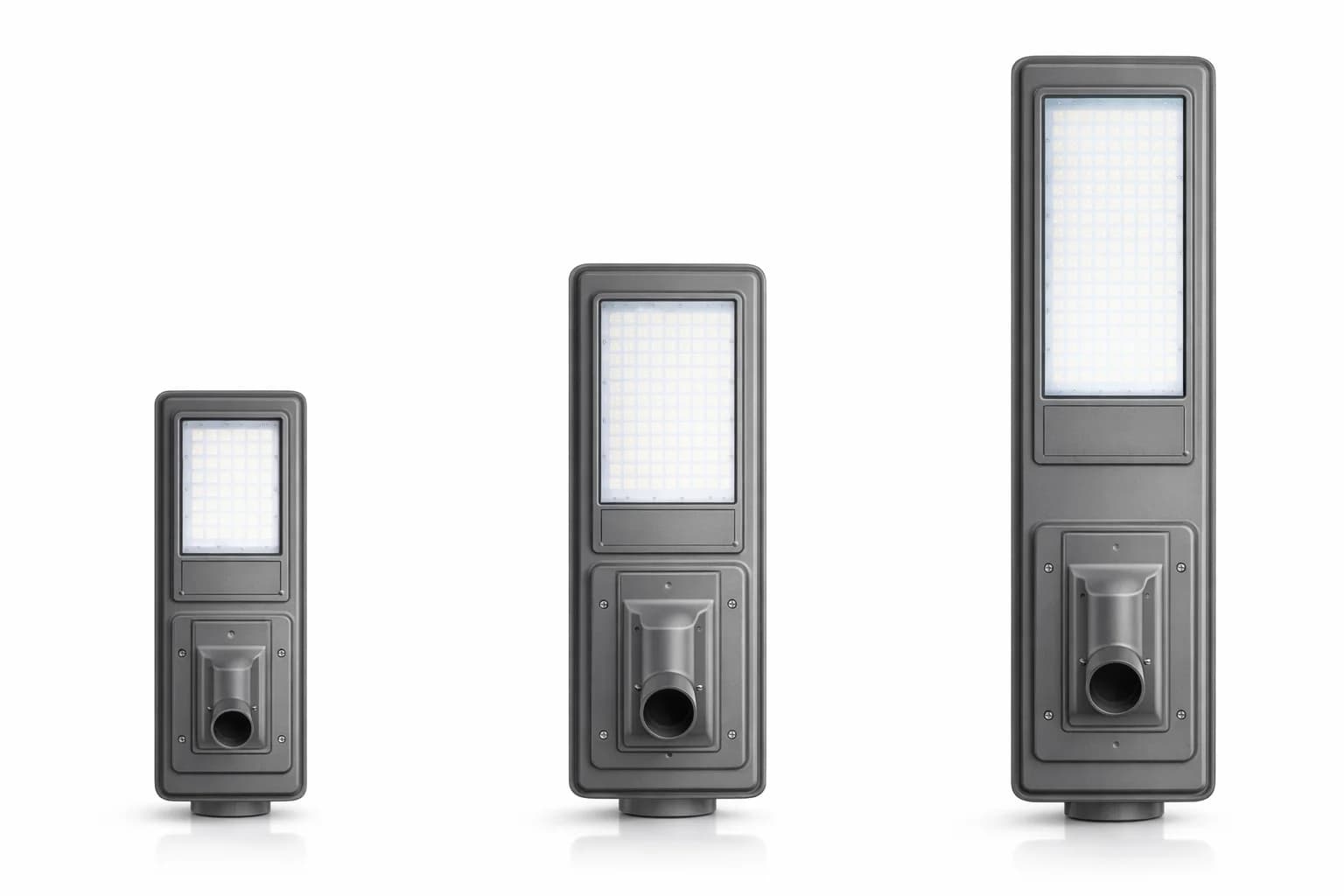
1. Wattage vs. Mounting Height: The Spec Most Buyers Get Wrong
Wattage is not brightness. Wattage measures power consumption. Lumens measure light output. The ratio — lumens per watt (lm/W) — tells you how efficiently power converts to illumination.
A well-engineered 20 W light with high-efficiency 5054 LED chips produces 3,800 lumens. A budget 40 W light with generic chips produces 3,200 lumens. The 20 W light is brighter, runs longer on the same battery, and requires a smaller solar panel. These are numbers from our own testing.
Street lighting is about delivering uniform illumination at ground level, not raw brightness. A 30 W light at 4 meters produces blinding hot spots. The same light at 10 meters produces dim, uneven coverage. Mounting height determines beam spread, which determines coverage area, which determines whether the light works for its purpose.
What to verify: Ask for the recommended mounting height, beam angle, and pole-to-pole spacing for each wattage. If a supplier cannot provide these three numbers together, they have not done the photometric design work.
2. Battery Type and Capacity: Where Projects Live or Die
The battery is the most expensive single component in a solar street light, and it is the most common point of failure. Battery chemistry determines three things that matter to your project: how many years the light operates before replacement, whether it works in cold weather, and whether it poses a fire risk on the pole.
LiFePO4 (Lithium Iron Phosphate): This is the chemistry we use in every model. LiFePO4 delivers 2,000+ charge cycles to 80% capacity — translating to 5-7 years of nightly use. No thermal runaway risk even under abuse conditions. Discharge holds down to -20 degrees C. Flat voltage profile means consistent LED output from full charge through 80% discharge.
NMC (Lithium Nickel Manganese Cobalt): The cheaper alternative some suppliers use to hit lower price points. NMC delivers 500-800 cycles — roughly 1.5-2.5 years before noticeable degradation. Carries thermal runaway risk if the BMS fails. Cold performance degrades significantly below -10 degrees C. Higher energy density per kilogram, but in a pole-mounted application weight is rarely the constraint.
Capacity matters as much as chemistry:
Battery capacity is measured in watt-hours (Wh), not just amp-hours (Ah). A 3.2 V 75 Ah LiFePO4 battery stores 240 Wh. If your 30 W light runs at full power for 8 hours, it consumes 240 Wh — leaving zero margin for cloudy days. This is why we size our batteries for 2-3 days of autonomy at designed runtime, not just one night.
What to verify: Ask for the specific battery chemistry (LiFePO4 or NMC), the voltage, the capacity in Wh (not just Ah), the cycle life rating, the discharge temperature range, and the BMS protection features. If the supplier quotes only Ah without voltage, they may be obscuring a low-voltage cell that stores far less energy than it appears.
3. Solar Panel Sizing and Efficiency: Harvest Determines Runtime
The solar panel is the power source for the entire system. Its job is to fully recharge the battery during daylight hours so the light runs through the night. Panel sizing is not about peak watt ratings — it is about real-world energy harvest under your specific conditions.
Panel efficiency tiers:
- Grade A mono-crystalline (20-22%): The standard. Maximum harvest per square meter.
- Poly-crystalline (15-17%): Needs 25-30% more area for equivalent output.
- Amorphous thin-film (8-10%): Avoid entirely.
The panel-to-load ratio: Panel wattage should be 2-3x the LED wattage. This accounts for suboptimal sun angles, cloudy days, and dust. Our BF-SSL-20 Series at 30 W LED uses a 90 W panel — a 3:1 ratio ensuring full recharge with 4-5 hours of usable sunlight.
What to verify: Panel grade (Grade A mono-crystalline), cell efficiency percentage, and an EL (electroluminescence) test image to reveal micro-cracks. Confirm whether panel wattage is STC (Standard Test Conditions) or real-world — they differ by 15-25%.
4. Autonomy Days: How Long the Light Survives Without Sun
Autonomy is the number of consecutive cloudy or rainy days the light can operate at designed brightness without any solar charging. This spec separates lights designed for reliable infrastructure from lights designed to pass a factory demo.
If you are deploying lights for a municipal road or rural electrification project, they must work every night — including during monsoon season and extended overcast periods. A light with 1 day of autonomy fails on the second cloudy day.
How autonomy is calculated: Battery capacity (Wh) / Nightly energy consumption (Wh). For our BF-SSL-22-80W with adaptive dimming (100% for 4 hours, 50% for 6 hours): nightly consumption = (30 x 4) + (15 x 6) = 210 Wh. Battery: 288 Wh. Base autonomy: 1.37 nights. With the controller extending dim-period to 10 W under low-battery conditions, effective autonomy reaches 2+ rainy days.
What to verify: Ask for the autonomy calculation showing the specific dimming profile, the battery capacity, and the resulting nights of backup. Then confirm whether the quoted autonomy assumes full brightness or a dimmed profile. A supplier quoting "5 days autonomy" at 10% brightness is technically correct but practically useless.
5. IP Rating: Verified Protection vs. Marketing Claims
IP (Ingress Protection) ratings define dust and water resistance. For solar street lights, IP65 is the standard requirement — it means fully dust-tight (rated 6) and protected against water jets from any direction (rated 5). This covers rain, storms, coastal conditions, and pressure washing.
The verification gap: Many suppliers stamp IP65 without third-party testing. A self-declared IP rating is meaningless. Genuine certification requires lab testing per IEC 60529 with a numbered report. We test every model at accredited facilities and include reports with every quotation. See our certifications guide for how to verify.
What to verify: Request the IP test report with lab name, accreditation number, and test date. No report means the rating is unverified.
6. Wind Resistance: The Spec Nobody Asks About Until It Fails
A 15 kg all-in-one unit crashing from an 8-meter pole is a safety hazard and a liability. Wind pressure increases with the square of wind speed — a 100 km/h wind exerts 4x the force of a 50 km/h wind. The effective load depends on frontal area, mounting height, and housing drag coefficient.
Design features that matter:
- Streamlined housing: Lower drag coefficient reduces force on the bracket and pole.
- Tiltable panel: Reduces frontal area presented to prevailing winds.
- Reinforced bracket: Die-cast aluminum with through-bolt mounting outperforms stamped sheet metal with self-tapping screws. The bracket is the failure point in most wind damage cases.
- Vibration damping: Lock nuts and vibration-resistant hardware prevent gradual loosening from sustained wind fatigue.
What to verify: Ask for the maximum wind speed rating, the test standard (GB/T 7000.5 or IEC 60598-2-3), and whether the rating covers the complete assembly including bracket — not just the housing alone.
7. Controller and Sensor Type: Intelligence That Saves Energy
The controller manages energy flow; the sensor determines when and how bright the light runs.
Controller types:
- MPPT: 97-99% solar charging efficiency. The standard for quality solar street lights.
- PWM: 70-80% efficiency. If the entire unit costs under $50, it almost certainly uses PWM regardless of what the label claims.
Sensor types:
- Light + time control: Programmed dimming schedule (e.g., 100% until midnight, 50% until dawn). Our baseline across all models.
- Light + time + motion sensor: Dims when no motion detected, full brightness on detection. Extends battery life 30-50% in low-traffic areas.
- Light + time + microwave: Greater detection range than basic motion sensors, reliable in rain and fog. Eliminates false triggers from animals.
For projects on low-traffic roads where motion sensing can deliver substantial battery savings, see our dedicated motion sensor solar street lights (BF-MSS-23 Series/BF-MSS-24 Series) — engineered specifically around motion-triggered dimming profiles for 40-60% energy reduction.
What to verify: Controller IC brand, charging efficiency with test data, sensor type, and programmable dimming options (time segments, brightness levels, field-adjustable or factory-fixed).
Wattage-to-Height Selection Table: Real Product Data
The following tables use actual specifications from three models in our lineup — validated through photometric testing and field installations, not theoretical calculations.
BF-SSL-20 Series
| Configuration | LED Wattage | Lumen Output | Panel | Battery (LiFePO4) | Height | Spacing |
|---|---|---|---|---|---|---|
| BF-SSL-20-45W | 12 W | 2,280 LM | 45 W | 3.2 V / 144 Wh | 4 M | 15 M |
| BF-SSL-20-65W | 20 W | 3,800 LM | 65 W | 3.2 V / 240 Wh | 6 M | 22 M |
| BF-SSL-20-90W | 30 W | 5,700 LM | 90 W | 3.2 V / 336 Wh | 8 M | 28 M |
BF-SSL-21 Series
| Configuration | LED Wattage | Lumen Output | Panel | Battery (LiFePO4) | Height | Spacing |
|---|---|---|---|---|---|---|
| BF-SSL-21-65W | 20 W | 3,800 LM | 65 W | 3.2 V / 240 Wh | 6 M | 15 M |
| BF-SSL-21-90W | 30 W | 5,700 LM | 90 W | 3.2 V / 288 Wh | 7 M | 20 M |
| BF-SSL-21-120W | 35 W | 6,650 LM | 120 W | 3.2 V / 384 Wh | 8 M | 25 M |
BF-SSL-22 Series
| Configuration | LED Wattage | Lumen Output | Panel | Battery (LiFePO4) | Height | Spacing |
|---|---|---|---|---|---|---|
| BF-SSL-22-60W | 20 W | 3,800 LM | 60 W | 3.2 V / 240 Wh | 6 M | 15 M |
| BF-SSL-22-80W | 30 W | 5,700 LM | 80 W | 3.2 V / 288 Wh | 7 M | 20 M |
| BF-SSL-22-120W | 40 W | 7,600 LM | 120 W | 3.2 V / 480 Wh | 9 M | 32 M |
All models share: 5054/3030 LED chips, 6000 +/- 500 K color temperature, -20 degrees C to 60 degrees C discharge range, CE certified, IP65 rated, light + time control as standard.
How to read this table: Match pole height to wattage and spacing. For 7-meter poles with 20-meter spacing, both BF-SSL-21-90W and BF-SSL-22-80W fit. The BF-SSL-22 Series offers equivalent battery (288 Wh) with a smaller panel (80 W vs 90 W) — better for high-irradiance regions where panel area is less critical.
LiFePO4 vs. NMC: Quick Comparison
This table summarizes why we chose LiFePO4 exclusively for our product line — and why you should insist on it from any supplier.
| Specification | LiFePO4 | NMC (Ternary Lithium) |
|---|---|---|
| Cycle Life (to 80% capacity) | 2,000+ cycles | 500-800 cycles |
| Expected Service Life | 5-7 years | 1.5-2.5 years |
| Thermal Stability | No thermal runaway | Risk above 150 degrees C |
| Low Temperature Discharge | -20 degrees C | -10 degrees C |
| Energy Density | 90-120 Wh/kg | 150-220 Wh/kg |
| Self-Discharge Rate | Less than 3% / month | 5-8% / month |
| Cost per Wh (cell level) | $0.12-0.15 | $0.08-0.11 |
| Cost per Cycle | $0.00006-0.00008 | $0.00010-0.00022 |
| BMS Complexity | Standard | Requires thermal management |
| Fire Risk | Negligible | Requires mitigation |
The cost-per-cycle line is the one that matters for B2B buyers. NMC looks cheaper per watt-hour at purchase. LiFePO4 costs 40-60% less per charge cycle over the battery lifetime. For a street light that cycles every single night, this difference compounds into thousands of dollars saved across a fleet deployment. Our cost guide breaks down the full BOM economics.
Why We Designed These Specs This Way
Understanding the "why" behind specifications helps you evaluate any supplier's claims — not just ours.
5054/3030 LED chips: High-efficiency with L70 lumen maintenance at 50,000 hours. Budget 2835 chips degrade to 70% within 15,000 hours. We chose chips that still meet photometric targets at end-of-life, not just out-of-box.
Battery capacities: Each is sized for 2+ days of autonomy at the designed dimming profile. The BF-SSL-20-90W at 336 Wh stores enough for 2 full nights at standard schedule (100% for 4 hours, 50% for 6 hours) — meaningful cloudy-day buffer without oversizing.
Variable panel-to-LED ratios: BF-SSL-20-45W uses 45 W panel for 12 W LED (3.75:1). BF-SSL-22-120W uses 120 W for 40 W (3:1). Higher-wattage models at greater heights face less shading; lower-wattage models at 4 meters need more panel reserve.
6000 K color temperature: Cool white appears 15-20% brighter to the dark-adapted eye than warm white at identical lumens. For road safety, 6000 K is engineering-optimal. Warmer temperatures available on request.
FAQ
Get Spec Sheets for Your Project
Every specification discussed in this guide is documented for each model in our lineup. Browse our solar street light catalog to compare models side-by-side, request datasheets, and request a quotation with full technical documentation. Our engineering team is available to help you match specifications to your specific road conditions, climate zone, and lighting standards.
For further reading on topics covered in this guide:
- Solar Street Light Cost Breakdown — full BOM-to-FOB cost analysis
- All-in-One vs Split Solar Street Light — design architecture comparison
- Solar Street Light Certifications Guide — how to verify CE, IP, and IEC ratings
- Solar Street Light ROI Calculator — project payback and TCO estimate
- Wattage Selector — interactive sizing starting point