

We manufacture both. Our all-in-one range — the BF-SSL-20, BF-SSL-21, BF-SSL-22 and BF-SSL-P series, 45-135W solar panel — puts every component in one sealed housing. Our split-type range — the BF-SSL-ST series, 40-100W solar panel — mounts the panel separately from the lamp body.
Because we build both, we have no reason to argue for one. This comparison sets out what each architecture is genuinely good at, using our production records, installation logs, and warranty data. The two designs solve different problems, and the right choice is decided by your site, not by a preference.
Two Architectures, Two Philosophies
The all-in-one vs split solar street light debate is fundamentally a design philosophy question: do you optimize for simplicity or for flexibility? Neither answer is universally correct. The right answer depends on your project's wattage, climate, security environment, and maintenance infrastructure.
All-in-One (Integrated) Solar Street Light
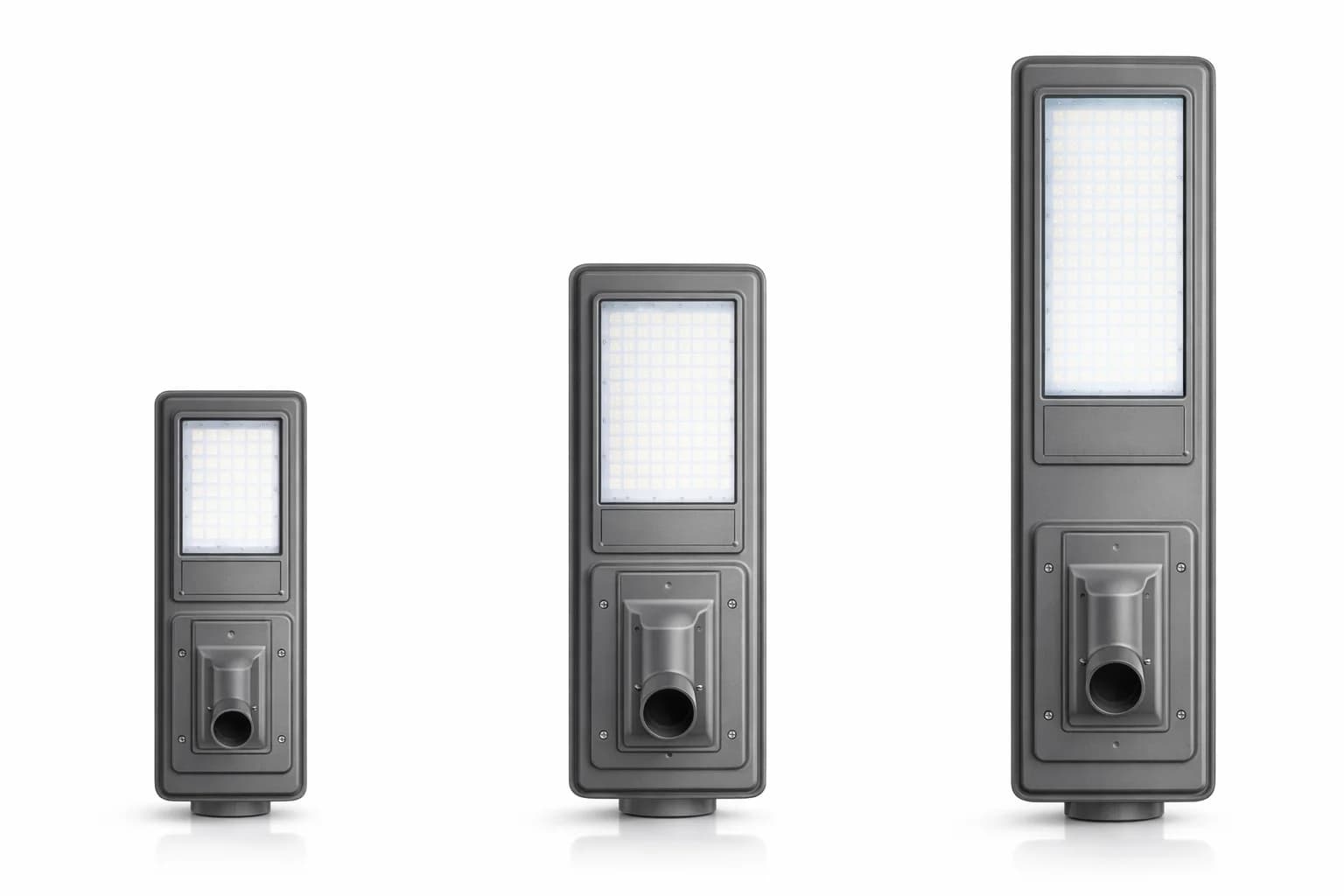
An integrated solar street light packs every component — monocrystalline solar panel, LiFePO4 battery, LED module, and MPPT charge controller — into a single sealed housing. The unit mounts to a pole with one bracket. No external cables. No separate battery box. No panel arm. One object, one connection point, done.
The solar panel forms the top surface of the housing, angled to capture sunlight. The battery sits beneath the panel inside the enclosure. The LED array points downward. The controller manages charging, discharge, and lighting modes. Everything communicates internally through PCB traces, not external wiring.
Split-Type (Separated) Solar Street Light
A split type solar street light separates the solar panel from the light/battery unit. The panel mounts on its own arm or on the pole top at whatever angle maximizes solar harvest. A weatherproof cable (typically 3-5 meters) runs from the panel down the pole to the battery enclosure. The battery may sit inside the LED head, in a separate box mounted mid-pole, or in an enclosure at the pole base.
This separation allows each component to be sized independently. The panel can be as large as the mounting structure supports. The battery can be as heavy as the pole base can handle. The LED head can be positioned for optimal light distribution without worrying about panel orientation.
Head-to-Head: 10 Factors That Actually Matter
The solar street light design comparison below draws from our production records, field installation logs, and three years of warranty claim data. Where we cite numbers, they come from our own deployments and documented customer reports.
| Factor | All-in-One (BF-SSL Series) | Split-Type (BF-SSL-ST Series) |
|---|---|---|
| Installation time | 10-15 min per unit | 30-45 min per unit |
| Cable theft risk | Zero — no exposed cables | High — cable between panel and battery |
| Maintenance approach | Replace entire unit | Can replace individual components |
| Panel and battery ceiling | Bounded by what one sealed housing can carry | Each component sized independently |
| Wind resistance | Single-body aerodynamics | Panel acts as wind sail |
| Aesthetics | Clean, modern, single profile | Multiple components visible on pole |
| Unit cost | Lower (fewer parts, simpler assembly) | Higher (more components, more labor) |
| Upgradability | Replace whole unit to upgrade | Can upgrade battery or panel separately |
| Weight distribution | All weight concentrated at pole top | Can be distributed (battery at base) |
| Heat dissipation | Panel covers battery — heat buildup concern | Separated — better thermal performance |
Each of these factors deserves explanation, because the table alone does not capture the engineering tradeoffs.
Installation: 15 Minutes vs. 45
This is the integrated design's clearest advantage, and on volume projects it is often the deciding one.
Our data from 500+ deployments: 15-minute average per unit. One worker. One wrench. Unbolt from the shipping frame, lift onto the pole bracket, tighten four bolts, confirm power-on. No cable routing, no connector crimping, no panel angle adjustment.
Split-type installation requires mounting the panel (adjusting tilt for latitude), routing cable through the pole, making electrical connections, weatherproofing every junction, and system testing. A competent two-person crew: 30-45 minutes. An inexperienced crew in a rural deployment zone: 45-60 minutes, with wiring mistakes that surface as failures weeks later.
For a 200-unit village deployment: all-in-one requires 50 person-hours, split-type requires 100-200. When deploying solar street lights under a government tender with a fixed deadline, installation speed is a project survival metric.
Cable Theft: Where the All-in-One Has No Exposure
In Sub-Saharan Africa, the Middle East, and South Asia, copper cable theft is a serious operational risk. Split-type systems expose 3-5 meters of cable between panel and battery — visible, accessible with basic tools, and worth money at a scrap dealer.
An all-in-one unit has no external cables. Stealing components means unbolting the entire fixture, which requires tools, a ladder, and conspicuous effort. Our field data from West African deployments: zero cable-related failures in all-in-one installations vs. 8-12% annual cable theft rates reported by customers who previously used split-type in the same regions.
If your project has any cable theft history, all-in-one eliminates this risk category entirely.
Maintenance: Simplicity vs. Granularity
Here is where we acknowledge a genuine split-type advantage. When a specific component fails in a split system — a degraded battery, a cracked panel, a failed LED driver — you can replace that one component without touching the rest. A battery swap takes 20 minutes. A panel replacement takes 15. The cost is the cost of one component.
When a component fails in an all-in-one unit, the practical reality is that the entire unit comes down. You can open the sealed enclosure and replace internal components, but it requires trained personnel, resealing to maintain IP65 protection, and retesting. Most project operators find it faster and more reliable to swap the entire unit and refurbish the failed one at a workshop.
However — and this is critical — the failure frequency is not the same. Our warranty data shows all-in-one units generate 15-20% fewer claims overall. The dominant reason: no external cable connections. In split-type systems, cables and connectors account for roughly 30% of all field failures — water ingress through degraded seals, connector corrosion, physical damage from wind-induced movement, and installation wiring errors. These failure modes do not exist in the integrated design.
The maintenance tradeoff: split-type is cheaper per repair incident, but all-in-one has fewer incidents. For most B2B projects, fewer failures beats cheaper repairs.
Maximum Wattage: Where Split-Type Wins Clearly
This is the design envelope of the all-in-one form factor. Physics imposes hard limits on how much solar panel area, battery capacity, and LED power you can fit into a single aerodynamic housing that a standard pole can support.
Our largest all-in-one models top out at a 135W solar panel, which is what a single-body housing can carry on a standard pole. Going beyond that requires a larger panel surface — increasing wind load and weight past practical limits for an integrated unit — or compromising on runtime.
Split-type systems break this constraint entirely. Because the panel is separate, it can be sized to whatever the mounting structure supports, and the battery can sit in a ground-level enclosure with far more capacity than any lamp housing allows. Well-designed split systems reach output and autonomy figures that no integrated housing can match.
The practical boundary: once a project needs a panel or a battery larger than one sealed housing can carry, the split-type design is not just preferable — it is necessary. The integrated form factor cannot deliver that much solar harvest and storage without unacceptable compromises in wind resistance or runtime.
Wind Resistance: Aerodynamics vs. Sail Effect
An integrated solar street light presents a single streamlined profile. Our wind tunnel testing: BF-SSL-22 Series withstands sustained 150 km/h winds without structural concern.
A split-type system mounts a flat panel perpendicular to the pole — essentially a sail. A typical 40W split panel adds 0.3-0.5 square meters of wind-catching area, creating lateral loads that demand heavier poles or reinforced brackets. In typhoon zones, coastal regions, or high-altitude sites, this becomes a structural liability.
For moderate wind climates, both designs work fine. For exposed locations with sustained winds above 80 km/h, all-in-one has a measurable advantage.
Heat Dissipation: Where Split-Type Has the Physics Advantage
Heat management in a single housing is an engineering constraint of the all-in-one architecture, and it is where our thermal design work goes.
In an integrated unit, the solar panel sits directly on top of the battery compartment. The panel reaches 60-70 degrees C under direct tropical sun. The LiFePO4 battery underneath receives conducted heat from the panel and generates its own heat during charging. This stacked thermal profile reduces charging efficiency and accelerates long-term capacity degradation.
We mitigate this with thermal insulation layers, ventilated housing design, and intelligent charge rate limiting when temperature exceeds thresholds. Our batteries still achieve 2,000+ full cycles (5-7 years) in tropical climates. But a split-type system — panel in the sun, battery in a shaded enclosure meters away — simply does not face this thermal challenge.
The mechanism is worth spelling out, because it is sharper than "reduced efficiency." Look at the two temperature ranges on any solar street light datasheet: ours read 0-50°C for charging and -20-60°C for discharging. The charging window is the narrower one, and that is a property of the lithium iron phosphate cell rather than a manufacturer's caution — a cell can safely deliver current at temperatures where it can no longer safely accept it. So above roughly 50°C the battery management system does not throttle charging, it stops charging, waits for the pack to cool, and resumes.
Now put that against the shape of a hot summer day. Peak generation and peak pack temperature arrive at the same moment: early afternoon. If the pack has crossed its threshold by then, the system is producing the most power it will make all day at precisely the hours it cannot store any of it. Charging resumes in the evening, into weak low-angle sun. The light then draws down a battery that was filled in the margins of the day rather than at its peak.
That failure does not look like a broken fixture. It looks like lights dimming earlier each week as the season progresses — in the season with the shortest nights and the lightest load, which is why it confuses people. It is also why, in sustained 40°C-plus climates, where the battery sits relative to the collector stops being a detail and becomes a design variable worth asking about.
In extreme heat climates (sustained ambient above 40 degrees C — Arabian Gulf, Saharan Africa, South Asia), the split-type design's thermal separation provides a measurable battery longevity advantage.
Cost: Total Project Economics
The solar street light design comparison on cost requires looking beyond unit price to total installed cost and lifetime cost.
Unit cost: An all-in-one unit costs less to manufacture. Fewer housings, no cable assemblies, no separate panel mounting hardware, simpler assembly process. Our all-in-one models run 15-25% less per unit than comparable split-type systems from other manufacturers.
Installation cost: The all-in-one's advantage. Half the labor time, no electrician, no specialized wiring skills. On a 100-unit project the labor saving alone offsets any per-unit price difference.
Total installed cost: All-in-one saves 20-30% on a typical 100-unit project when you add unit cost savings and installation labor savings together.
Lifetime cost: The split-type's advantage. A failed battery at year 6 in a split system means replacing a $30-50 pack; the same failure in a sealed all-in-one means field service or a unit swap, at a higher cost per incident. Set against that, the integrated design has fewer external connections and generates fewer incidents to begin with.
10-year TCO: Within the output range one sealed housing can carry, our modeling shows all-in-one total cost of ownership is 15-25% lower. Beyond it, split-type TCO becomes competitive because separated components justify the higher installation cost.
For a detailed cost analysis, see our solar street light cost guide.
When to Choose All-in-One
Choose the integrated solar street light design when your project meets these conditions:
- Standard road and street applications. Secondary roads, village paths, residential streets, parking areas, campus walkways — the majority of solar street light projects. Our BF-SSL-20, BF-SSL-21, BF-SSL-22 and BF-SSL-P series span 45-135W solar panel and cover this range completely.
- Security concerns exist. Any location with cable theft history, vandalism risk, or limited security infrastructure benefits from eliminating external cables entirely.
- Fast deployment required. Government tenders with tight timelines, disaster relief lighting, mass rural electrification — any project where 15-minute installation matters.
- Unskilled labor will install. When the installation crew consists of local workers without electrical training, the all-in-one design removes every wiring-related failure mode.
- Budget is constrained. Lower unit cost plus lower installation cost equals the lowest total project cost across the range a single housing covers.
- Pole location receives direct sunlight. When the mounting position has clear sky access, the integrated panel captures sufficient solar energy without needing separate positioning.
When to Choose Split-Type
Choose the split type solar street light design when your project hits these requirements:
- Output beyond what an integrated housing can hold. Highway lighting, major intersections, sports court perimeters, industrial yards — where the panel and battery a project needs are larger than any single sealed housing can carry.
- Extreme heat climate. Regions with sustained ambient above 40 degrees C, where keeping the battery out from directly beneath the solar collector protects charge acceptance through the hottest hours. Our BF-SSL-ST series is the range we point hot-climate buyers to — see the heat dissipation section above for how the 0-50°C charging window behaves through a summer afternoon.
- Component-level maintainability is a priority. Organizations with established maintenance teams and spare parts inventory that can service individual components efficiently.
- Mounting position is shaded. When the ideal light position is under tree canopy or building overhang but nearby areas receive full sun, a split panel on an extended arm solves the orientation problem.
- Custom configurations required. Projects needing non-standard panel angles, oversized battery banks, or specialized LED optics that cannot be accommodated in a standard integrated housing.
- Weight distribution matters. Very tall poles (10m+) where concentrating all weight at the top creates excessive moment forces — split-type allows relocating the battery to a lower mount point.
Both Architectures, In Our Range
We started with the integrated design and it remains the larger part of our output, because most of what buyers ask us for lands squarely in its strengths: secondary roads, village paths, residential compounds, campus and parking lighting, deployed in volume, installed by general crews, often in places where an exposed cable is a liability.
We added the split-type range for the projects that ask the other set of questions — where the panel has to face a different direction than the light, where the mounting position is partly shaded, or where sustained summer heat around the battery is the constraint that decides year three.
- All-in-One Solar Street Lights — BF-SSL-20/21/22/P, 45-135W solar panel. Fastest to install, no external cable, lowest installed cost.
- Split Solar Street Lights — BF-SSL-ST, 40-100W solar panel. Independent panel orientation, lamp body out from under the collector.
For model selection, read our how to choose a solar street light guide. For cost planning, see the solar street light cost guide.