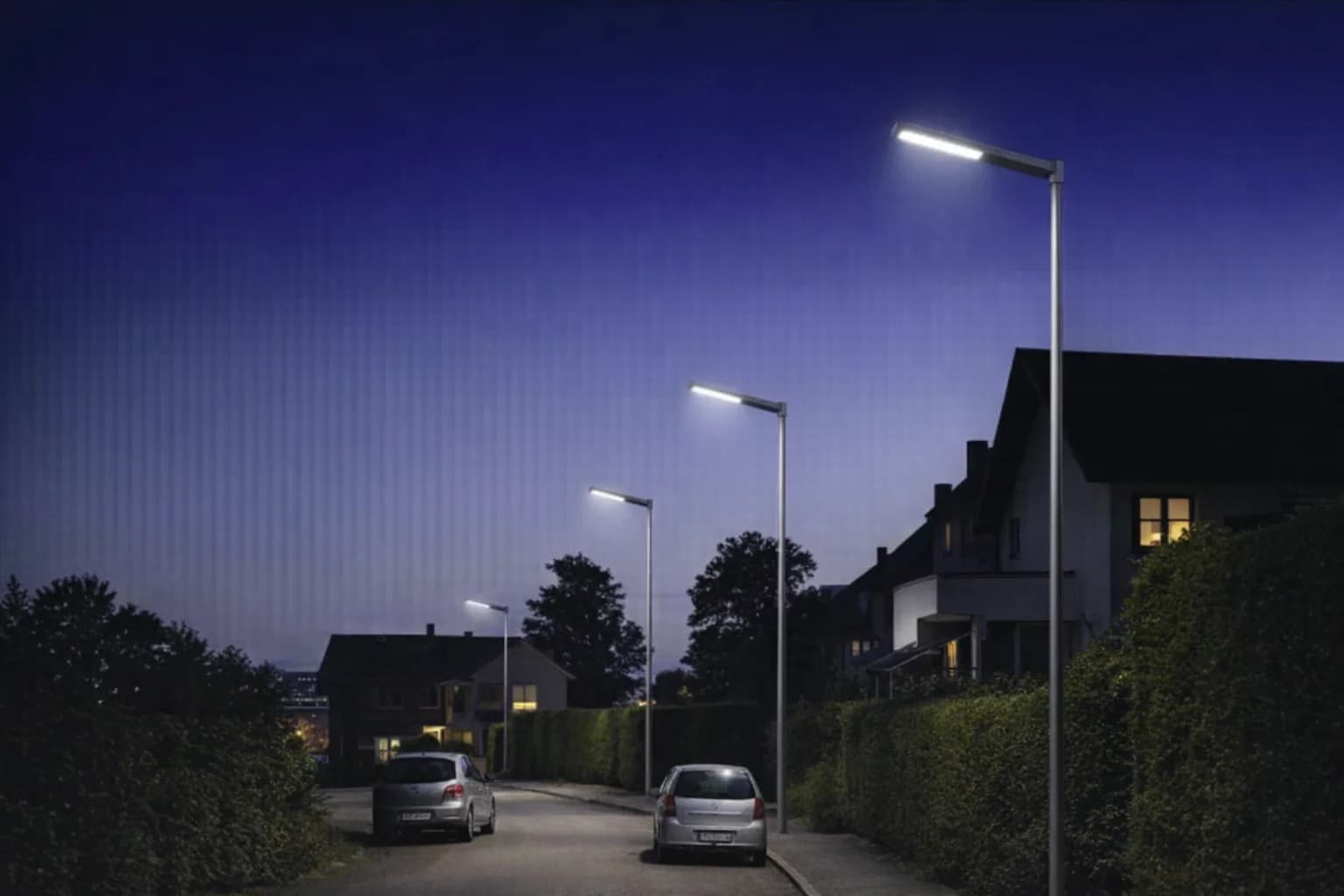
Ask five suppliers for a "40W solar street light" and you will get five different products. Not because anyone is lying, but because a solar street light has two wattages, and the industry has never agreed on which one goes on the label.
This article explains what each number means, how to translate between them, and why the most useful way to size a fixture does not involve wattage at all.
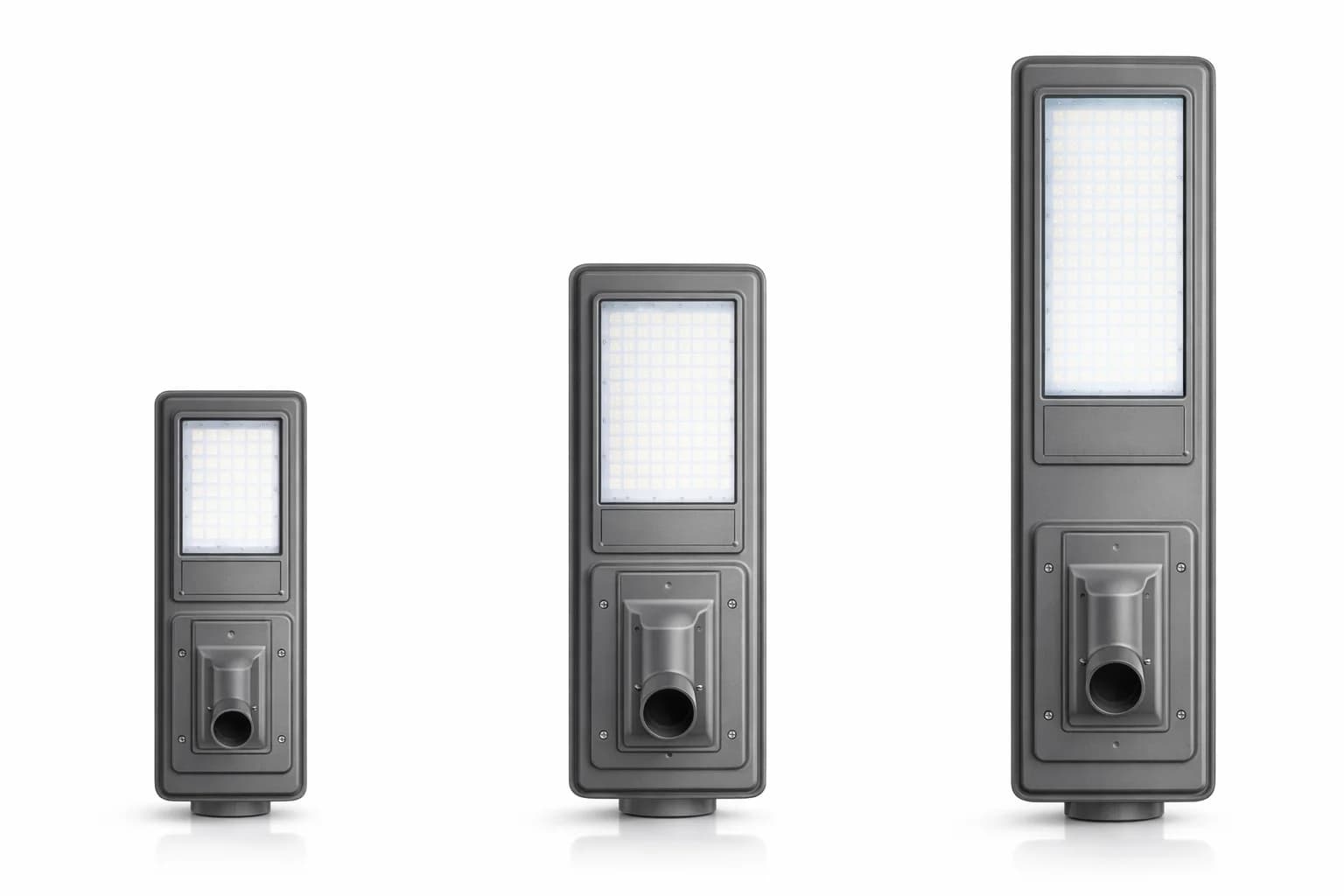
Two Wattages, One Fixture
A grid-powered street light has one wattage: what the LED draws. A solar street light has two.
LED wattage is the power the light source consumes. It is the number that relates to brightness — more or less, depending on how efficient the chips are.
Solar panel wattage is the peak output of the photovoltaic panel bolted to the fixture. It has nothing to do with brightness. It determines how fast the battery refills and how much margin you have on an overcast day.
The two are not interchangeable, and they are not proportional in any fixed ratio. A 65W panel might sit above a 20W LED on one model and a different LED on another.
Most of the solar lighting industry labels products by panel wattage. That is the convention we follow: BF-SSL-20-65W means a 65W solar panel. Some suppliers label by LED wattage instead. Neither is wrong — but if you compare a panel-labelled 65W fixture against an LED-labelled 40W fixture, you are comparing two different measurements and the conclusion will be nonsense.
The first question to ask any supplier is not "how many watts" but "watts of what".
Translation Table: the Number You Searched For, and Ours
If you arrived here searching for a wattage, this table maps it to our range. Every figure is a row in the spec table on our solar street light product page.
| If you are shopping for | Our model | Solar panel | LED | Lumens | Recommended height |
|---|---|---|---|---|---|
| a 12W solar street light | BF-SSL-20-45W | 45W | 12W | 2,280 lm | 4 m |
| a 20W solar street light | BF-SSL-20-65W | 65W | 20W | 3,800 lm | 6 m |
| a 20W solar street light (wide beam) | BF-SSL-21-65W | 65W | 20W | 3,800 lm | 6 m |
| a 30W solar street light | BF-SSL-20-90W | 90W | 30W | 5,700 lm | 8 m |
| a 30W solar street light (wide beam) | BF-SSL-21-90W | 90W | 30W | 5,700 lm | 7 m |
| a 35W solar street light | BF-SSL-21-120W | 120W | 35W | 6,650 lm | 8 m |
| a 40W solar street light | BF-SSL-22-120W | 120W | 40W | 7,600 lm | 9 m |
Two things worth noticing in that table.
The same lumen figure can mean very different coverage. BF-SSL-20-65W, BF-SSL-21-65W and BF-SSL-22-60W all run a 20W LED rated at 3,800 lumens. Their recommended pole spacings are 22 m, 15 m and 15 m. The reason is the beam: the BF-SSL-21 head spreads its light wider across the pole line, which puts more of it on the verge and the footway and less of it far down the road — so the poles have to sit closer together. The BF-SSL-20 head throws the same lumens further along the carriageway and reaches 22 m. Same light on paper, seven metres of difference on the road, and no wattage figure on any datasheet will show it to you.
Our high-power BF-SSL-P Series is not in the table. It runs 65W to 135W panels with 4,750 to 9,500 lumens for 6-10 m poles. The factory has not given us a per-model LED figure for that series, so we are not going to invent one.
Sizing Without Wattage: Pole Height and Road Width
Wattage is an input. What you actually need to know is whether the light reaches the road and how many poles you have to buy. Two numbers answer both, and both are on our spec tables.
Recommended height is the mounting height the factory specifies for each SKU. Recommended spacing is how far apart poles of that model should sit.
| Application | Pole height | Model | Recommended spacing |
|---|---|---|---|
| Residential pathway, park walkway | 4 m | BF-SSL-20-45W | 15 m |
| Village street, secondary road | 6 m | BF-SSL-20-65W | 22 m |
| Secondary road, wider spread | 6 m | BF-SSL-21-65W / BF-SSL-22-60W | 15 m |
| Compound road, small parking area | 7 m | BF-SSL-21-90W / BF-SSL-22-80W | 20 m |
| Main road | 8 m | BF-SSL-20-90W | 28 m |
| Main road, wider spread | 8 m | BF-SSL-21-120W | 25 m |
| Main road, large parking lot | 9 m | BF-SSL-22-120W | 32 m |
A rough sanity rule while you are still planning: pole height should be somewhere near road width. A 6 m carriageway gets 6 m poles. Under 6 m wide, one row of poles on a single side is usually enough. Over 10 m, you are into staggered poles on both sides, and each side only has to cover half the width.
If you would rather answer three questions than read a table, the Wattage Selector does the same job interactively.
Counting Poles
Fixture count falls straight out of the spacing figure:
Poles = road length ÷ recommended spacing
A 500 m road with BF-SSL-20-65W at 22 m spacing needs about 23 poles. The same road with BF-SSL-22-120W at 32 m spacing needs about 16. That gap — seven poles, plus seven foundations and seven installation crew-hours — is usually a bigger line item than the price difference between the two fixtures.
This is the real cost lever in wattage selection, and it runs opposite to intuition: the more expensive fixture can be the cheaper project. Our cost guide breaks down where the money actually goes.
The Mistake: Treating Panel Wattage as a Brightness Rating
Now that the site labels by panel wattage, there is a new way to get this wrong: assuming a 120W model is twice as bright as a 60W model.
It is not. Lumens come from the LED module. Compare BF-SSL-22-60W (60W panel, 3,800 lm) with BF-SSL-22-120W (120W panel, 7,600 lm) — panel doubles, lumens roughly double, so far so good. Now compare BF-SSL-21-120W (120W panel, 6,650 lm) with BF-SSL-22-120W (120W panel, 7,600 lm). Identical panel, 14 percent more light from one of them — because the LED behind it is 40W rather than 35W.
What a bigger panel actually buys you is faster recharge and more headroom on cloudy days. That matters — in a monsoon region it may matter more than lumens. But it is a different property, and reading it as brightness will get you the wrong fixture.
The panel is sized to the LED and the dimming schedule. That pairing is the engineering; the number on the label is just a name.
Parking Lots: a Different Shape of Problem
Roads are linear, so you space poles along a line. A parking lot is an area, so you are laying out a grid — and the question stops being "what wattage" and becomes "how many poles, how far apart".
On 7-9 m poles, two models cover most parking projects:
- BF-SSL-22-80W — 80W panel, 5,700 lm, 7 m pole, 20 m spacing. Suits small to mid lots and compound parking.
- BF-SSL-22-120W — 120W panel, 7,600 lm, 9 m pole, 32 m spacing. The widest spacing in our range, which means the fewest poles across a large open surface.
Take the lot's long and short dimensions, divide each by the recommended spacing, and you have a pole grid. Perimeter-only layouts leave the middle of the lot dark, so run at least one interior row on anything wider than about 40 m.
Our parking lot solar lighting page has a worked layout and the questions worth asking before you commit to a pole count.
What Our Spec Tables Carry
Every SKU on the product page lists the same rows, and every number in this article came from one of them:
- Solar panel power — what the panel generates, and the number in our model names
- Luminous flux — the lumen rating of the LED module
- Battery capacity — Wh, which sets how much charge is banked for a cloudy stretch
- Recommended height and recommended spacing — the factory's mounting figures, and the two numbers that actually decide your pole count
- LED chip type and count — 3030 or 5054, with the pieces per fixture
Runtime in hours is not among them, and that is deliberate: it swings with latitude, season, and how the installer sets the dimming schedule. Ask any supplier quoting a single runtime figure which of those three they assumed.
For the seven specs worth verifying before you place an order — with any supplier — see how to choose a solar street light.