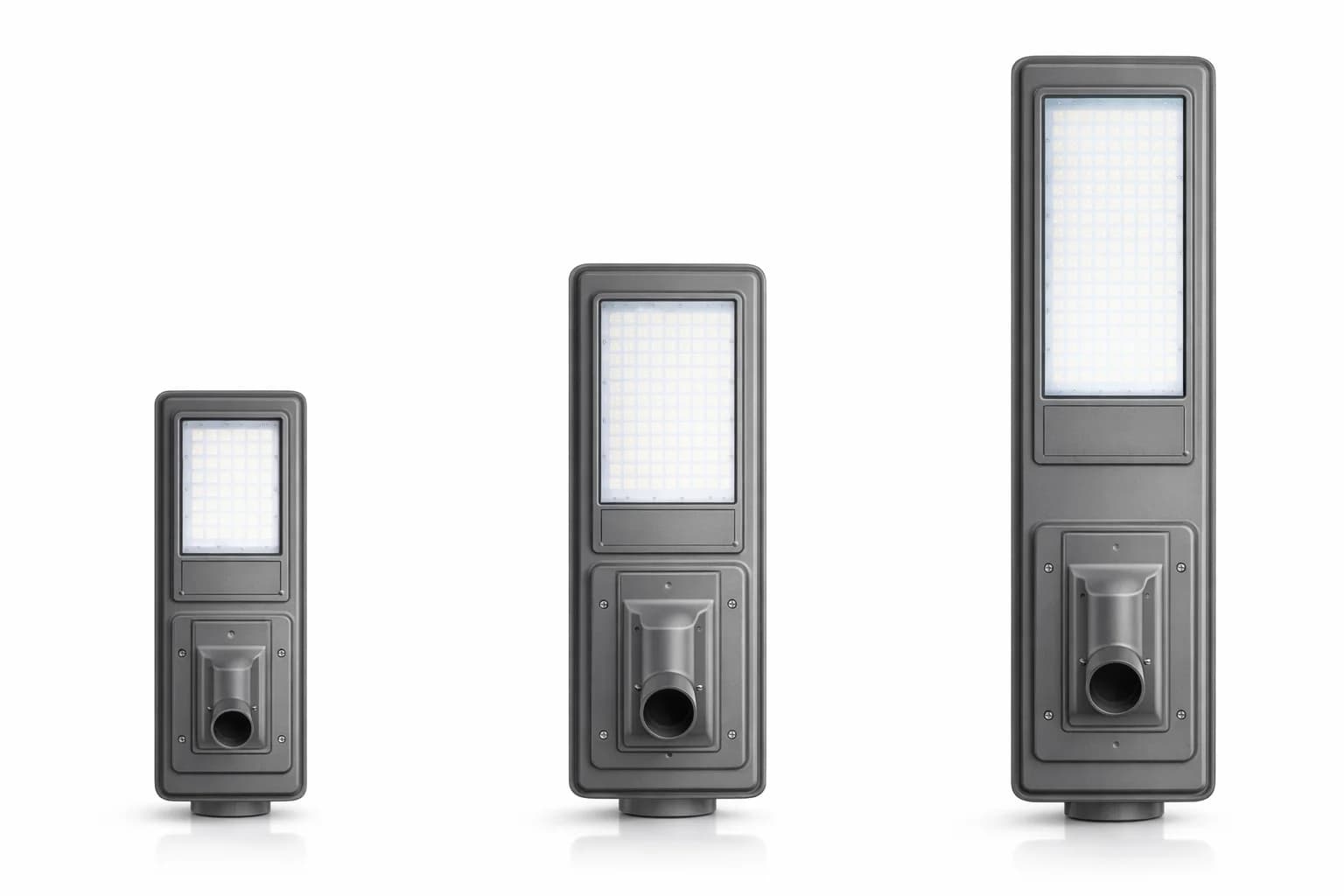
Highway lighting is a life-safety system. At 80-120 km/h, a driver has 1-3 seconds to react to road hazards — and reaction depends entirely on visibility. Insufficient or inconsistent lighting across highway corridors directly correlates with nighttime accident rates.
The traditional solution — kilometers of underground cabling, transformer stations, and grid-powered fixtures — costs $15,000-25,000 per kilometer to install before electricity bills begin. For remote highway segments through deserts, mountains, or developing regions, the grid simply does not reach.
We manufacture solar highway lights that eliminate cabling entirely. Each pole is self-powered: mount it, and it works. We have supplied highway and road lighting systems across 30+ countries, from coastal expressways in Southeast Asia to highland corridors in East Africa. This page covers exactly how to light your highway with solar: which fixtures, what spacing, at what height, and how it compares to grid power per kilometer.
Why Highway Lighting Is an Engineering Problem, Not a Shopping Problem
Highways are not parking lots or village roads. They present a unique set of engineering constraints that most solar lighting suppliers cannot solve:
Driver Visibility at High Speed
At 100 km/h, a vehicle covers 28 meters per second. A driver needs to identify road hazards — vehicles, pedestrians, debris, lane merges — from at least 100 meters ahead. This requires not just brightness, but uniform illumination across the full road width with controlled glare. Dark patches between poorly spaced fixtures create dangerous adaptation zones where the eye cannot adjust quickly enough.
Extreme Wind Loads at Height
Highway lights sit on 8-12m poles in open, unsheltered corridors — exactly where wind loads are highest. A fixture that works fine on a 5m garden pole becomes a structural liability at 10m on an exposed highway median. Every component — fixture housing, panel mounting, pole wall thickness, foundation anchor bolts — must be engineered for robust wind resistance .
Continuous Multi-Kilometer Deployment
A highway project is not 10 fixtures in a parking lot. It is 35-70 fixtures per kilometer, stretching across 5, 10, or 50 kilometers. This scale demands consistent quality across every unit, reliable supply chain logistics, phased delivery schedules, and factory-level quality control with batch traceability.
Median and Shoulder Requirements
Modern highway standards require illumination on both the main carriageway and critical zones: median barriers, entry/exit ramps, merge lanes, and shoulders. Each zone has different optical requirements — Type II distribution for straight road segments, Type III distribution for wider coverage at interchanges. A single fixture model rarely covers all zones optimally.
Critical Infrastructure Autonomy
Highway lighting cannot afford blackouts. A string of dark fixtures on an expressway at 2 AM is a safety emergency, not an inconvenience. Battery autonomy must cover 5+ consecutive rainy days at full brightness, not the 2-3 days acceptable for residential or commercial installations.
How We Solve It: Engineered Solar Fixtures for Road-Grade Deployment
Every Beamfact highway solar fixture is an all-in-one system: high-efficiency monocrystalline solar panel, oversized LiFePO4 battery bank, MPPT charge controller, and commercial-grade LED module with road-specific optics. The all-in-one design integrates all components on a single pole — reducing wind surface area at the pole top and allowing each component to be optimally angled.
Road-Specific Optical Engineering
We use Type II and Type III IES optical distributions designed specifically for road surface coverage:
- Type II: Medium lateral throw for straight road segments — projects light across the road width with controlled cutoff to prevent driver glare
- Type III: Wide forward throw for interchanges, ramps, and junctions — covers broader areas where vehicles change direction
Both distributions are engineered to maximize road surface illuminance while minimizing upward light waste and oncoming driver glare (TI < 15% per CIE 115).
Wind-Rated Structure
Every highway installation receives a structural specification matched to local wind zone data:
| Component | Specification |
|---|---|
| Fixture Housing | Die-cast aluminum, robust wind rated |
| Solar Panel Mount | Adjustable tilt bracket, stainless steel hardware |
| Pole | Hot-dip galvanized steel, 3.5-4.0mm wall thickness |
| Foundation | Reinforced concrete cage, anchor bolt sizing per wind zone |
| Overall Windage | Minimized by all-in-one integrated design |
Intelligent Highway Dimming Profile
Highway traffic is not constant. Our MPPT controller runs a traffic-adaptive dimming profile that extends battery life by 30-40% without compromising safety:
| Time Period | Mode | Output | Rationale |
|---|---|---|---|
| Sunset - Midnight | Full Power | 100% | Peak traffic volume |
| Midnight - 5 AM | Economy | 60-70% | Reduced traffic, maintain CIE minimum |
| 5 AM - Sunrise | Full Power | 100% | Morning commuter ramp-up |
Even in economy mode, output remains above CIE 115 minimum requirements for the road class. The profile is configurable per project based on local traffic patterns.
Recommended Configurations by Road Type
We have standardized three highway configurations based on road classification. Each has been validated in real deployments and designed to meet CIE 115 / EN 13201 standards.
Secondary Road (6-7m width, 60-80 km/h)
| Parameter | Specification |
|---|---|
| Recommended Fixture | BF-SSL-21-90W |
| Luminous Output | 5,700 LM per unit |
| Optical Distribution | Type II |
| Mounting Height | 8M |
| Pole Spacing | 25-30M (single side) |
| Fixtures per km | 34-40 units |
| Achieved Lux Level | 12-15 lux average |
| Battery Autonomy | 5 rainy days |
| Estimated Cost per km | $13,600 - $20,000 |
| Installation Time per km | 3-4 days (2 crews) |
Primary Highway (10-14m width, 80-100 km/h)
| Parameter | Specification |
|---|---|
| Recommended Fixture | BF-SSL-22-120W |
| Luminous Output | 7,600 LM per unit |
| Optical Distribution | Type II + Type III (mixed) |
| Mounting Height | 9-10M |
| Pole Spacing | 30-35M (bilateral staggered) |
| Fixtures per km | 58-68 units (both sides) |
| Achieved Lux Level | 15-20 lux average |
| Battery Autonomy | 5-7 rainy days |
| Estimated Cost per km | $34,800 - $47,600 |
| Installation Time per km | 5-7 days (2-3 crews) |
Expressway Interchange (multi-lane, 100-120 km/h)
| Parameter | Specification |
|---|---|
| Recommended Fixture | BF-SSL-22-120W (main) + BF-SSL-22-120W (ramp) |
| Luminous Output | 7,600 LM (main) + 7,600 LM (ramp) |
| Optical Distribution | Type III (interchange) + Type II (ramp) |
| Mounting Height | 10-12M (main) + 8-9M (ramp) |
| Pole Spacing | 25-30M (staggered bilateral) |
| Fixtures per Interchange | 40-80 units (depending on complexity) |
| Achieved Lux Level | 20-30 lux average (transition zones) |
| Battery Autonomy | 5-7 rainy days |
| Estimated Cost per Interchange | $24,000 - $56,000 |
| Installation Time | 5-10 days (3 crews) |
All configurations include LiFePO4 batteries with highway-grade autonomy and hot-dip galvanized steel poles with reinforced foundations.
Need a road lighting specification? Send us your road cross-section, corridor length, and location, and we will provide a complete photometric design: fixture positions, lux distribution map, uniformity ratio, and CIE compliance verification — all within 72 hours. Get your road lighting specification.
Performance Data and Certifications
We track field performance from our highway installations to continuously validate our design specifications.
From our road lighting deployments:
- Average maintained illuminance: 13.8 - 19.5 lux (measured 12 months post-install across multiple road classes)
- Uniformity ratio (Emin/Eavg): 0.35 - 0.45 (within CIE 115 requirements)
- Battery health after 2 years: 91-95% original capacity
- Zero-blackout rate across all installations with 5+ day autonomy configuration
- Fixture survival rate in typhoon/cyclone events: 100% (robust wind rated rated units)
Certifications for highway applications:
- CE (European Conformity)
- IP65 (BF-SSL-21 Series / BF-SSL-22 Series — full weather and dust protection)
- RoHS (Environmental Compliance)
- UN38.3 (Battery Transport Safety)
- ISO 9001 (Quality management system)
- ISO 14001 (Environmental management system)
We provide all test reports, IES photometric files, and certification documents with your quotation. For projects requiring specific national standards compliance, we supply customized documentation packages.
For factory quality assessment methodology, see: 9-Point Quality Checklist for Buying Solar Lights from China.
Cost Comparison: Solar vs Grid-Powered Highway Lighting (per 1 km)
We calculated total cost of ownership for a typical 1 km two-lane primary road with bilateral lighting (approximately 60 fixtures):
| Cost Item | Grid-Powered | Solar (Ours) |
|---|---|---|
| Fixtures (60 units) | $6,000 - $9,000 | $36,000 - $42,000 |
| Poles + Foundations (60 units) | $12,000 - $18,000 | $12,000 - $18,000 |
| Trenching + Cabling (1 km) | $8,000 - $15,000 | $0 |
| Transformer Station | $3,000 - $5,000 | $0 |
| Electrician + Permits | $2,000 - $4,000 | $0 |
| Installation Labor | $4,000 - $6,000 | $3,000 - $5,000 |
| Upfront Total | $35,000 - $57,000 | $51,000 - $65,000 |
| Electricity (per year) | $2,400 - $4,800 | $0 |
| Maintenance (per year) | $1,200 - $2,400 | $400 - $800 |
| 5-Year Running Cost | $18,000 - $36,000 | $2,000 - $4,000 |
| 5-Year Grand Total | $53,000 - $93,000 | $53,000 - $69,000 |
| 10-Year Grand Total | $71,000 - $129,000 | $55,000 - $73,000 |
Verdict: Solar fixtures cost more upfront per unit, but eliminate cabling, trenching, transformer, and electrician costs. At the 5-year mark, solar matches grid on total cost. By year 10, solar saves $16,000-$56,000 per kilometer. For remote highway segments where grid extension exceeds $8,000-15,000 per km, the upfront cost equation flips immediately — solar is cheaper from day one.
The economics become overwhelming at scale: a 20 km highway corridor saves $320,000-$1,120,000 over 10 years with solar versus grid.
For a detailed breakdown of solar fixture component costs, read: Solar Street Light Cost Breakdown: From BOM to FOB Price.
Get Your Road Lighting Specification
Tell us your road parameters and we will deliver a complete highway lighting specification:
- Photometric layout — fixture positions on your road cross-section and corridor plan
- Lux distribution map — illumination levels across every lane, shoulder, and median
- CIE 115 / EN 13201 compliance report — verifying your design meets road lighting standards
- Wind load calculation — pole and foundation sizing for your local wind zone
- Budget estimate — fixtures, poles, foundations, shipping, and total project cost per kilometer
Ready to start?
- Send us your road parameters (cross-section, corridor length, location, wind zone) for a custom specification (response within 72 hours)