

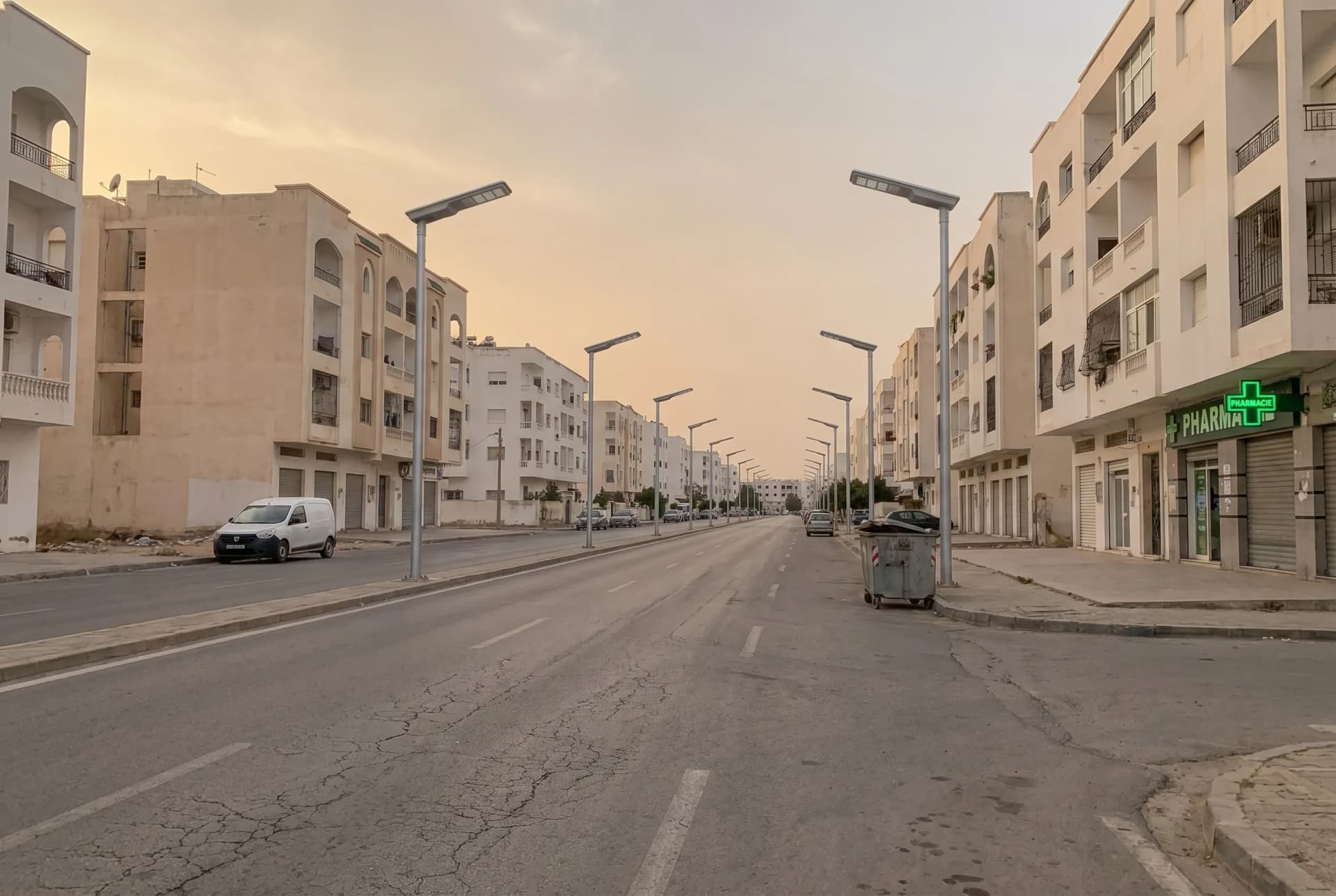
Project Overview
A municipal development authority in Algiers was upgrading a 5km secondary urban road in the city's new district. The road connects residential zones to commercial areas and carries significant pedestrian and vehicle traffic — but had either no lighting or aging, non-functional fixtures across most of its length. Grid electricity supply in the area was unreliable, with scheduled power cuts during peak demand periods regularly leaving the road dark at night.
The project required 201 solar street lights — one every 25 meters along the full 5km stretch — capable of operating independently from the grid. The authority needed a solution that could be installed quickly to minimize road disruption, and one that eliminated the ongoing electricity and maintenance costs that made their grid-connected lighting financially unsustainable.
We delivered all 201 units. Our 6-person installation crew completed the entire 5km deployment in 5 days.
The Challenge
Algeria's urban infrastructure faces a specific set of pressures that compound each other:
Chronic grid overload.
- Industrial and residential electricity demand has outpaced generation capacity.
- Municipal street lighting is routinely deprioritized during peak load — the lights go dark precisely when traffic needs them most: at night.
- The client's existing grid-connected fixtures on adjacent roads experience multiple outages per month during summer peak periods.
Missing or deteriorated infrastructure.
- The 5km road section had been developed with minimal lighting investment. Some stretches had no fixtures at all.
- Where fixtures existed, many were inoperative — corroded mounts, failed ballasts, disconnected cabling.
- Pedestrian visibility at night was critically poor, creating direct safety hazards for both foot traffic and vehicles.
Prohibitive grid connection costs.
- Running new underground power cables along 5km of developed urban road meant trenching through existing pavement, navigating around buried utilities, installing transformer stations, and coordinating permits with multiple agencies.
- The civil works estimate exceeded the budget for the lighting fixtures themselves — and would require months of disruptive road construction.
North African climate demands.
- Algiers receives strong solar irradiance averaging 5.0 peak sun hours daily — excellent for solar energy harvest.
- But the Mediterranean climate also brings salt-laden coastal air, summer temperatures above 40 degrees Celsius, and occasional sandstorms from the Sahara.
- Any lighting system deployed here must withstand these conditions year-round without degradation.
Our Solution: BF-SSL-21 Series 120W — Road-Grade High-Output
We selected the BF-SSL-21 Series 120W solar street light for this deployment. The BF-SSL-21 Series is our road-grade workhorse: 180 pieces of 3030 LED chips delivering 6,650 lumens per unit, paired with a 120W monocrystalline panel and 384Wh LiFePO4 battery. At 8m mounting height with 25m spacing, this configuration provides continuous illumination across a full 5km secondary urban road with no dark gaps.
Why 120W over lower wattage options? Urban secondary roads demand higher illuminance than parking lots or village paths. The 6,650 lm output from 180 LED chips at 8m height delivers the ground-level lux required for mixed vehicle and pedestrian traffic. Our lower-wattage BF-SSL-21 variants provide adequate coverage for area lighting, but a 5km road with 25m spacing needs the sustained output and larger battery reserve that the 120W configuration provides — particularly for maintaining full brightness during shorter winter charge days in North Africa.
Technical Parameters
| Parameter | Value |
|---|---|
| Fixture Model | BF-SSL-21-120W |
| Quantity | 201 units |
| Solar Panel | 120W monocrystalline per unit |
| Luminous Flux | 6,650 lm per unit |
| LED Configuration | 3030 chips x 180 |
| Battery | 3.2V / 384Wh LiFePO4 |
| Control Mode | Light sensor + programmable timer |
| Mounting Height | 8m |
| Pole Spacing | 25m |
| Road Coverage | 5,000m (5km) |
| Fixture Dimensions | 1,528 x 400 x 187 mm |
| Installation Crew | 6 workers |
| Installation Time | 5 days |
Installation
Total installation time: 5 days from first pole to last fixture powered on. Six workers.
Logistics: We shipped all 201 units in 3 standard 40-foot high-cube containers — approximately 67 units per container.
- Solar panels — packed vertically with foam separators.
- Fixtures and mounting hardware — reinforced cartons with impact cushioning.
- Poles — wrapped in protective film.
- Small components (controllers, fasteners, anchor bolts) — consolidated into dedicated hardware boxes within each container.
- Container sequencing — packed to match the installation sequence: the first container off-loaded at the road's starting point, the last at the far end, eliminating back-and-forth logistics.
Installation process:
-
Site survey and staking — Survey crew walked the full 5km route, marked 201 pole positions at 25m intervals, identified underground utilities and obstructions, and produced a final installation drawing.
-
Foundation construction — Reinforced concrete foundations poured for each pole position with embedded anchor bolts. Foundation dimensions calculated for 8m pole wind-load specifications.
-
Pre-assembly and testing — All fixtures assembled and tested at a staging area near the road:
- Solar panels connected to controllers
- Batteries wired
- Charge/discharge cycles verified
- Light-sensing and timer modes confirmed
- Every unit verified operational before field installation — eliminating rework on a 5km linear site where revisiting a failed unit means driving back along the road
-
Pole erection and fixture mounting — 6-person crew divided into sub-teams:
- Foundation prep
- Pole lifting
- Fixture attachment
- Cable connection
- Poles verified for vertical alignment; all fasteners torqued to specification
-
Full-system commissioning — All 201 units activated for a full-night test run. Light output verified at multiple points along the 5km route. Auto on/off confirmed. Zero units required rework.
The 5-day completion compares to an estimated 3-4 months for equivalent grid-connected lighting — accounting for cable trenching, transformer installation, grid connection permits, and pavement restoration.
Results
Road safety:
- Full 5km coverage — Zero blind spots. 201 fixtures at 25m intervals provide continuous illumination across the entire road section, meeting urban secondary road standards for mixed pedestrian and vehicle traffic.
- 6,650 lm per fixture — Uniform brightness along the entire route.
- Automatic operation — Light sensor activates at dusk, timer controls dimming schedule. Zero manual intervention.
Grid independence:
- Zero electricity cost — 201 units operating entirely on solar power. No grid connection at any point along the 5km route.
- Zero outage risk — Unlike adjacent grid-connected roads, this section maintains full illumination regardless of grid load or scheduled power cuts.
Financial impact:
- 73,365 kWh annual electricity eliminated — Equivalent grid consumption for 201 fixtures at 100W running 10 hours nightly. At typical commercial electricity rates, this translates to $7,000-11,000 in annual savings depending on local tariff.
- Maintenance cost reduced by over 90% — No cable inspections, no transformer servicing, no electrical fault repairs. Only periodic solar panel cleaning required. Annual maintenance under $500 versus $2,500-4,000 for equivalent grid infrastructure.
- Projected payback: 3-4 years. After recovery, all electricity and maintenance savings flow directly to the municipal budget.
Logistics efficiency:
- 3 x 40ft HC containers — Full project shipped in a single batch.
- 5-day installation — Minimal road disruption. No trenching, no pavement cuts, no traffic detours.
- 6-person crew — No licensed electricians required.
Environmental:
- 100% clean energy — Zero carbon emissions from lighting operations.
- Zero underground infrastructure — No cables, no conduits, no transformer pads. The road surface remains completely intact.
Engineering Takeaways
This project reinforced several principles specific to large-scale linear deployments:
-
Battery sizing must account for winter charge days. Algiers has meaningful seasonal variation — winter days are shorter and cloudier than summer. The 384Wh LiFePO4 battery in the BF-SSL-21-120W provides sufficient reserve to maintain full-night operation even during the shortest charge days in December and January. Under-sizing the battery for a road project where nightly operation is non-negotiable would create seasonal reliability failures that undermine the entire deployment.
-
Pre-assembly eliminates field failures at scale. Testing every unit at a staging area before installation meant zero rework during the 5-day field deployment. For a 201-unit linear project, pre-assembly testing is not optional — it is the only way to hold a compressed timeline.
-
Container packing strategy directly affects installation speed. We packed the 3 containers to match the installation sequence along the road. Fixtures, poles, and hardware for each road section were grouped together. This kept the installation crew moving forward continuously rather than shuttling materials back and forth — a logistics detail that becomes critical on a 5km deployment.
Start a Similar Project
Planning solar lighting for an urban road, highway, or municipal infrastructure project? We provide free lighting layout design and logistics planning. Share your road dimensions and lighting requirements — our engineering team will recommend the optimal model, quantity, and container configuration within 24 hours.
Browse our complete solar street light range or explore our government project solar lighting solutions for municipal planning guidance. For road-type planning, compare the highway solar lighting, village solar lighting, and rural area solar lighting owners before finalizing fixture quantity and pole spacing.