Picture a food truck park at Saturday lunch rush. Twelve vendors, two hundred customers, the smell of tacos and fresh coffee. Behind one truck, a gas generator roars at 75 decibels — drowning out conversation, pumping exhaust across the picnic tables, heat radiating off the engine housing. The vendor next door has a portable power station on the floor. Zero noise. Zero fumes. Customers never know it is there.
We manufacture portable power stations at our Fujian factory — 1500W and 3000W LiFePO4 units designed specifically for mobile commercial use. Food truck operators, pop-up shop outfitters, and mobile retail equipment suppliers across 30+ countries source these units from us factory-direct. This page covers exactly which model fits which mobile business type, real-world runtime calculations for common equipment, and why battery power is replacing generators in food zones worldwide.
Why Gas Generators Are Becoming Unacceptable for Mobile Food Business
Generators were the only option for decades. That era is ending — not because battery technology suddenly appeared, but because cities, health departments, and customers are all pushing back at the same time.
Exhaust Fumes Near Food Preparation
This is the dealbreaker. A gas generator produces carbon monoxide, nitrogen oxides, and particulate matter — directly beside open food. Health inspectors in cities like Los Angeles, London, and Singapore are increasingly citing food vendors for generator emissions in food preparation zones. Some jurisdictions now explicitly ban combustion generators within 6 meters of food service areas. Your equipment suppliers face a simple question: can this power source legally operate next to food?
Noise Complaints That Limit Operating Locations
A typical portable generator runs at 65-80 dB — louder than a vacuum cleaner, running continuously for 8-12 hours. Residential neighborhoods, hospital zones, school perimeters, and upscale shopping districts enforce noise ordinances of 55-65 dB at property boundaries. Every location a generator cannot go is a market your food truck customer cannot serve. Silent power stations open those locations.
Fuel Cost Eating Into Thin Margins
Food trucks operate on razor-thin margins. A generator burning $15-30 per day in diesel or gasoline adds $4,000-7,500 per year in fuel costs alone — before oil changes, spark plugs, and carburetor maintenance. For a business averaging $500-800 per day in revenue, fuel is 2-5% of gross revenue consumed by the power source alone.
Dirty Power Damaging Sensitive Electronics
Cheap generators produce modified sine wave output with voltage fluctuations and harmonic distortion. POS tablet systems, card readers, digital scales, and LED signage suffer shortened lifespans and intermittent failures. A single POS crash during lunch rush costs more in lost sales and frustrated customers than the price difference between a generator and a power station.
Space and Weight Penalties
A 3000W generator occupies 0.15-0.25 cubic meters of truck floor space, weighs 25-45 kg, and needs ventilation clearance on all sides (exhaust pipe, air intake, cooling). That space is premium real estate inside a food truck — space that could hold a prep counter, extra supplies, or a second refrigerator.
Regulatory Momentum Against Generators
Cities are not slowing down on emission regulations — they are accelerating. London's Ultra Low Emission Zone, California's CARB regulations, and the EU's Stage V emission standards all target small combustion engines, including portable generators. Equipment suppliers who distribute generators face increasing compliance risk. Battery power stations sidestep all emission regulations entirely.
How Our Portable Power Stations Solve Every Mobile Business Pain Point
Every problem above maps directly to a feature of our LiFePO4 power stations.
Zero emissions, period. No combustion, no exhaust, no carbon monoxide. Place the unit inside a food truck, under a counter, beside a prep station — anywhere. No ventilation clearance required. No health code violations possible from the power source itself.
Silent operation. Our units produce under 45 dB at full load — quieter than a normal conversation. At partial load (typical food truck usage), they are effectively inaudible. This opens every noise-restricted location: residential neighborhoods, hospital districts, school zones, and premium retail areas where your customers want to operate.
Pure sine wave output. Both the 1500W and 3000W models produce clean, stable pure sine wave AC — identical to wall outlet power. POS systems, card readers, coffee grinders, and sensitive electronics run without interference, voltage spikes, or harmonic distortion. No more mysterious POS crashes at peak hours.
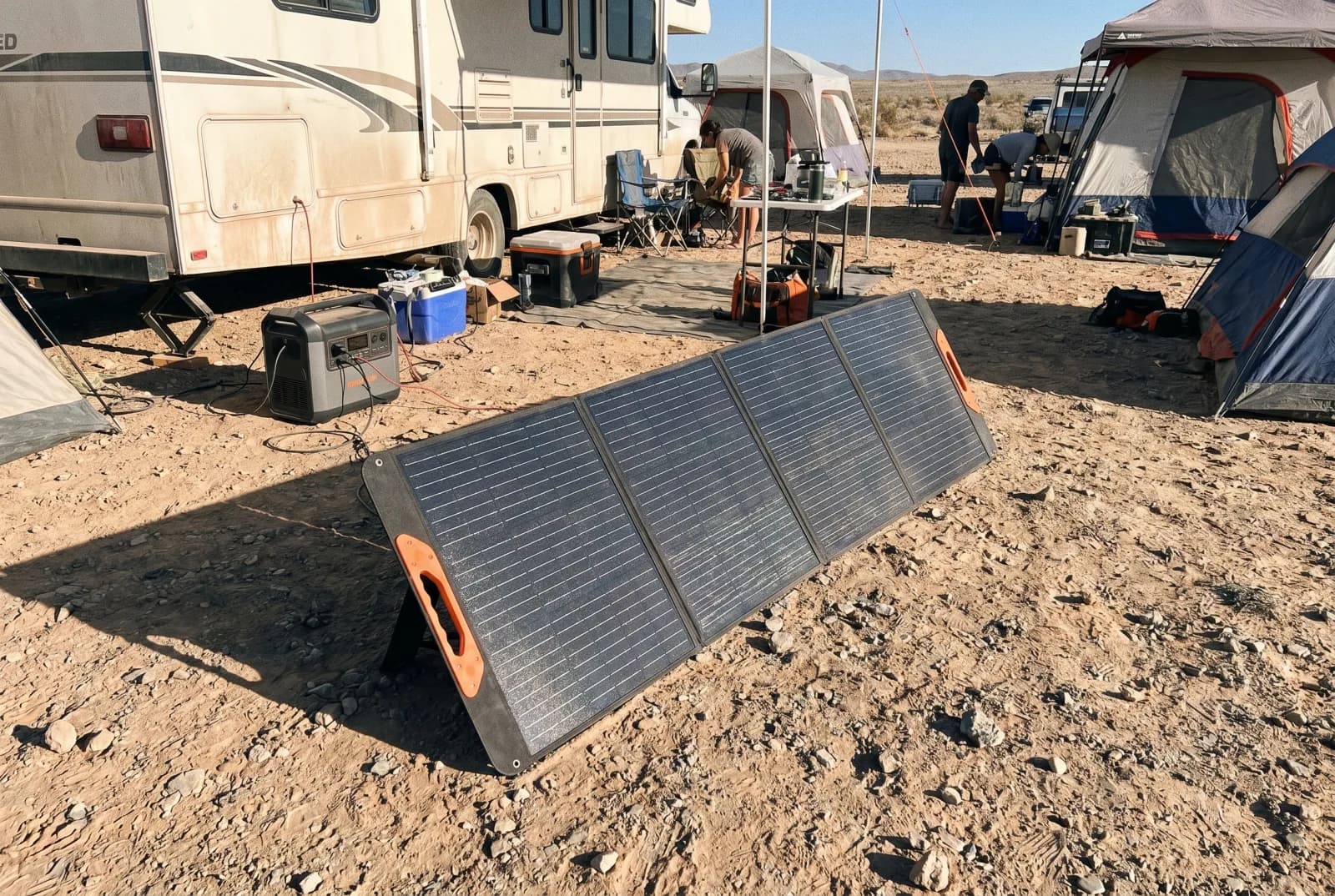
Solar recharge extends operating hours. Pair with our foldable solar panels (120W for the 1500W unit, 500W for the 3000W unit) and recharge during operation. A 500W panel in direct sunlight adds roughly 400-450Wh per hour — enough to substantially extend a full-day food truck operation or fully recharge between lunch and dinner service.
Trolley design fits food truck workflows. The BF-PPS-3000W includes a built-in telescoping handle and wheels. Roll it from your vehicle to your booth. No lifting 30+ kg of generator. Retract the handle and the unit stores flat at 350x300x430mm — compact enough to slide under a food truck counter.
LiFePO4 safety for enclosed spaces. LiFePO4 chemistry does not experience thermal runaway — the failure mode that causes lithium-ion fires. In an enclosed food truck where a battery fire would be catastrophic, this chemistry choice is not a luxury, it is a necessity. Our BMS provides overcharge, over-discharge, overcurrent, and short circuit protection as additional safety layers.
Which Model for Which Business Type
We configure two tiers based on real food truck and mobile retail equipment loads. The table below uses measured power draws from common commercial equipment — or send us your equipment list and we will size the unit against it.
Equipment Power Reference
| Equipment | Typical Draw | Surge on Startup | Notes |
|---|---|---|---|
| Espresso grinder | 200-350W | 400-500W | 1-2 min per use |
| Commercial blender | 350-500W | 600-800W | 30 sec per use |
| Electric kettle (1L) | 1000-1500W | — | 3-5 min to boil |
| Mini fridge / cooler | 50-80W | 150-250W | Compressor cycles on/off |
| LED string lights (10m) | 40-60W | — | Continuous |
| POS system + router | 25-40W | — | Continuous |
| Phone / tablet charging | 15-30W | — | Intermittent |
| Rice cooker | 400-700W | — | 20-30 min per batch |
| Electric griddle (small) | 1200-1800W | — | Continuous during cooking |
Small Operation: Coffee Cart, Juice Bar, Crepe Stand
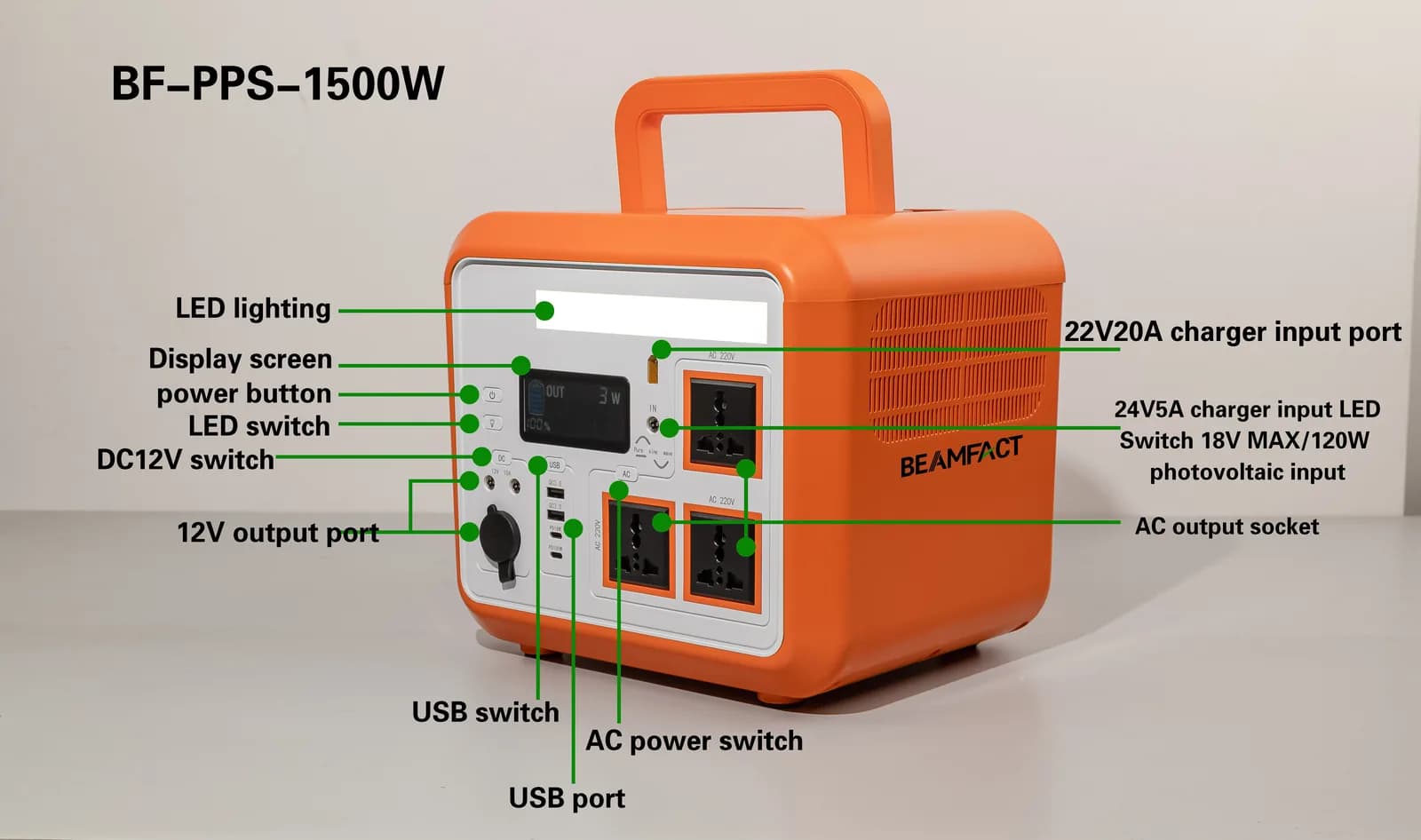
Recommended: BF-PPS-1500W (1500W / 1152Wh)
| Parameter | Specification |
|---|---|
| Model | BF-PPS-1500W |
| AC Output | 3 outlets, 1500W pure sine wave |
| Battery | LiFePO4, 1152Wh (19.2V/60Ah) |
| Weight | 11.22 kg (easy one-person carry) |
| Dimensions | 280 x 245 x 250 mm |
| Housing | PC/V0 flame retardant |
| Charging | 400W AC (3h full), 120W solar, 100W USB-C PD |
| USB Ports | 2x 18W, PD 30W, PD 100W, 15W wireless |
| Solar Panel | BF-PV-P150W (18V glass) or BF-PV-F100W (18V foldable) |
Typical Load Profile:
| Equipment Running | Power Draw | Runtime on Full Charge |
|---|---|---|
| Grinder + lights + POS | ~320W | ~3.5 hours |
| Blender + lights + POS | ~490W | ~2.3 hours |
| Kettle only (boiling cycles) | ~1300W | ~50 minutes |
| Lights + POS + phone charging (standby) | ~110W | ~10 hours |
Best for: Morning coffee market (3-4 hours), juice cart at farmer's market, crepe stand, small pop-up retail booth needing lights and POS only.
Medium-Large Operation: Food Truck, Mobile Kitchen, Multi-Vendor Setup
Recommended: BF-PPS-3000W (3000W / 3045Wh)
| Parameter | Specification |
|---|---|
| Model | BF-PPS-3000W |
| AC Output | 2 outlets, 3000W pure sine wave (shared) |
| Battery | LiFePO4, 3045Wh (25.6V/119Ah) |
| Weight | 31.85 kg (trolley design — roll, do not lift) |
| Dimensions | 350 x 300 x 430 mm (handle retracted) |
| Housing | Sheet metal, industrial grade |
| Charging | 600W AC (5h full), 500W solar (XT60, 10-90V) |
| USB Ports | USB 36W, USB 18W, PD 18W, PD 100W |
| Mobility | Telescoping handle + wheels (extends to 895mm) |
| Solar Panel | BF-PV-P250W ×2 parallel (36V glass) or BF-PV-F400W (36V foldable) |
Typical Load Profile:
| Equipment Running | Power Draw | Runtime on Full Charge |
|---|---|---|
| Rice cooker + fridge + lights + POS | ~630W | ~4.8 hours |
| Kettle + fridge + lights + POS | ~1600W | ~1.9 hours |
| Fridge + lights + POS (between rushes) | ~150W | ~20 hours |
| Full truck: griddle + fridge + lights + POS | ~1900W | ~1.6 hours |
With 500W solar panel added: In 6 hours of sunlight, solar contributes approximately 2500Wh — nearly a full recharge. A food truck drawing 350W average with solar assist can operate 12+ hours.
Best for: Full-day food truck operation, mobile kitchen catering, pop-up restaurant. For multi-vendor food parks, deploy one BF-PPS-3000W per 2-3 low-power vendors or one per high-power vendor.
Multi-Unit Deployment: Food Parks, Festival Vendor Rows, Mobile Catering Companies
For food parks or catering companies powering 5-10+ vendors, we supply fleet quantities of the BF-PPS-3000W with centralized solar charging stations. Contact us for fleet pricing and custom branding options. Each unit operates independently — no shared wiring, no single point of failure. If one unit needs charging, swap in a fresh one and keep operating.
Safety and Certification: Why This Matters for Food Business
Mobile food business operates in enclosed spaces near people, near food, and near flammable materials. Power source safety is not optional.
LiFePO4 Battery Chemistry. Unlike NMC lithium-ion cells, LiFePO4 (lithium iron phosphate) does not undergo thermal runaway. The olivine crystal structure remains stable up to 270 degrees C. In a food truck where a battery fire means catastrophic loss of business and potential injury to staff and customers, this chemistry choice eliminates the most dangerous failure mode.
BMS Protection. Every unit includes a Battery Management System providing overcharge protection, over-discharge protection, overcurrent protection, short circuit protection, and temperature monitoring. The system shuts down before any parameter reaches a dangerous threshold.
Certifications:
| Certification | What It Covers | Status |
|---|---|---|
| CE | European safety and EMC compliance | BF-PPS-1500W: Certified |
| UN38.3 | Lithium battery transport safety testing | BF-PPS-1500W: Certified |
| MSDS | Material Safety Data Sheet for shipping | BF-PPS-1500W: Certified |
| Maritime Transport | Approved for sea freight shipping | BF-PPS-1500W: Certified |
| CE + UN38.3 | Full certification package | BF-PPS-3000W: Recommended, available on request |
Industrial Housing (3000W). The BF-PPS-3000W uses sheet metal construction — not plastic. This survives the daily bumps, drops, and rough handling of commercial food truck use. The 1500W unit uses PC/V0 flame retardant housing rated for self-extinguishing behavior.
For a complete guide to portable power station certifications and what they mean for your market, read: Portable Power Station Certification Guide.
Portable Power Station vs Gas Generator for Food Trucks
This comparison uses a 3000W portable generator (typical food truck size) against our BF-PPS-3000W.
| Dimension | Gas Generator (3000W) | BF-PPS-3000W |
|---|---|---|
| Noise Level | 65-80 dB (loud conversation to vacuum) | Under 45 dB (library quiet) |
| Emissions Near Food | CO, NOx, particulates — health code risk | Zero emissions |
| Daily Fuel / Energy Cost | $15-30 (diesel/gas) | $0.40-0.80 (wall recharge) |
| Weight | 25-45 kg + fuel | 31.85 kg (no fuel) |
| Footprint | 0.15-0.25 m3 + ventilation clearance | 0.045 m3, no clearance needed |
| Output Quality | Modified sine wave, voltage fluctuations | Pure sine wave, stable |
| Startup Behavior | Pull-cord or electric start, warm-up time | Press button, instant power |
| Indoor / Enclosed Use | Prohibited (CO poisoning risk) | Fully permitted |
| Maintenance | Oil changes, spark plugs, carb cleaning, fuel filter | None (wipe clean) |
| Refueling During Use | Must shut down, cool down, refuel | Solar recharge while running |
| Permitted Locations | Restricted in many food zones | No restrictions |
| Lifespan | 2,000-5,000 hours | 2,000+ charge cycles (10,000+ hours equivalent) |
| Fire Risk | Fuel leak + hot exhaust = fire risk | LiFePO4 — no thermal runaway |
Verdict: For mobile food business, the generator's only advantage is unlimited runtime with fuel refills. The power station wins on every other dimension — noise, safety, emissions, operating cost, permitted locations, and electronics compatibility. For food trucks operating 4-8 hour shifts with overnight recharging access, the power station is the superior choice. For 16+ hour continuous heavy-load operations without any recharging opportunity, a generator or hybrid approach may still be necessary. We help you calculate the exact crossover point for your customer's specific use case.
Get Your Food Truck Power Quote
Tell us about your mobile business customers and we will deliver:
- Equipment load analysis — match your customer's exact equipment list to the right model and calculate realistic runtime
- Solar pairing recommendation — the right panel size for their operating hours and location latitude
- Fleet pricing — volume discounts for distributors and equipment outfitters
- Custom branding options — your logo and brand colors on the units (MOQ applies)
- Certification package — CE, UN38.3, MSDS documentation for your target market
Ready to start?
- Primary: Get Food Truck Power Quote — send your equipment list for a custom power analysis (response within 48 hours)
- Secondary: Download Mobile Business Power Guide — PDF with runtime calculations for common food truck and mobile retail equipment