

The battery inside a portable power station determines how long it lasts, how safe it is, and how much it actually costs over its lifetime. Most comparison articles are written by reviewers who test the finished product without understanding what is inside. We are in a different position. Beamfact manufactures four portable power station models from 300W to 3000W, and every single one uses tier-1 LiFePO4 cells from a leading Chinese battery manufacturer. This was not a marketing decision — it was an engineering decision we made after evaluating NMC, NCA, and LiFePO4 cells against the specific demands of portable power applications.
What "Lithium-Ion" Actually Means: Three Chemistries, Three Behaviors
The label "lithium-ion" covers an entire family of battery chemistries that behave differently in every measurable way. When a portable power station lists "lithium-ion battery" without specifying the chemistry, the buyer has no idea what they are getting. Here are the three chemistries used in portable power stations today.
LiFePO4 (Lithium Iron Phosphate) uses an iron-phosphate cathode. Nominal voltage: 3.2V per cell. The iron-phosphate crystal structure is exceptionally stable — it does not release oxygen under thermal abuse, which eliminates the thermal runaway failure mode entirely. This is the chemistry in all four of our BF-PPS models.
NMC (Nickel Manganese Cobalt) uses a layered oxide cathode. Nominal voltage: 3.6-3.7V per cell. Higher energy density than LiFePO4, which means lighter weight per Wh. But the layered oxide structure is thermally less stable, and cycle life is significantly shorter. Most consumer-grade portable power stations under $300 use NMC.
NCA (Nickel Cobalt Aluminum) uses a similar layered structure to NMC with aluminum substitution. Nominal voltage: 3.6V per cell. Highest energy density of the three, but the shortest cycle life and highest thermal sensitivity. Tesla uses NCA in vehicles (with massive thermal management systems). Some ultra-light portable power stations use NCA cells.
Chemistry Comparison: LiFePO4 vs NMC vs NCA
Every number in this table comes from cell manufacturer datasheets or our own BMS-level testing. No marketing estimates.
| Parameter | LiFePO4 (3.2V) | NMC (3.6-3.7V) | NCA (3.6V) |
|---|---|---|---|
| Cycle Life (to 80% capacity) | 2,000+ cycles | 500-800 cycles | 300-500 cycles |
| Practical Lifespan (daily use) | 5-6 years | 1.5-2 years | 1-1.5 years |
| Thermal Runaway Risk | None | Moderate | High |
| Thermal Runaway Onset | Not applicable | 210°C | 150°C |
| Operating Temp (discharge) | -20°C to 60°C | -10°C to 45°C | -10°C to 45°C |
| Operating Temp (charge) | 0°C to 50°C | 0°C to 45°C | 0°C to 45°C |
| Energy Density | 90-120 Wh/kg | 150-220 Wh/kg | 200-260 Wh/kg |
| Self-Discharge Rate | Less than 3%/month | 5-8%/month | 5-10%/month |
| Depth of Discharge (usable) | 80-90% | 70-80% | 60-80% |
| Cost Per Wh (cell level) | $0.08-0.12 | $0.06-0.09 | $0.07-0.10 |
| Weight Per kWh | 8-11 kg | 4-7 kg | 4-6 kg |
| Cobalt Content | Zero | 10-20% cathode | 5-15% cathode |
Verdict: LiFePO4 wins on cycle life, safety, temperature tolerance, and total cost of ownership. NMC and NCA win on energy density and upfront cost. For a portable power station — a device that contains a large energy store, gets transported in vehicles, operates in tents and enclosed spaces, and is expected to last years — the LiFePO4 advantages are decisive.
Why LiFePO4 Is the Only Defensible Choice for Portable Power Stations
Safety in Enclosed Spaces
A portable power station operates inside tents, RVs, bedrooms during power outages, and vehicle cabins. These are enclosed, often poorly ventilated spaces where a battery fire means immediate danger to people. LiFePO4 chemistry physically cannot undergo thermal runaway. The iron-phosphate cathode does not release oxygen when overheated — no oxygen release means no self-sustaining exothermic reaction, no fire, no explosion.
NMC cells begin thermal runaway at approximately 210°C. NCA cells begin at approximately 150°C. These temperatures can be reached through internal short circuit, BMS failure, or external heat exposure. A single cell failure can cascade through the entire pack.
We design our BMS with overcharge, over-discharge, overcurrent, short circuit, and over-temperature protection on every model. But the BMS is the second line of defense. The chemistry itself is the first — and with LiFePO4, the first line never fails.
Cycle Life Matches Real Usage Patterns
A portable power station used for weekend camping charges and discharges approximately 100-150 times per year. A unit used for daily emergency backup or job site power cycles 300-365 times per year. Here is what that means in practice:
| Usage Pattern | Cycles/Year | LiFePO4 (2,000 cycles) | NMC (600 cycles) | NCA (400 cycles) |
|---|---|---|---|---|
| Weekend camping | 100-150 | 13-20 years | 4-6 years | 2.5-4 years |
| Frequent outdoor use | 200-250 | 8-10 years | 2.5-3 years | 1.5-2 years |
| Daily use | 365 | 5-6 years | 1.5-2 years | 1-1.5 years |
For daily-use applications — construction sites, food trucks, off-grid living — an NMC unit needs replacing every 18-24 months. A LiFePO4 unit lasts 5-6 years before capacity degrades below 80%. That is not a minor difference. It is the difference between a tool and a consumable.
Temperature Tolerance for Real-World Conditions
Portable power stations do not live in climate-controlled rooms. They sit in car trunks that reach 60°C in summer. They operate at construction sites in desert heat. They power heaters in winter camping at -15°C. They get left in unheated garages through freezing winters.
LiFePO4 operates from -20°C to 60°C for discharge. NMC and NCA start degrading rapidly above 45°C and lose 30-40% capacity below -10°C. In our thermal chamber testing, LiFePO4 cells retained 92% capacity at -10°C and 85% at -20°C. NMC cells from comparable manufacturers dropped to 65% at -10°C.
For charging, LiFePO4 accepts charge from 0°C to 50°C. Our BMS includes low-temperature charge lockout that prevents charging below 0°C — this protects against lithium plating on the anode, which permanently damages any lithium cell chemistry.
Low Self-Discharge Protects Stored Units
Portable power stations spend most of their life in storage — in a closet, garage, or warehouse — waiting for the next camping trip or the next power outage. LiFePO4 self-discharges at less than 3% per month. After 6 months of storage, a fully charged LiFePO4 unit retains approximately 82% charge. An NMC unit at 5-8% monthly self-discharge retains approximately 50-60% after the same period.
For B2B buyers, this matters at the inventory level. Units sitting in warehouse inventory for 3-6 months before sale arrive at the customer with usable charge. With NMC, extended warehouse time means customers receive half-dead units that create a poor first impression.
Cost-Per-Cycle: The Number That Ends the Debate
Upfront price is the wrong metric. Cost per cycle captures the true economics. Here is the math using our actual product pricing:
| Metric | LiFePO4 (BF-PPS-600W) | NMC Equivalent (competitor) |
|---|---|---|
| Unit Price (approximate retail) | $450-550 | $300-400 |
| Battery Capacity | 576Wh | 576Wh |
| Rated Cycle Life | 2,000+ | 500-800 |
| Cost Per Cycle | $0.23-0.28 | $0.38-0.80 |
| Replacements in 5 years (daily use) | 0 | 1-2 |
| Total 5-Year Cost (with replacements) | $450-550 | $600-1,200 |
Verdict: LiFePO4 costs 15-25% more upfront but 60-70% less over the product lifetime. The breakeven point occurs at approximately 800 cycles — less than 3 years of regular use. After that, every cycle with LiFePO4 is saving money against NMC.
For bulk buyers purchasing 100+ units for rental fleets, emergency stockpiles, or resale channels, the lifetime cost difference is transformative. One hundred LiFePO4 units that each last 5+ years replace three hundred NMC units over the same period.
Our Product Line: LiFePO4 Across All Models
Every Beamfact portable power station uses LiFePO4 cells. Our cell supplier is a tier-1 manufacturer with 17 GWh annual capacity, supplying Volkswagen, Bosch, and grid-scale energy storage projects. Here is what that means in each of our models:
| Model | Battery Config | Capacity | Weight | AC Output |
|---|---|---|---|---|
| BF-PPS-300W | 12.8V / 15Ah | 192Wh | 2.6 kg | 300W pure sine wave |
| BF-PPS-600W | 12.8V / 45Ah | 576Wh | 6.0 kg | 600W pure sine wave |
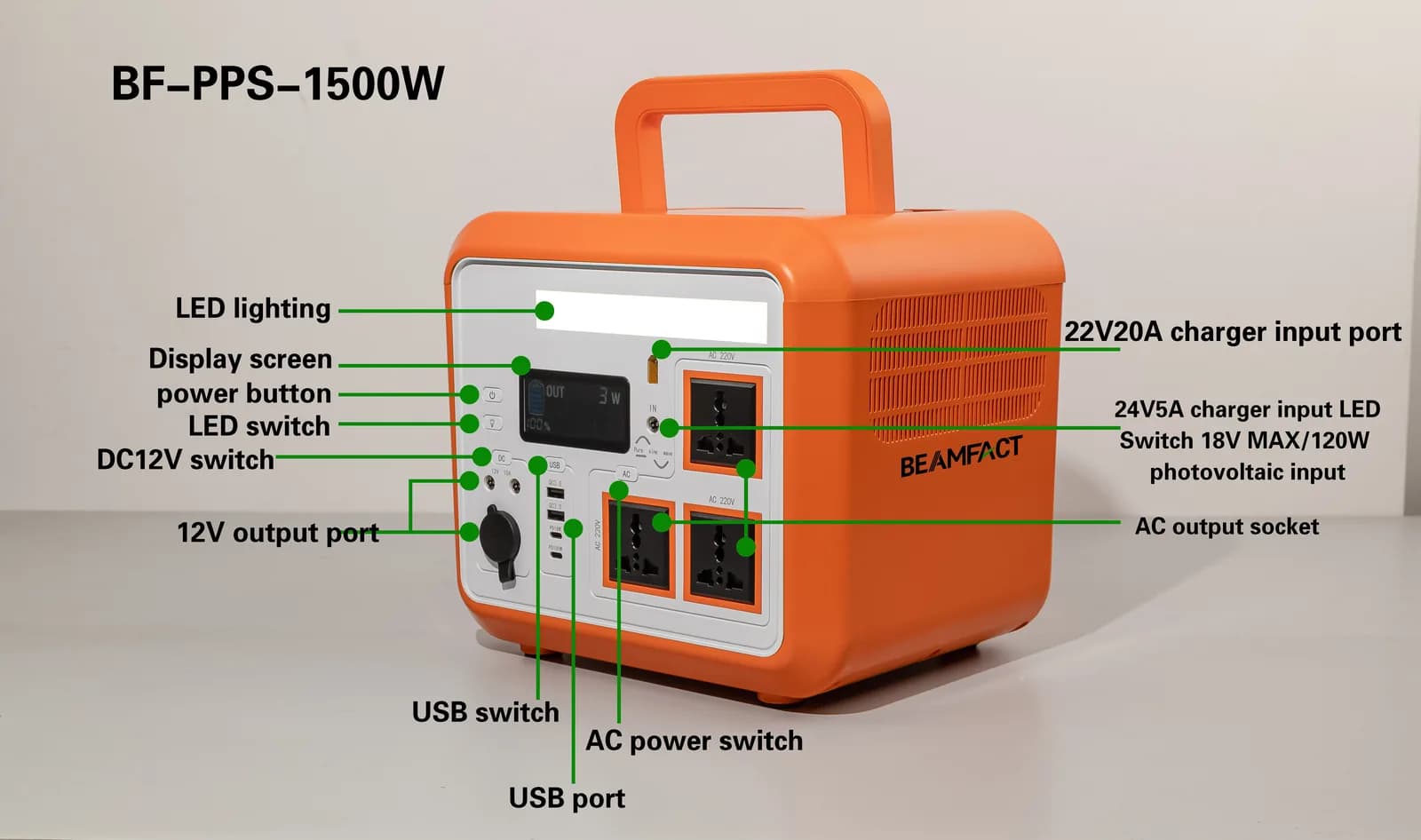
| BF-PPS-1500W | 19.2V / 60Ah | 1152Wh | 11.22 kg | 1500W pure sine wave |
| BF-PPS-3000W | 25.6V / 119Ah | 3045Wh | 31.85 kg | 3000W pure sine wave |
All four models use pure sine wave inverters — the same waveform as grid electricity. This is not negotiable for powering sensitive electronics like CPAP machines (40W), laptops, TVs, and phone chargers. Modified sine wave inverters (used in cheaper power stations to cut costs) cause buzzing, overheating, and interference with connected devices.
How to Verify Battery Claims from Any Supplier
The portable power station market has the same problem as the solar light industry: widespread battery misrepresentation. We have disassembled competitor products and found NMC cells in units labeled "LiFePO4," capacities overstated by 30-50%, and BMS boards with no temperature protection. Here is how to verify what you are buying.
Check the Voltage
This is the fastest verification method. Measure the open-circuit voltage of a fully charged unit.
| Chemistry | Voltage Per Cell (Full Charge) | 4S Pack Voltage | 8S Pack Voltage |
|---|---|---|---|
| LiFePO4 | 3.4-3.5V | 13.6-14.0V | 27.2-28.0V |
| NMC | 4.0-4.2V | 16.0-16.8V | 32.0-33.6V |
| NCA | 4.0-4.2V | 16.0-16.8V | 32.0-33.6V |
If a supplier claims LiFePO4 but the pack voltage reads in the NMC range, it is NMC relabeled.
Ask for the Cell Brand and Datasheet
Legitimate manufacturers name their cell supplier and provide the cell datasheet. The datasheet includes rated capacity, cycle life curves, operating temperature range, and internal resistance specifications. If a supplier cannot tell you the cell brand, they either sourced the cheapest cells available (no traceability) or do not want you to cross-reference their claims.
Verify the BMS Specification
A proper BMS for a LiFePO4 portable power station includes:
- Overcharge protection: Cutoff at 3.65V per cell (14.6V for 4S)
- Over-discharge protection: Cutoff at 2.5V per cell (10.0V for 4S)
- Overcurrent protection: Matched to the inverter's maximum draw
- Short circuit protection: Immediate cutoff with auto-recovery
- Temperature protection: Charge lockout below 0°C, discharge cutoff above 60°C
If the BMS spec sheet is unavailable, the unit likely uses a generic protection board with minimal functionality.
Weigh the Unit
LiFePO4 is heavier than NMC for the same capacity. If a claimed 576Wh LiFePO4 unit weighs significantly less than expected (accounting for housing, inverter, and electronics weight), the capacity is overstated or the chemistry is not LiFePO4. Our BF-PPS-600W at 576Wh weighs 6 kg — the battery cells alone account for approximately 4 kg.
The Weight Tradeoff: Why It Matters Less Than You Think
The primary argument against LiFePO4 in portable power stations is weight. At 8-11 kg per kWh versus 4-7 kg per kWh for NMC, a LiFePO4 unit is approximately 40-60% heavier for the same capacity. This is a real engineering constraint — but context determines whether it matters.
When weight matters: Backpacking, hiking, airline carry-on. Our BF-PPS-300W at 2.6 kg is already at the upper limit for true backpack portability. An NMC equivalent could weigh 1.6-1.8 kg.
When weight does not matter: Car camping, RV use, construction sites, home backup, events. Our BF-PPS-3000W weighs 31.85 kg — it has wheels and a telescoping handle because nobody carries it. Whether it weighed 20 kg or 32 kg is irrelevant when it rolls.
For the vast majority of portable power station use cases — vehicle-transported, site-deployed, stored at home — the weight difference between LiFePO4 and NMC is a specification line item, not a functional limitation.
Our Engineering Position
After evaluating cells from multiple chemistry families and building prototypes with NMC, NCA, and LiFePO4 packs, our position is unambiguous:
LiFePO4 is the only chemistry we will put in a portable power station. The zero thermal runaway risk, the 2,000+ cycle longevity, the -20°C to 60°C operating range, and the 60-70% lower lifetime cost make it the only defensible engineering choice for a product that stores substantial energy and operates in uncontrolled environments near people.
We chose our cell supplier specifically because they provide automotive-grade quality control, full batch traceability, and independently verifiable specifications. When we tell buyers our cells are rated for 2,000+ cycles, they can confirm that number with the supplier's published data — they do not have to take our word for it.
This is the same engineering logic we apply to our solar street lights and solar flood lights, where LiFePO4 has been our standard chemistry for years. Our detailed LiFePO4 vs lithium-ion comparison for solar lights covers the same chemistry fundamentals from the perspective of outdoor lighting — the safety and longevity arguments are identical.
Explore our complete portable power station lineup to see the specifications for all four models, or contact our engineering team for cell datasheets and BMS documentation.
Related Reading
- Portable Power Station Certification Guide — UL, FCC, CE, UN38.3 requirements by market, with costs and Amazon compliance warning
- How to Choose a Portable Power Station Manufacturer — 6-point evaluation framework covering cell transparency, BMS quality, certifications, and more