

Certifications are not optional decorations on a product spec sheet. They are legal gates that determine whether your portable power station clears customs, stays listed on Amazon, qualifies for government tenders, and protects you from liability when something goes wrong. As Beamfact's certification specialist, I manage every test submission across our portable power station lineup — and I have seen enough rejected shipments and delisted Amazon products to know that certification confusion costs real money.
This guide covers every certification that matters for portable power stations, what each one actually tests, what it costs, which markets require what, and how to verify authenticity. We are transparent about what we currently hold and what we are working toward.
Market Entry Checklist
Start here if you are deciding whether a supplier can support your sales channel. The right certification set depends on market access, sales platform, and shipping mode.
| Market / Channel | Required Before Sale | Required Before Shipment | Highest-Risk Gap |
|---|---|---|---|
| Amazon US | UL 2056 or UL 2743, FCC Part 15 | UN38.3, MSDS | Listing removal without valid UL documentation |
| US / Canada retail | UL 2056 or UL 2743, FCC Part 15 | UN38.3, MSDS | Product-liability exposure and retail rejection |
| EU / UK | CE covering EMC, LVD, RoHS | UN38.3, MSDS, Maritime Transport Report | Incomplete CE scope |
| Australia / New Zealand | SAA/RCM | UN38.3, MSDS | Electrical safety documentation gap |
| Global B2B project supply | Market-specific safety documents | UN38.3, MSDS, DG documents | Cell-level report used instead of pack-level report |
Why Portable Power Stations Face Stricter Certification Requirements
Portable power stations sit at an intersection of three regulatory categories that multiply the certification burden:
-
Large lithium battery products — Battery transport safety regulations (UN38.3, IMDG Code, IATA DGR) apply to any product containing lithium cells. Portable power stations contain 192Wh to 3,045Wh — far above the 100Wh threshold that triggers enhanced regulatory scrutiny.
-
AC output electronics — Unlike simple USB power banks, portable power stations contain inverters that produce AC mains voltage (110V/220V). This triggers electrical safety standards (UL 2743, IEC 62133, CE LVD) that do not apply to DC-only devices.
-
Consumer-accessible high-energy devices — These products are used by non-technical consumers in homes, tents, and vehicles. Regulators treat them more seriously than industrial equipment because the users cannot be assumed to have electrical training.
The net result: a portable power station requires more certifications than a solar street light, a power bank, or a standalone battery pack. Understanding which certifications you actually need — versus which ones suppliers list to impress — saves months and thousands of dollars.
What You Need by Market: The Decision Matrix
Before diving into individual certifications, here is the summary that answers the question most buyers ask first: "What do I need for my market?"
USA / Canada
| Level | Certifications | When You Need It |
|---|---|---|
| Required | UL 2056 or UL 2743 + FCC Part 15 | Amazon listings, retail distribution |
| Recommended | + DOE energy efficiency | Utility rebate programs, large retail chains |
| Shipping | UN38.3 + MSDS | All international shipments |
Amazon warning: Amazon US now actively enforces UL certification for portable power stations and power banks. Listings without valid UL documentation face removal, inventory seizure at FBA warehouses, and seller account suspension. This is not a future risk — it is current enforcement as of 2026.
EU / UK
| Level | Certifications | When You Need It |
|---|---|---|
| Required | CE (EMC + LVD + RoHS) + UN38.3 | Any EU/UK import and sale |
| Recommended | + IEC 62133 (battery safety) | Professional distribution, B2B channels |
| Shipping | UN38.3 + MSDS + Maritime Transport Report | Sea freight to EU ports |
Australia / New Zealand
| Level | Certifications | When You Need It |
|---|---|---|
| Required | SAA/RCM (EMC + electrical safety) | Retail sale in AU/NZ |
| Recommended | + UN38.3 | International shipping, professional channels |
| Shipping | UN38.3 + MSDS | All shipments containing lithium batteries |
Global Shipping (All Markets)
| Certification | Purpose | Status |
|---|---|---|
| UN38.3 | Lithium battery transport safety | Mandatory — no exceptions |
| MSDS | Material safety documentation for customs | Mandatory for lithium products |
| Maritime Transport Report | Sea freight compliance (IMDG Code) | Mandatory for ocean shipment |
| DG Packaging Certification | Dangerous goods packaging compliance | Required by many carriers |
Certification-by-Certification Deep Dive
UN38.3 — Battery Transport Safety
What it tests: UN38.3 is the United Nations standard for lithium battery transport safety. The test sequence subjects battery packs to conditions they might encounter during transport:
- Altitude simulation (low pressure equivalent to 15,000m)
- Thermal cycling (-40°C to +75°C, 10 cycles)
- Vibration testing (simulating truck and air transport)
- Shock testing (simulating drops and handling impacts)
- External short circuit
- Impact/crush testing
- Overcharge testing
- Forced discharge testing
Required for: Every country that regulates lithium battery transport — effectively every market worldwide. Without UN38.3, freight forwarders refuse to book shipments, shipping lines reject containers, and airlines ban cargo acceptance.
Cost: $2,500-5,000 per battery pack configuration.
Timeline: 4-6 weeks. Several tests are destructive — units are deliberately abused to failure under controlled conditions.
Critical distinction: A cell-level UN38.3 report from the cell manufacturer covers the bare cell only. It does not cover the assembled battery pack with BMS, wiring harness, and housing. You need pack-level UN38.3 testing for the complete product as shipped. We test at the pack level for every model because that is what goes inside the box the customer receives.
Our status: All four BF-PPS models carry pack-level UN38.3 certification.
MSDS — Material Safety Data Sheet
What it covers: The MSDS (also called SDS — Safety Data Sheet) documents the chemical composition, hazard classification, first aid measures, fire-fighting measures, and disposal instructions for the lithium battery product. Customs authorities worldwide require MSDS documentation for any shipment containing lithium batteries.
Required for: All international shipments of lithium battery products. Without an MSDS, customs clearance is delayed or denied.
Cost: $500-1,500 per product configuration.
Timeline: 1-2 weeks (documentation-based, no destructive testing).
Our status: MSDS documentation is current for all four BF-PPS models.
Maritime Transport Report
What it covers: The Maritime Transport Report validates that lithium battery products meet the IMDG Code (International Maritime Dangerous Goods Code) requirements for ocean freight. It covers:
- Battery classification (UN3481 for lithium-ion batteries packed with equipment)
- Packaging compliance
- Labeling and marking requirements
- Documentation requirements for carrier acceptance
Required for: All ocean shipments containing lithium batteries. Since portable power stations ship by sea (air freight is prohibitively expensive for units this heavy), this is effectively mandatory for all international trade.
Cost: $1,500-3,000 per product configuration.
Timeline: 2-4 weeks, often processed alongside UN38.3 testing.
Our status: Maritime Transport Reports are current for all four BF-PPS models.
CE Marking — European Conformity
What it covers: CE marking for portable power stations involves multiple EU directives:
- EMC Directive (2014/30/EU): Electromagnetic compatibility — the power station must not emit interference that disrupts other devices, and must resist external interference. The inverter and charge controller are the primary EMC concerns.
- LVD Directive (2014/35/EU): Electrical safety for products operating between 50-1000V AC. Since portable power stations output 110V or 220V AC, LVD applies. This covers insulation, grounding, protection against electric shock, and abnormal operation safety.
- RoHS Directive (2011/65/EU): Restriction of hazardous substances — lead, mercury, cadmium, hexavalent chromium, PBBs, PBDEs.
Required for: EU (27 member states), UK (UKCA technically required post-Brexit, but CE is still widely accepted alongside UKCA). CE is also recognized as a baseline quality signal across the Middle East, Africa, and Southeast Asia.
Cost: $3,000-6,000 per product model (covering all three directives).
Timeline: 4-8 weeks from sample submission to certificate issuance.
Our status: CE certified for the BF-PPS-1500W. Remaining models in progress.
UL 2056 / UL 2743 — North American Safety
What it covers: UL standards for portable power products in the US and Canadian markets:
- UL 2056 — "Portable Lithium-Ion Battery Packs." Originally written for power banks, but Amazon references it for portable power stations.
- UL 2743 — "Portable Power Packs." Specifically covers larger portable power products with AC inverter output. This is the technically correct standard for portable power stations.
Both standards test:
- Electrical safety (insulation, grounding, abnormal charging, temperature rise)
- Battery safety (overcharge, over-discharge, short circuit, crush, drop)
- Mechanical safety (enclosure strength, stability, sharp edges)
- Fire and shock hazard prevention
- Marking and instruction requirements
Required for: USA and Canada. Unlike CE (which allows manufacturer self-declaration with technical file), UL requires third-party testing AND ongoing quarterly factory surveillance inspections.
Cost: $12,000-20,000 for initial certification. $3,000-5,000 per year for ongoing factory surveillance.
Timeline: 12-20 weeks including testing, factory inspection scheduling, and report generation.
Why it is the most expensive certification: UL inspectors visit the factory every quarter to verify that production units match the certified design. Component substitution, BMS changes, or housing modifications without UL notification trigger certification suspension. This level of ongoing oversight is why UL certification filters out manufacturers who cannot maintain consistent production quality.
Amazon enforcement: Amazon US has been actively removing portable power station and power bank listings that lack UL certification since 2023. The enforcement includes:
- Listing suppression with compliance documentation request
- FBA inventory quarantine for non-compliant products
- Seller account suspension for repeated violations
- Requirement to provide UL certificate number and test report reference
Our status: UL certification is on our roadmap. We currently do not sell directly on Amazon US. Buyers targeting Amazon US should budget for UL certification as part of their market entry cost.
FCC Part 15 — US Electromagnetic Compatibility
What it covers: FCC Part 15 ensures portable power stations do not emit electromagnetic interference exceeding US limits. The inverter, charge controller, and any wireless modules (Bluetooth, WiFi for app control) all generate EMI that must comply.
- Unintentional radiators (inverter, controller): conducted and radiated emissions testing
- Intentional radiators (Bluetooth/WiFi modules, if equipped): additional testing under Subpart C
Required for: All electronic devices sold in the United States.
Cost: $2,000-5,000 per product configuration. Higher for models with wireless connectivity.
Timeline: 4-6 weeks.
Our status: FCC testing planned alongside UL certification for US market entry.
IEC 62133 — Battery Safety
What it covers: IEC 62133 is the international standard for safety requirements for portable sealed secondary (rechargeable) cells and batteries. It covers:
- Continuous charging at specified conditions
- External short circuit protection
- Free fall (drop test)
- Mechanical shock
- Thermal abuse
- Crush and nail penetration
- Forced internal short circuit
Required for: Not legally mandatory in most markets as a standalone requirement, but referenced by CE (as a harmonized standard) and increasingly demanded by professional buyers and insurance underwriters. IEC 62133 compliance demonstrates battery safety beyond what UN38.3 transport testing covers.
Cost: $3,000-6,000 per battery configuration.
Timeline: 6-8 weeks.
Recommendation: For manufacturers targeting professional distribution channels in the EU and UK, IEC 62133 is becoming a de facto requirement. It provides additional safety validation beyond CE marking and strengthens product liability defense.
How to Verify Certification Authenticity
Fake certifications are widespread in the portable power station industry. The problem is worse than in solar lighting because the market is newer and growing faster, attracting manufacturers who prioritize speed over compliance. Here is the verification process we recommend.
Step 1: Identify the Testing Laboratory
Every legitimate certification document names the testing laboratory and its accreditation number. Check the laboratory against these databases:
- UL certificates: Verify at productiq.ulprospector.com
- EU Notified Bodies: Verify in the NANDO database (ec.europa.eu/growth/tools-databases/nando)
- ISO 17025 accredited labs: Verify at your national accreditation body or ILAC (ilac.org)
If the certificate does not name a specific laboratory, or names a laboratory that does not appear in accreditation databases, the certificate is fabricated.
Step 2: Contact the Laboratory
Call or email the testing laboratory with the certificate number. Legitimate labs confirm or deny certificate existence within 24-48 hours. This single step eliminates the majority of fraudulent certifications.
Step 3: Match the Product
The certificate must reference the exact product model being sold. A UN38.3 report for "Model A" does not cover "Model A-V2" if the battery configuration changed. A CE certificate for a 600W unit does not cover a 1500W unit. Check that the model number on the certificate matches the model number on the purchase order.
Step 4: Check the Scope
For CE, verify all three directives are covered (EMC + LVD + RoHS). A CE certificate covering only EMC is incomplete for a portable power station with AC output. For UL, verify the certificate is under UL 2056 or UL 2743 — not an unrelated UL standard.
Beamfact's Current Certification Status
We are transparent about what we hold and what we do not. This table reflects our status as of June 2026.
| Certification | BF-PPS-300W | BF-PPS-600W | BF-PPS-1500W | BF-PPS-3000W |
|---|---|---|---|---|
| UN38.3 | Yes | Yes | Yes | Yes |
| MSDS | Yes | Yes | Yes | Yes |
| Maritime Transport Report | Yes | Yes | Yes | Yes |
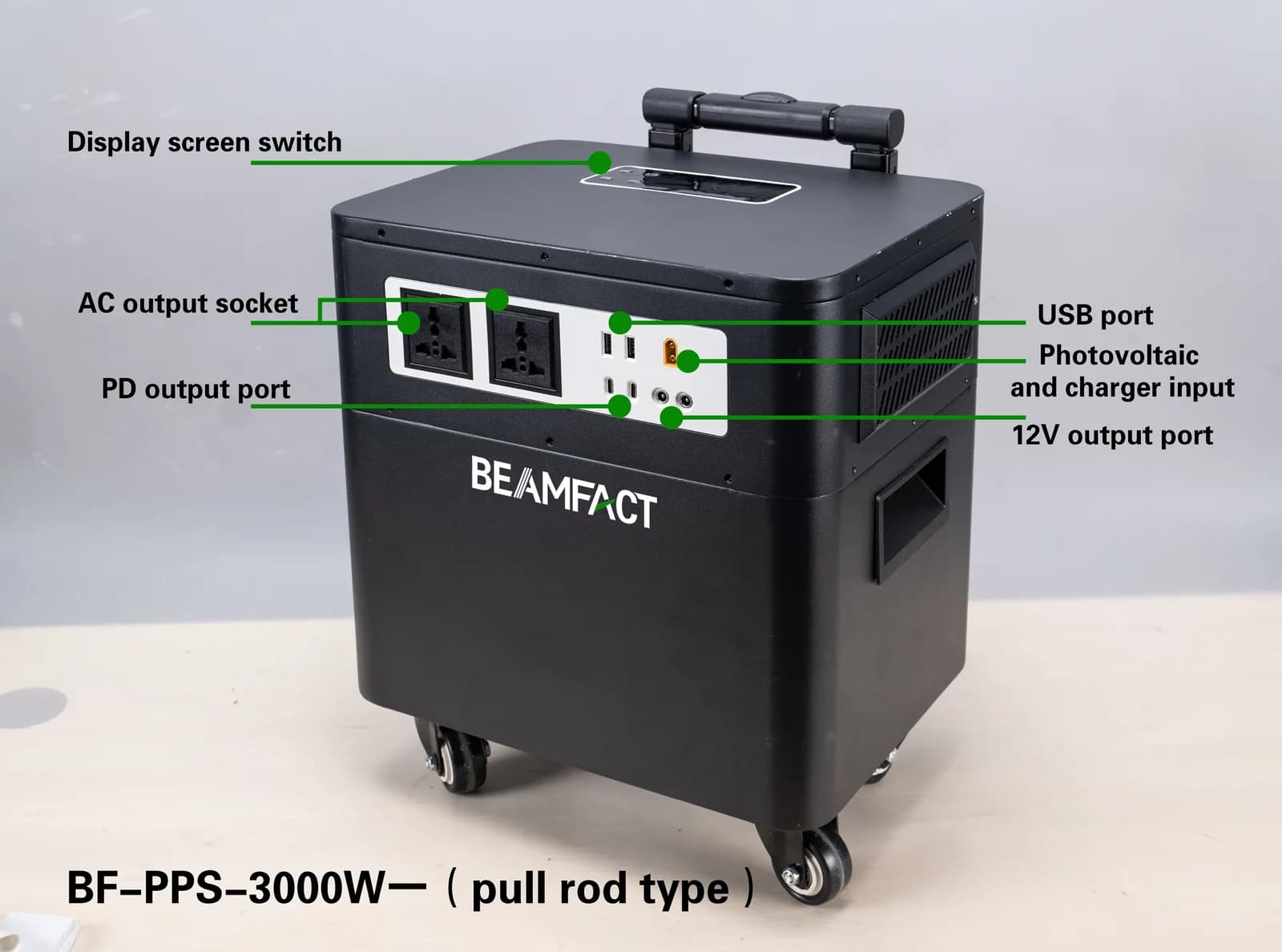
| CE (EMC + LVD + RoHS) | In progress | In progress | Yes | In progress |
| UL 2056/2743 | Roadmap | Roadmap | Roadmap | Roadmap |
| FCC Part 15 | Roadmap | Roadmap | Roadmap | Roadmap |
What this means for buyers:
- All models can be shipped internationally by sea without documentation issues. UN38.3, MSDS, and Maritime Transport Reports are complete.
- BF-PPS-1500W is ready for EU/UK markets with full CE certification.
- US market (Amazon) requires UL certification. We supply product samples and the technical file for buyer-initiated UL testing; factor the testing timeline into your launch plan.
Our solar street light certifications guide lists the certificates held across our lighting product lines and how to verify each one.
The Amazon Seller Warning
This section addresses a specific, urgent concern for buyers reselling portable power stations on Amazon US.
The situation: Amazon has been systematically enforcing UL certification requirements for portable power products since 2023. The enforcement pattern:
- Amazon requests UL documentation via Seller Central notification
- Seller has 30 days to provide valid UL 2056 or UL 2743 certification
- Failure to provide documentation results in listing suppression
- Repeated non-compliance triggers account-level enforcement (suspension)
- FBA inventory of non-compliant products is quarantined and may be disposed of at seller's cost
The cost of non-compliance:
- Lost inventory value ($5,000-50,000+ depending on stock levels)
- Lost sales during listing suppression (weeks to months)
- Account suspension recovery is expensive and uncertain
- Competitor advantage while your listings are down
The practical advice: If you plan to sell portable power stations on Amazon US, UL certification is not optional — it is an operating cost. Budget $15,000-25,000 for initial UL + FCC certification and $3,000-5,000 per year for ongoing compliance. Factor this into your landed cost calculation before committing to inventory purchases.
Certification Cost Summary
For manufacturers and importers budgeting market entry, here is the full cost picture:
| Market | Certification Package | Estimated Cost | Timeline |
|---|---|---|---|
| Global shipping | UN38.3 + MSDS + Maritime Transport | $4,500-9,500 | 4-8 weeks |
| EU/UK | CE (EMC + LVD + RoHS) | $3,000-6,000 | 4-8 weeks |
| EU/UK (recommended) | CE + UN38.3 + MSDS + IEC 62133 | $9,000-17,000 | 8-14 weeks |
| USA/Canada | UL 2056/2743 + FCC | $14,000-25,000 | 12-20 weeks |
| USA (Amazon-ready) | UL + FCC + UN38.3 + MSDS | $19,000-34,000 | 14-22 weeks |
| Australia/NZ | SAA/RCM | $3,000-5,000 | 6-8 weeks |
These are per-model costs. A manufacturer with four portable power station models seeking US market certification faces $56,000-100,000+ in testing fees alone. This economic reality explains why the US portable power station market has fewer competitors than CE-only markets — the certification barrier is working as designed.
Certification Red Flags from Suppliers
Next Steps
Explore our certified portable power station lineup — every product page lists certification details with document availability upon request.
For context on our broader certification philosophy, read our solar street light certifications guide which covers the same verification framework applied to our lighting products.
Contact our certification team for copies of UN38.3 reports, MSDS documents, CE certificates, and Maritime Transport Reports for any BF-PPS model.
Related Reading
- LiFePO4 vs Lithium-Ion for Portable Power Stations — Battery chemistry comparison with cycle life, safety, and cost-per-cycle data
- How to Choose a Portable Power Station Manufacturer — 6-point evaluation framework covering cell transparency, BMS quality, and more