

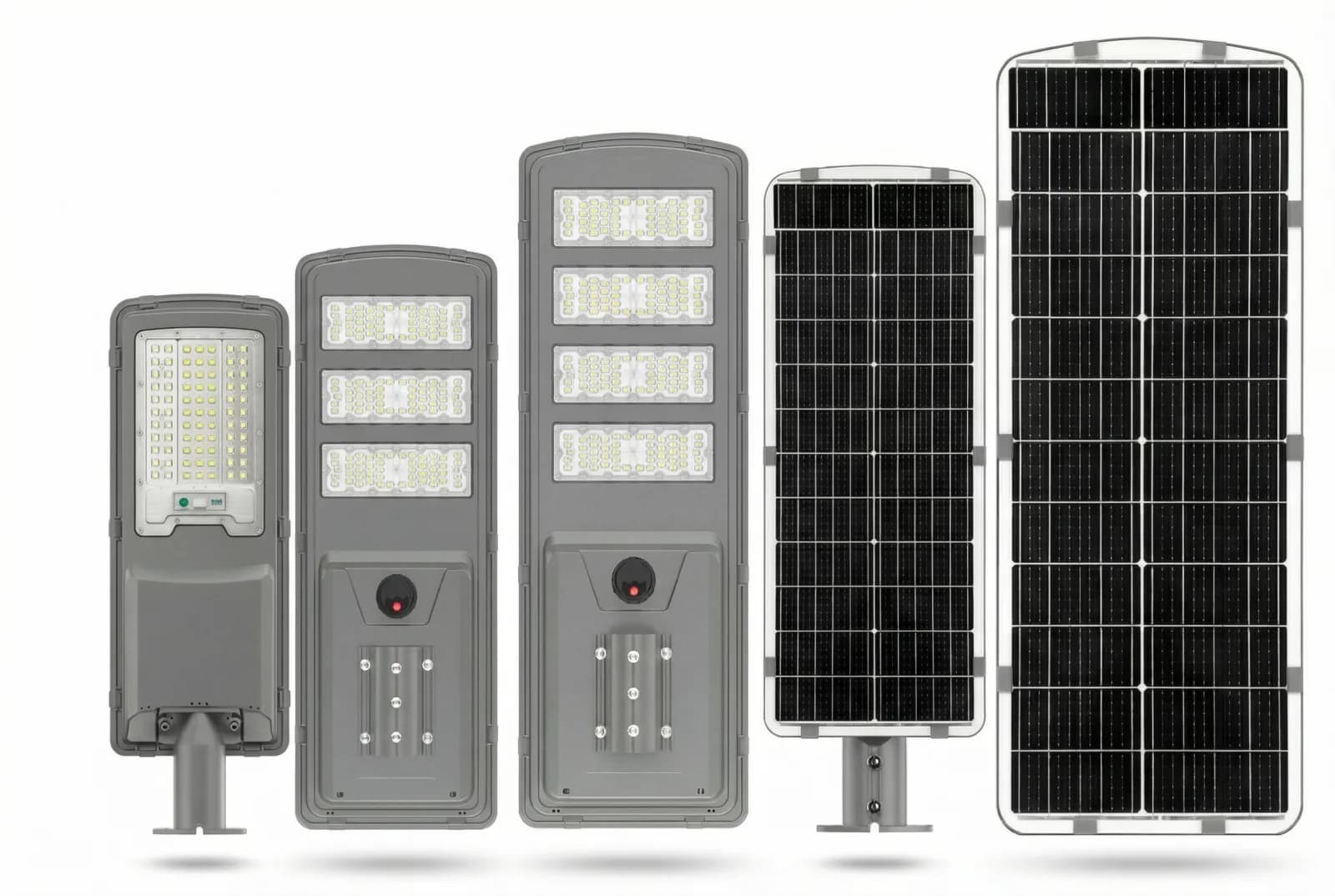
We build both motion sensor and constant-brightness solar street lights. Our motion sensor models — the BF-MSS-23 Series (10/20/25W) and BF-MSS-24 Series (10/15/20W) — sit alongside our constant-brightness range (BF-SSL-20 Series, BF-SSL-21 Series, BF-SSL-22 Series) on the same production line, in the same factory, tested by the same engineers. We do not favor one over the other. We favor the one that fits your project.
Here is when each type actually makes sense — and when choosing wrong wastes your budget.
The Confusion Most Buyers Face
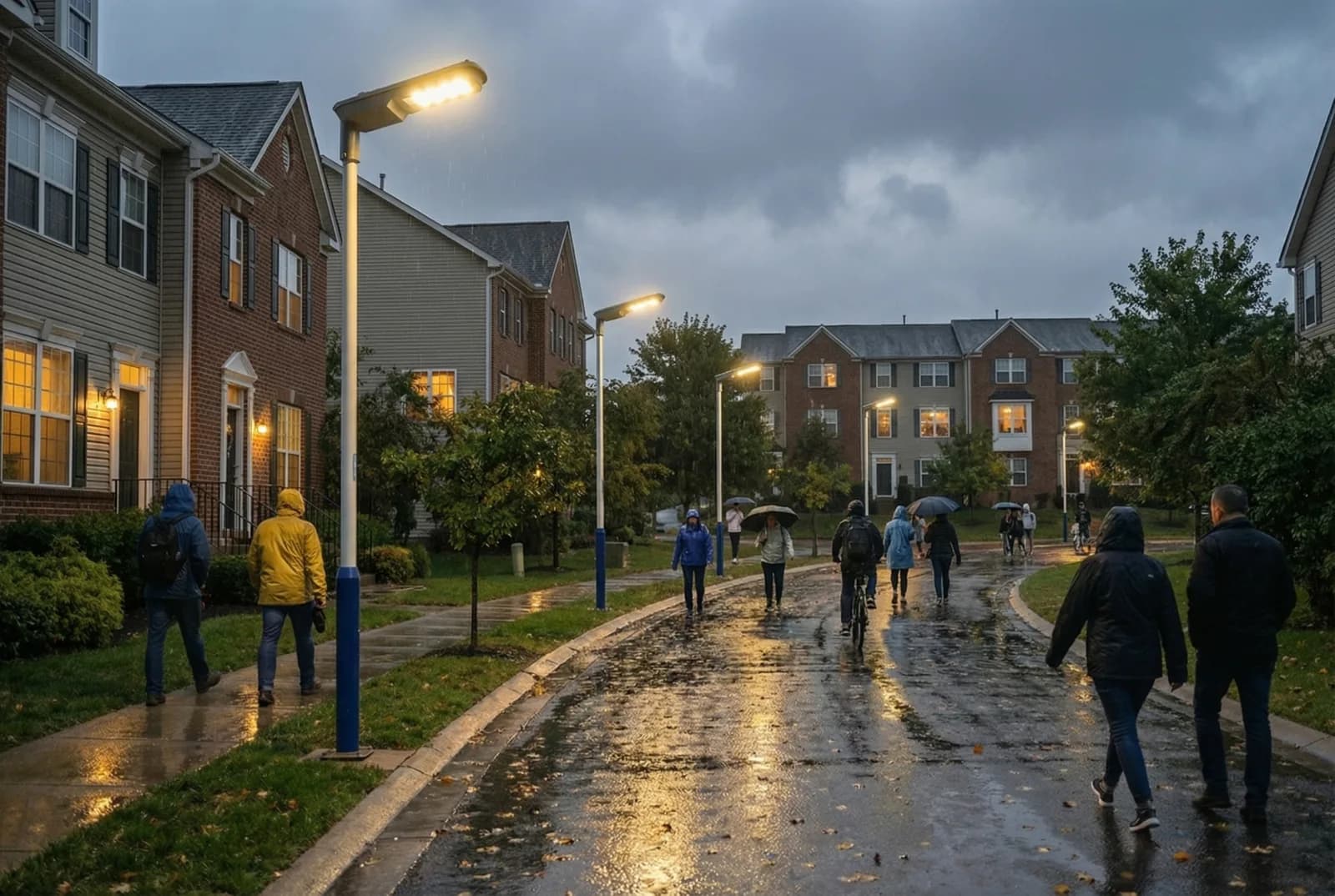
Every week, we receive inquiries that start with "I want motion sensor solar street lights" or "I need constant-brightness solar lights" — and roughly half the time, the buyer has picked the wrong type for their application.
The confusion is understandable. Motion sensor sounds like a universal upgrade: detect people, save energy, what is not to like? But a motion activated solar street light on a busy highway is worse than useless — it creates dangerous flickering as vehicles trigger constant brightness changes. And a constant-brightness light on a quiet residential path wastes 40-60% of its battery capacity illuminating empty space all night.
The right choice depends on one variable: how much traffic does the road carry after dark? Everything else — cost, battery size, maintenance — follows from that single question.
How Motion Sensor Solar Street Lights Work
A solar street light with motion sensor operates in a three-phase cycle that repeats throughout the night. Understanding this cycle is essential to understanding when the technology helps and when it hurts.
Phase 1: Standby Mode (30% Brightness)
When no motion is detected, the light runs at approximately 30% of its rated output. A 20W motion sensor model draws roughly 6W during standby. This is not darkness — it provides ambient illumination sufficient for spatial orientation and basic safety. Pedestrians can see the path. Drivers can see the road edge. The area is not "dark" in any practical sense.
Phase 2: Motion Detected (100% Brightness)
When the motion sensor detects a moving heat signature — a person, a vehicle, a large animal — the light instantly boosts to 100% output. The transition takes less than 0.5 seconds. Full brightness holds for a configurable duration, typically 5 to 30 seconds after the last detected motion.
Phase 3: Return to Standby
After the hold time expires with no further motion detected, the light ramps back down to 30%. The cycle repeats as needed throughout the night.
The Net Effect on Energy
This three-phase cycle produces 40-60% battery savings compared to running at constant full brightness all night. The exact savings depend on traffic density — a path with 20 motion triggers per night saves more than one with 200 triggers. But even in moderately trafficked residential areas, the savings are substantial enough to allow a smaller battery, a smaller solar panel, or longer autonomy days.
Side-by-Side: Motion Sensor vs Constant Brightness at the Same Wattage
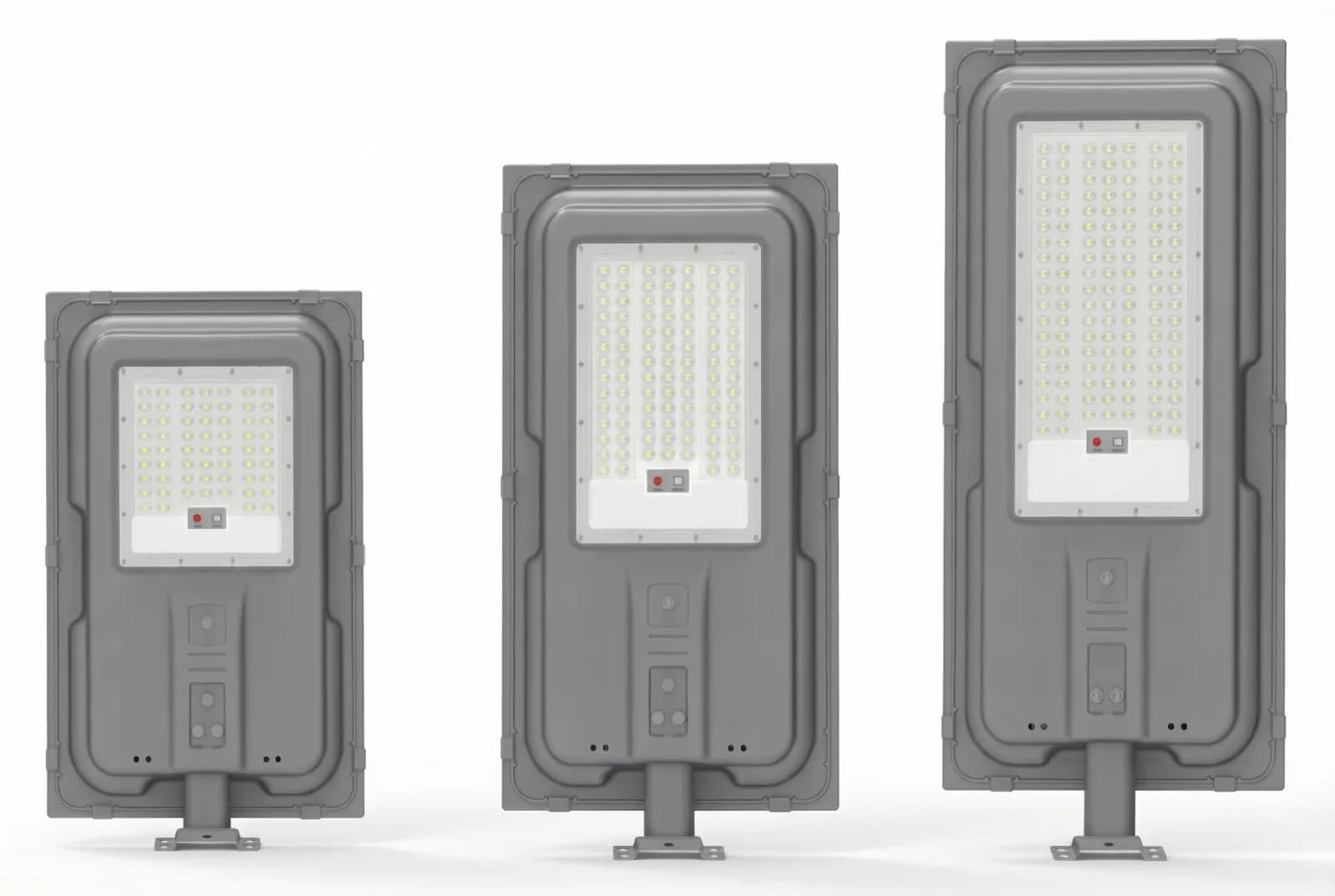
Numbers matter more than marketing. Here is a direct comparison between our BF-MSS-23-40W (motion sensor) and our BF-SSL-20-65W (constant brightness). Same LED wattage. Same lumen output. Different operating philosophy.
| Specification | BF-MSS-23-40W (Motion Sensor) | BF-SSL-20-65W (Constant) |
|---|---|---|
| Solar Panel Power | 40 W | 65 W |
| Lumen Output | 3,800 LM | 3,800 LM |
| LED Chip | 5054 | 5054 |
| Sensor Type | Motion sensor (light + time + human) | None (light + time) |
| Standby Power | ~6 W (30%) | 20 W (100% all night) |
| Battery Chemistry | LiFePO4 | LiFePO4 |
| Battery Capacity | 192 Wh | 240 Wh |
| Nightly Consumption (est.) | ~96 Wh | ~160 Wh |
| Autonomy (typical) | 2+ nights | 1.5 nights |
| Best Application | Low-traffic residential, paths | Main roads, high-traffic areas |
The motion sensor model achieves the same peak brightness with a 20% smaller battery. This is not a compromise — it is physics. When the light spends 70% of the night at 30% power, the energy budget shrinks accordingly. The smaller battery means lower unit cost, lighter weight, and less demand on the solar panel.
But — and this is the critical caveat — the BF-MSS-23-40W is not suitable for a road where vehicles pass every 30 seconds. On that road, the motion sensor triggers constantly, the light never enters standby, and you have paid for a sensor that adds cost and complexity without delivering savings. Worse, the smaller battery designed for intermittent use may not sustain constant full-brightness operation through the entire night.
Application Decision Matrix: When to Use Each Type

This is the table we share with every B2B buyer who asks "motion sensor or constant?" It reflects our engineering team's recommendations based on field deployment data across both product lines.
| Application | Motion Sensor? | Why |
|---|---|---|
| High-traffic main road | No | Constant brightness required for continuous vehicle traffic. Motion sensor adds cost without benefit. |
| Residential street | Yes | Low nighttime traffic. 40-60% battery savings with no reduction in safety. |
| Community pathway | Yes | Intermittent pedestrian use. Standby ambient light sufficient between motion events. |
| Parking lot perimeter | Yes | Security boost — instant full brightness on motion alerts both the person and any observers. |
| Construction site | Yes | Lighting needed only when workers are present. Massive battery savings during idle hours. |
| Highway | No | Constant illumination mandatory for high-speed vehicle safety. Any brightness variation is dangerous. |
| Village road (main) | No | Even in low-traffic villages, main roads carry steady evening traffic. Constant brightness preferred. |
| Village road (side path) | Yes | Very low traffic after dark. Motion sensor extends battery life significantly. |
| School campus | Yes | Activity concentrated in early evening. Standby mode covers the quiet hours. |
| Industrial facility perimeter | Yes | Security application. Motion-triggered brightness serves as a visual deterrent. |
The pattern is clear: motion sensor wins where traffic is intermittent and loses where traffic is continuous. The boundary is not precise — a village main road with 10 vehicles per hour after midnight is a judgment call. But the extremes are unambiguous.
Battery Savings Math: Real Numbers from Real Products
Let us calculate the actual energy savings using our product specifications. This is the math our engineering team runs when sizing batteries for each model.
Scenario: 12-Hour Night, Low-Traffic Residential Street
BF-SSL-20-65W (Constant Brightness):
- Consumption: 20W x 12 hours = 240 Wh
- Battery required: 240 Wh minimum (our spec: 240 Wh LiFePO4)
- Autonomy: 240 / 240 = 1.0 night at full power
- With adaptive dimming (100% for 5h, 50% for 7h): (20 x 5) + (10 x 7) = 170 Wh per night
- Autonomy with dimming: 240 / 170 = 1.4 nights
BF-MSS-23-40W (Motion Sensor):
Assume 15 motion triggers per night, each lasting 30 seconds. Total full-brightness time: 7.5 minutes. Remaining: 11 hours 52.5 minutes at 30%.
- Full brightness: 20W x 0.125h = 2.5 Wh
- Standby: 6W x 11.875h = 71.25 Wh
- Total consumption: 73.75 Wh
- Battery: 192 Wh LiFePO4
- Autonomy: 192 / 73.75 = 2.6 nights
The difference: 73.75 Wh vs 170 Wh per night. The motion sensor model consumes 57% less energy. Even accounting for more generous motion triggers — say 60 triggers of 30 seconds each (total 30 minutes at full power) — consumption rises to only 81.25 Wh. The savings hold under any realistic low-traffic scenario.
This is why the BF-MSS-23 Series can deliver 2+ nights of autonomy with a battery that is 48 Wh smaller than the BF-SSL-20 Series. Smaller battery, lower cost, same peak performance. The motion sensor is not just an energy-saving feature — it is a system-level cost optimization.
Our Motion Sensor Models
We currently offer two motion sensor solar street light series, each designed for different mounting and aesthetic requirements.
BF-MSS-23 Series (10W / 20W / 25W)
The BF-MSS-23 Series is our standard motion sensor model. Available in three wattage configurations:
- BF-MSS-23-25W: 1,900 LM, suited for 3M poles, narrow pathways
- BF-MSS-23-40W: 3,800 LM, suited for 5M poles, residential streets
- BF-MSS-23-50W: 4,750 LM, suited for 6M poles, wider residential roads
All three share: motion sensor with light + time + human control modes, LiFePO4 battery, MPPT controller, and IP65 protection.
BF-MSS-24 Series (10W / 15W / 20W)
The BF-MSS-24 Series is our ultra-slim design — lower profile, lighter weight, better suited for installations where visual elegance matters. Available in three configurations:
- BF-MSS-24-25W: Ultra-slim housing, pathway and garden applications
- BF-MSS-24-30W: Mid-range, campus and community roads
- BF-MSS-24-35W: Full residential capability in a slim form factor
Same sensor technology and battery chemistry as the BF-MSS-23 Series, with a housing redesigned for reduced wind profile and improved aesthetics.
Motion Sensor: What It Can and Cannot Do
The motion sensor in our models detects changes in infrared radiation — essentially, it senses moving heat sources against a cooler background. Understanding its capabilities and limitations prevents misapplication.
Detection range: 8-12 meters, depending on ambient temperature and target size. A walking person at 10 meters triggers reliably. A slow-moving person at 15 meters may not.
Detection angle: 120 degrees horizontal. The sensor covers a wide cone beneath the light, but does not detect motion behind the fixture or at extreme off-axis angles.
Response to vehicles: Vehicles produce large heat signatures and trigger the sensor reliably at the full detection range. This is desirable on residential streets and problematic on busy roads (constant triggering).
Environmental factors: Sensor sensitivity decreases when ambient temperature approaches body temperature (above 35 degrees C in extreme heat). Performance is reliable down to -20 degrees C. Heavy rain does not significantly affect motion detection — water droplets are too small to register as motion events.
FAQ
Choosing Between Our Models
If your project needs motion sensor capability, the choice between BF-MSS-23 Series and BF-MSS-24 Series comes down to aesthetics and wattage range. The BF-MSS-23 Series reaches 25W for wider road coverage. The BF-MSS-24 Series maxes at 20W but offers a slimmer profile that blends better in residential and campus environments.
If your project needs constant brightness — main roads, highways, high-traffic intersections — our BF-SSL-20 Series (45-90W panel), BF-SSL-21 Series (65-120W panel), and BF-SSL-22 Series (60-120W panel) cover the full range. See our how to choose a solar street light guide for model-by-model selection criteria.
For many large-scale projects, the right answer is a mix: motion sensor models on side streets and pathways, constant-brightness models on main roads. We supply both from the same factory, same lead time, same quality standards. A mixed order does not complicate procurement — it optimizes your budget.
Get Specifications for Your Project
Browse our complete motion sensor solar street light range for full datasheets, or compare against our constant-brightness solar street lights to see which fits your application. For security-focused deployments, explore our security solar lighting solutions. For residential projects, see our residential solar lighting solutions.
Need help deciding? Send us your project details — road type, pole height, traffic density, location — and our engineering team will recommend the right model mix. We would rather sell you the correct product than the most expensive one.
For further reading:
- How to Choose Solar Street Lights: 7 Key Specs — full selection framework
- PIR vs Microwave Sensor: Engineering Comparison — deep dive into sensor technology tradeoffs
- Solar Street Light Product Range — all models with specifications
- Security Solar Lighting Solutions — motion-triggered security configurations
- Residential Solar Lighting Solutions — neighborhood and community deployments