

We build solar flood lights from 20 W to 150 W solar panels at our factory in Fujian. We have shipped to 30+ countries. And we hear the same complaint from buyers who come to us after buying elsewhere: "It was bright for six months, then it died."
Here are the 6 specs that actually determine whether your solar flood light will still work in year 3 — and how to read them on any supplier's spec sheet.
Why 80% of Cheap Solar Flood Lights Fail Within 18 Months
Solar flood lights combine four systems — solar panel, charge controller, battery, and LED module — into one outdoor fixture. Each has its own failure mode, and budget manufacturers cut corners on all four.
Battery chemistry is the primary killer. Cheap 18650 NMC cells offer 300-500 charge cycles. One cycle per night = 10-16 months of useful life. Then runtime drops from 8 hours to 3, then 1, then zero.
Controller quality is the silent killer. A poor PWM controller overcharges the battery every cycle and wastes 15-25% of solar energy as heat. After 12 months, the battery has endured thousands of suboptimal cycles and the panel has effectively been 20% smaller than its rating.
IP sealing fails gradually. Budget silicone gaskets harden under UV. By month 12, micro-cracks admit humidity. By month 18, corrosion reaches the PCB.
These three failure modes drove our BF-SFL-26 Series and BF-SFL-27 Series design decisions: LiFePO4 batteries, MPPT controllers, die-cast aluminum with compression gaskets.
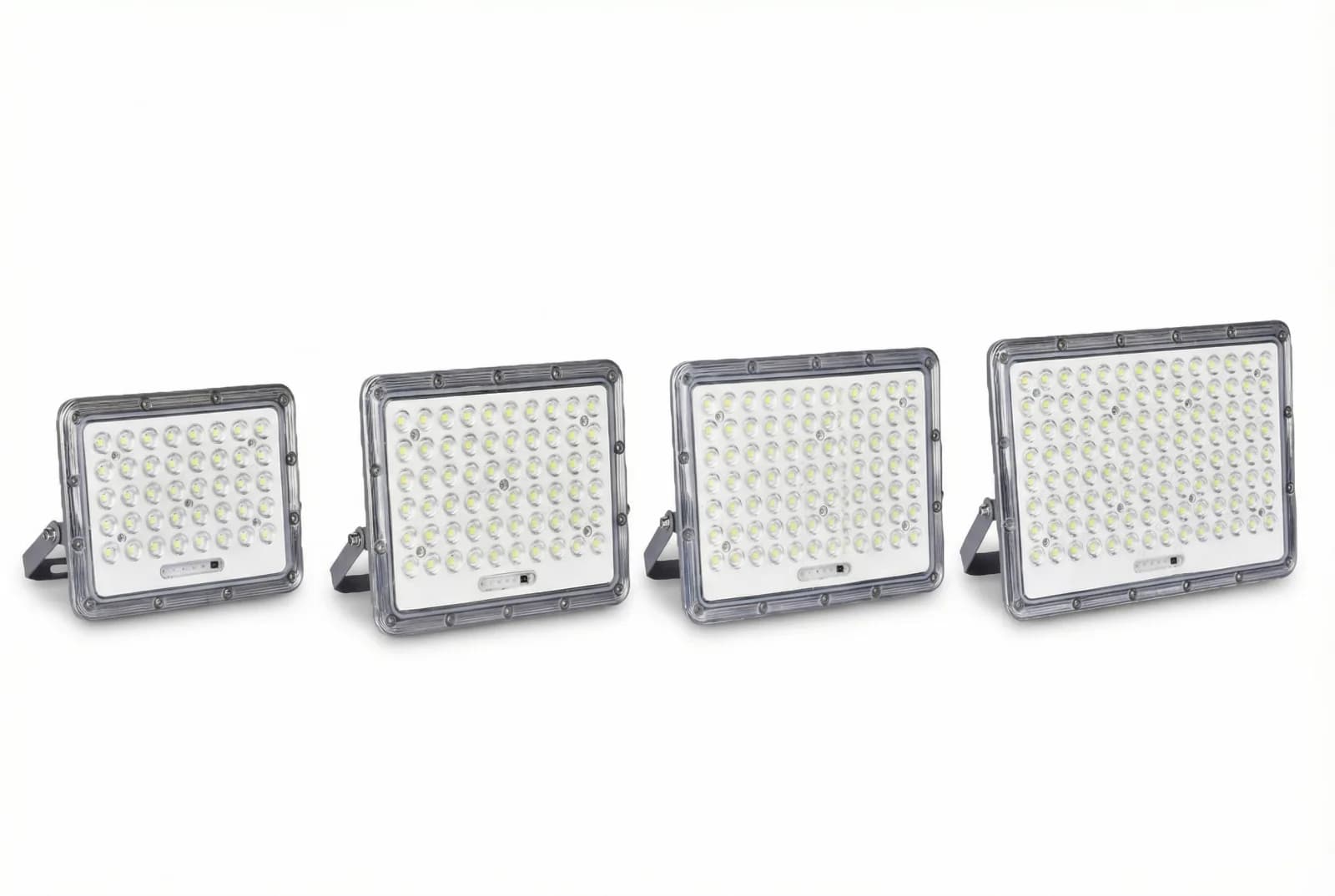
The 6 Specifications That Actually Matter
1. Lumens, Not Watts — The Only Brightness Number Worth Reading
Wattage measures power consumption. Lumens measure light output. The ratio — lumens per watt (lm/W) — reveals LED technology quality:
- Low-efficiency chips: Outdated technology. Drains battery faster, needs larger panel.
- Mid-efficiency chips: Acceptable for current-generation products.
- High-efficiency chips (5050, 5054): Our BF-SFL-26 Series and BF-SFL-27 Series use these for industry-leading luminous efficacy.
- Claims above 250 lm/W: Fabricated. No commercial LED chip achieves this.
Why this matters for solar: In AC fixtures, low efficiency means higher bills. In solar, it means shorter runtime and longer charging. Efficiency determines whether the system works at all.
How to verify: Get the LED chip model, look up its datasheet efficiency, multiply by LED wattage, derate 10-15%. If claimed lumens exceed this by 20%+, the spec is inflated.
2. Battery Chemistry — LiFePO4 vs. 18650: A 5x Lifespan Difference
This single spec determines whether a solar flood light survives past 18 months.
| Specification | LiFePO4 (3.2 V) | 18650 NMC/LCO (3.7 V) |
|---|---|---|
| Cycle life to 80% | 2,000+ cycles (5-7 years) | 300-500 cycles (10-16 months) |
| Thermal runaway risk | None — inherently stable | Yes — documented fire incidents |
| Discharge curve | Flat — consistent brightness | Sloping — visible dimming |
| Temperature range | -20 to 60 degrees C | Degrades below 0 degrees C |
Every BF-SFL-26 Series and BF-SFL-27 Series model uses 3.2 V LiFePO4. The cost premium is 30-40% over 18650 packs, but buys 4-5x the service life. On a per-year basis, LiFePO4 is cheaper.
How to verify: Check the voltage. 3.2 V nominal = LiFePO4. 3.7 V nominal = NMC/LCO. This one number tells the truth regardless of marketing copy.
3. Panel Wattage Ratio — The Spec Nobody Checks
The solar panel must harvest enough energy during daylight hours to fully charge the battery for nighttime operation. The ratio between panel wattage and LED wattage determines whether this is mathematically possible in your climate.
Minimum viable ratio: 2.5:1 (panel watts to LED watts)
This assumes 4-5 peak sun hours per day and 8-10 hours of designed runtime. In tropical and subtropical regions with consistent solar irradiance, 2.5:1 works. In higher latitudes, monsoon climates, or winter conditions, you need 3:1 or higher.
Quick formula: Panel W x peak sun hours x controller efficiency (0.85 MPPT / 0.70 PWM) = daily harvest (Wh). Compare against LED W x runtime hours = nightly consumption (Wh). If harvest < consumption, the system fails.
Example — BF-SFL-27-70W: 30 W x 10 hours = 300 Wh nightly consumption. With MPPT at 85% efficiency and 5 peak sun hours, minimum panel = 300 / (5 x 0.85) = approximately 71 W.
Red flag: A 30 W LED with a 30 W panel cannot work. The fixture will shut off early or drain the battery to damaging depths every night.
4. IP Rating — What the Numbers Actually Mean
IP ratings consist of two digits. The first digit (0-6) rates solid particle protection. The second digit (0-9) rates water protection. For outdoor solar flood lights, IP65 is the standard:
- IP65: Dust-tight (6) and protected against water jets from any direction (5). Suitable for wall-mounted, ground-level, and exposed installations.
The real question: IP ratings are tested on new units in lab conditions. Whether sealing holds after 3 years of UV, thermal cycling, and vibration depends on materials. Die-cast aluminum with compression gaskets (not adhesive silicone) maintains integrity far longer than plastic. All BF-SFL-26 Series and BF-SFL-27 Series models use EPDM compression gaskets rated for 10+ years.
How to verify: Ask for the IP test certificate with lab name and number. No certificate = self-declared rating.
5. Controller Type — MPPT vs. PWM: 25-30% Energy Difference
The charge controller regulates charging between the solar panel and battery. Two technologies exist:
MPPT (Maximum Power Point Tracking): Continuously adjusts operating voltage to extract maximum power. 85-95% conversion efficiency. Maintains performance when panel is partially shaded, dusty, or at non-optimal angles.
PWM (Pulse Width Modulation): Connects panel directly to battery at battery voltage. 65-75% conversion efficiency. Performance drops significantly with shade, dust, or suboptimal angles.
The practical difference: In real-world conditions, MPPT harvests 25-30% more energy from the same panel compared to PWM. This means 25-30% more runtime per night. The additional circuit cost is approximately $2-3 per unit — there is no engineering justification for using PWM in a product designed to last 5+ years. Every BF-SFL-26 Series and BF-SFL-27 Series model uses MPPT.
6. Housing Material — Thermal Management and Structural Life
The housing serves three functions: structural mounting, thermal management, and environmental sealing.
Die-cast aluminum is the only material suitable for professional solar flood lights. It conducts heat away from the LED junction (keeping chips efficient and long-lived), resists corrosion with powder coating or anodizing, withstands wind loads at height, and is completely UV-stable.
Injection-molded plastic (ABS/PC) traps heat at the LED junction, accelerating lumen depreciation. UV exposure causes brittleness within 2-3 years. Lower unit cost is offset by shorter replacement cycles.
Plastic body with bonded aluminum heat sink is a mid-range compromise. Thermal performance improves over pure plastic, but the plastic body still degrades under UV, and the aluminum-plastic bond can fail under thermal cycling.
All BF-SFL-26 Series and BF-SFL-27 Series models use die-cast aluminum with integrated heat sink fins. LED junction temperature stays below 65 degrees C at maximum power in 45 degrees C ambient — well within L70 lifetimes exceeding 50,000 hours.
Product Specifications: BF-SFL-26 Series and BF-SFL-27 Series
BF-SFL-26 Series — Compact Integrated Design
All-in-one housing with integrated solar panel. Single-unit installation — mount, aim, done.
| Model | Solar Panel Power | Lumens | LED Chip | Battery | Controller | IP Rating |
|---|---|---|---|---|---|---|
| BF-SFL-26-20W | 20 W | 1,900 lm | 5050 | 3.2 V LiFePO4 | Light + Time Control | IP65 |
| BF-SFL-26-30W | 30 W | 2,470 lm | 5050 | 3.2 V LiFePO4 | Light + Time Control | IP65 |
| BF-SFL-26-40W | 40 W | 3,420 lm | 5050 | 3.2 V LiFePO4 | Light + Time Control | IP65 |
| BF-SFL-26-50W | 50 W | 3,800 lm | 5050 | 3.2 V LiFePO4 | Light + Time Control | IP65 |
| BF-SFL-26-60W | 60 W | 4,750 lm | 5050 | 3.2 V LiFePO4 | Light + Time Control | IP65 |
All models: high-efficiency 5050 LED chips, dusk-to-dawn light sensor, programmable time control, die-cast aluminum housing, tempered glass lens, adjustable bracket (wall/pole).
BF-SFL-27 Series — High-Power Split-Type Design
Separate solar panel connected via cable. Panel and light mount independently.
| Model | Solar Panel Power | Lumens | LED Chip | Battery | Controller | IP Rating |
|---|---|---|---|---|---|---|
| BF-SFL-27-70W | 70 W | 5,700 lm | 5054 | 3.2 V LiFePO4 | Light + Time Control | IP65 |
| BF-SFL-27-100W | 100 W | 11,400 lm | 5054 | 3.2 V LiFePO4 | Light + Time Control | IP65 |
| BF-SFL-27-150W | 150 W | 15,200 lm | 5054 | 3.2 V LiFePO4 | Light + Time Control | IP65 |
All models: high-efficiency 5054 LED chips (optimized for higher current), split panel design, MPPT controller, heavy-duty die-cast aluminum housing.

Integrated vs. Split-Type: When to Use Which
The answer depends on one factor: whether the best lighting position gets direct sun.
Choose BF-SFL-26 Series (Integrated) when:
- Mounting surface has unobstructed sky exposure
- Installation is wall, fence, or pole in an open area
- Required illumination is 5,000 lumens or below
- Project scale favors speed — no cable routing needed
Choose BF-SFL-27 Series (Split-Type) when:
- Light must illuminate a shaded area (under eaves, covered yard, building north face)
- Optimal lighting angle does not face the sun path
- You need more than 5,000 lumens (BF-SFL-27 Series reaches 15,200 lm)
- High-latitude sites require different panel tilt vs. light aim
The tradeoff: Integrated units have fewer failure points but less flexibility. Split-type units solve the fundamental problem — the sun and the target are rarely in the same direction.
Application Matrix: Matching Models to Projects
| Application | Recommended Model | Why |
|---|---|---|
| Sign / Billboard | BF-SFL-26-40W (3,420 lm) | Covers a 3x6 m sign at 5-8 m throw. Integrated design for pole-top. See billboard lighting guide. |
| Perimeter security | BF-SFL-27-70W (5,700 lm) | Wide coverage for fence lines. Split design frees panel from sight lines. See security solutions. |
| Farm yard | BF-SFL-26-60W (4,750 lm) | Working visibility in open areas. Integrated = simple install. See farm solutions. |
| Construction site | BF-SFL-27-100W (11,400 lm) | High output, repositionable. No generator dependency. |
| Residential entrance | BF-SFL-26-20W (1,900 lm) | Entrance visibility without over-illumination. Compact. |
| Parking / commercial | BF-SFL-27-150W (15,200 lm) | Maximum output. Mount on 6-8 m pole, space at 20-25 m. |
Quality Red Flags: How to Spot a Bad Solar Flood Light
Here are the warning signs we tell every new customer to watch for.
Fake lumen claims. A 20 W light claiming 10,000 lumens is physically impossible with current LED technology. Cross-reference the LED chip model datasheet to verify realistic lumen output. Anything far above the chip's rated efficiency is fabricated.
"Lithium battery" without specifying LiFePO4. Check the voltage: 3.2 V nominal = LiFePO4 (5+ year life). 3.7 V nominal = NMC/LCO 18650 cells (18 month life). This one number tells you the truth.
PWM controllers labeled "intelligent MPPT." Genuine MPPT boards contain a DC-DC converter with toroidal inductor, switching MOSFETs, and dedicated MPPT IC. A simple board with a few capacitors is PWM regardless of the label.
Plastic housings with paint. Die-cast aluminum needs powder coating or anodizing, not paint. Paint on plastic hides cheap material — it will peel, crack, and admit moisture within 2 years.
No IP test certificate. Any factory can print "IP65." The certification requires accredited lab testing and a numbered certificate. No certificate on request = self-declared and meaningless.
Wattage listed without lumen data. A "100 W solar flood light" with no lumen spec means the supplier is counting on you to assume higher watts = brighter. Without lumen output data, wattage tells you nothing about brightness.
Frequently Asked Questions
Next Steps
Browse our complete solar flood light range with full specifications, photometric data, and pricing for every BF-SFL-26 Series and BF-SFL-27 Series model.
Related resources:
- AC vs Solar Flood Light: Engineering Comparison — When grid power makes more sense
- Solar Billboard Lighting Configuration Guide — Detailed sign illumination setup
- Security Solar Lighting Solutions — Perimeter and access point configurations
- Farm Solar Lighting Solutions — Agricultural yard and livestock area coverage