

Our engineering team in Fujian designs and manufactures both AC-powered LED flood lights and solar flood lights. We do not have a financial incentive to push one over the other — we sell both. This comparison is based on our own production specifications, lab testing, and field data from installations across 30+ countries.
The short answer: neither technology is universally superior. The right choice depends on grid access, brightness requirements, installation constraints, and climate. This guide gives you the engineering data to make that decision.

Quick Decision Table for Commercial Projects
Use this table before you compare fixture price. The real cost difference usually comes from trenching, wiring, permitting, and whether the fixture must run at full brightness all night.
| Site Condition | Choose Solar Flood Lights When | Choose AC Flood Lights When |
|---|---|---|
| Grid access | Cable runs are long, expensive, or impossible | Power is already at the mounting point |
| Installation surface | Asphalt, farm roads, temporary sites, remote yards | New construction with planned conduit |
| Brightness demand | Up to 15,200 LM from a 150W solar panel is enough | 200W+ or 20,000+ LM per fixture is required |
| Operating pattern | Dusk-to-dawn with dimming or motion boost is acceptable | Full output must run every hour, every night |
| Project type | Parking edges, farms, perimeter, construction, signage | Stadiums, loading docks, high-security CCTV zones |
| Financial driver | Lower 5-year TCO and fast deployment | Maximum lumen output and grid reliability |
For parking-area projects, pair this comparison with the dedicated commercial solar parking lot lighting guide.
Product Lines at a Glance
Before we compare, here are the specific product lines we are drawing data from:
Solar Flood Lights:
- BF-SFL-26 Series (20-60W panel, 1,900-4,750 LM) — compact integrated (all-in-one) with LiFePO4 battery, 120-degree beam, radar sensor option. Suited for residential security, small signage, and pathway lighting.
- BF-SFL-27 Series (70-150W panel, 5,700-15,200 LM) — high-output split-type with separate solar panel, LiFePO4 battery, intelligent charge controller, 120-degree beam. Designed for commercial parking, perimeter security, and billboard illumination.
AC LED Flood Lights:
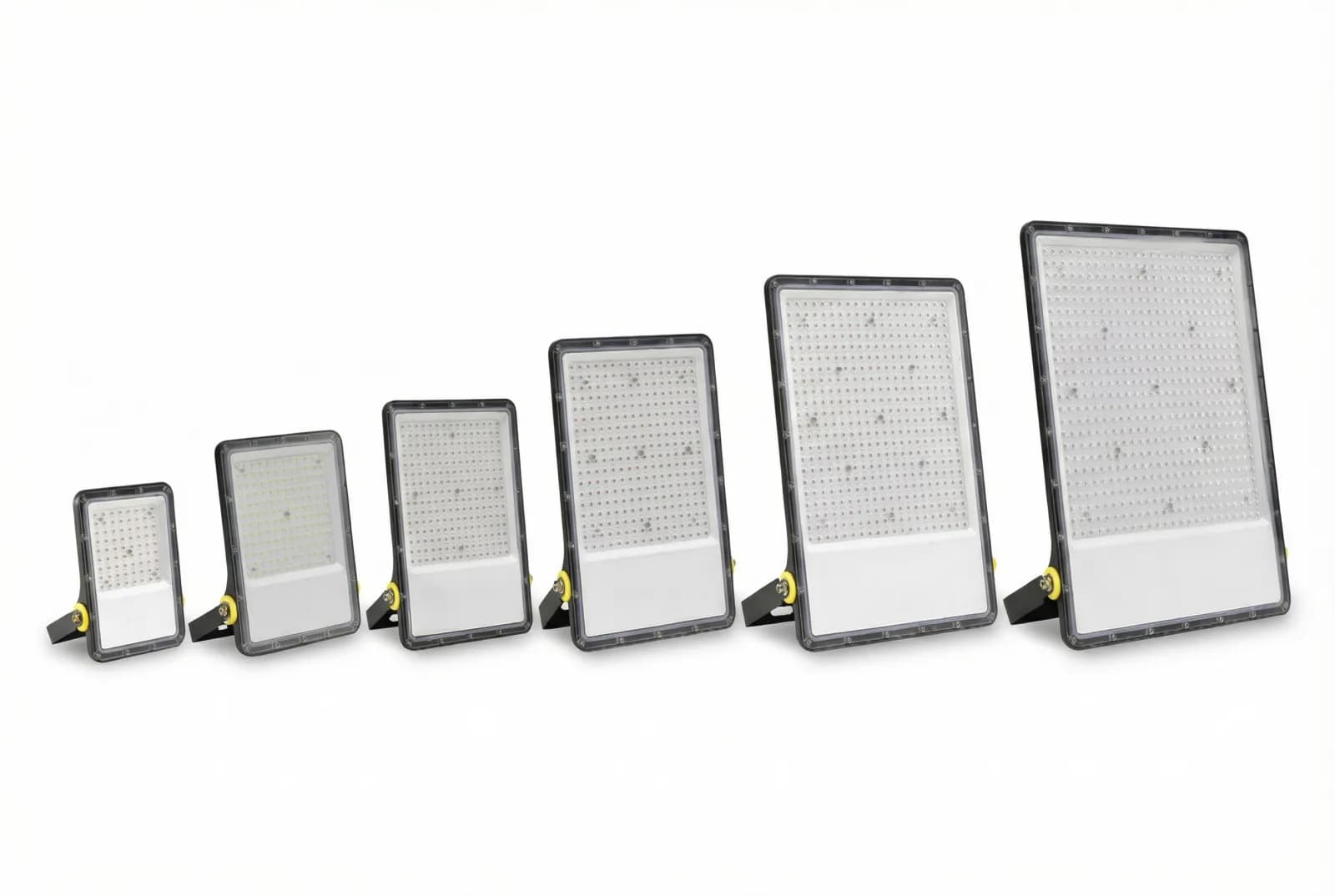
- BF-LFL-28 Series (50-400W, 7,500-60,000 LM) — ultra-slim 35mm profile, high-efficiency 3030 LED chips, premium industrial-grade driver, die-cast aluminum. Ideal for facades, billboards, and aesthetic installations.
- BF-LFL-29 Series (50-400W, 7,500-60,000 LM) — modular multi-head design, independently serviceable modules. Built for stadiums, warehouses, and high-mast sports lighting.
Browse our solar flood lights and LED flood lights for complete specifications.
Power Source: Grid Dependency vs. Solar Independence
AC flood lights draw power from the electrical grid through standard wiring. They deliver consistent brightness regardless of weather or season — a 200W BF-LFL-28 Series produces 30,000 lumens at midnight in January exactly as it does in July. The tradeoff: you need grid access, cabling, circuit breakers, and a licensed electrician.
Solar flood lights generate and store their own energy. Zero electricity cost, zero wiring. Our BF-SFL-27 Series uses intelligent charge controllers optimized for maximum energy harvest, particularly in partial-shade conditions. The tradeoff: output depends on solar charging, which varies by season and climate. A fully charged BF-SFL-27-150W unit delivers 15,200 lumens at full brightness for 4-6 hours, then the controller reduces output to 50-60% for remaining night hours.
The physics reality: A 50W solar panel in a region receiving 4 peak sun hours generates approximately 200 Wh per day. After charge controller and battery losses (15-20%), roughly 160-170 Wh reaches the LED. That powers a 30W LED at full brightness for about 5.5 hours. To match a 200W AC flood light running 10 hours nightly, you would need approximately 2,000 Wh of solar harvest — requiring a 500W panel array and massive battery. This is why solar flood lights cap at 80W while AC units scale to 400W and beyond.
Verdict: If you have reliable grid access and need sustained high output (200W+), AC wins on raw consistency and scalability. If grid access is expensive, unreliable, or unavailable, solar flood lights are the clear choice for applications up to 80W.
Lumen-per-Watt Efficiency: Different Chips, Different Constraints
Our solar and AC flood lights use different LED chip families optimized for their respective power systems. The BF-SFL-26 Series uses 5050 SMD chips, the BF-SFL-27 Series uses 5054 SMD chips — both selected for high efficacy at low-current DC drive. AC models use 3030 SMD chips optimized for high-current operation with AC drivers. These are different chip architectures, and the performance difference emerges at system level:
| Specification | Solar Flood Light | AC Flood Light |
|---|---|---|
| LED chip type | 5050 (BF-SFL-26 Series) / 5054 (BF-SFL-27 Series) | 3030 |
| System efficiency | High-efficiency DC-optimized | High-efficiency AC-optimized |
| Solar panel power | 20-150W | N/A (mains powered) |
| LED power range | Sized to the panel and dimming schedule | 50-400W |
| Max lumen output | 15,200 LM (BF-SFL-27-150W) | 60,000 LM (BF-LFL-29-400W) |
| Brightness consistency | Varies with battery state | Constant |
| Operating hours at full brightness | 4-6 hrs | Unlimited (grid-powered) |
Solar units achieve higher system efficiency because they use direct DC power — no AC-to-DC driver conversion loss — and the 5050/5054 chip architecture is optimized for low-current, high-efficacy operation. AC units lose 5-8% through the industrial-grade driver but compensate with unlimited operating time and far higher maximum wattage.
For applications demanding full brightness all night (security monitoring, sports courts, 24/7 warehouse lighting), AC is superior. For general area lighting where smart dimming is acceptable — parking lots, pathways, signage — solar provides adequate illumination at zero running cost. Read our solar flood light buying guide for detailed lumen-to-application matching.
Installation: Complexity, Time, and Real Cost
This is where solar delivers its most dramatic advantage. We have timed installations across hundreds of projects:
AC Flood Light Installation
- Trenching — underground cable run from distribution board to fixture location: $5-15 per meter depending on surface (grass vs. concrete vs. asphalt)
- Cabling — electrical cable, conduit, junction boxes: $2-5 per meter
- Circuit connection — circuit breaker, RCD, wiring at distribution board: $30-80 per circuit
- Licensed electrician — required by code in most jurisdictions: $40-100/hour
- Fixture mounting — bracket installation, aiming, wiring to junction box: 30-60 minutes per fixture
- Inspection — electrical inspection required in many markets: $50-150
Total time per fixture: 2-4 hours (plus trenching time) Total installation cost per fixture: $100-400 depending on cable run distance
Solar Flood Light Installation
- Mount bracket — wall mount, pole clamp, or ground stake: 10-15 minutes
- Position solar panel — aim toward optimal solar exposure, connect 5m cable to light: 5-10 minutes
- Power on — flip switch: 30 seconds
Total time per fixture: 15-30 minutes Total installation cost per fixture: $5-15 (basic tools, mounting hardware included)
The math: For a 10-fixture perimeter lighting project with average 30-meter cable runs, AC installation adds $3,000-6,000 to the project. Solar installation adds $50-150. This installation cost delta alone often pays for the higher unit cost of solar fixtures.
Running Cost: 5-Year Total Cost of Ownership
We calculated TCO across three project scales. Electricity cost assumed at $0.12/kWh (global commercial average), operating 10 hours per night, 365 days per year.
Scenario 1: Small Project (4 Fixtures, 30W Equivalent)
| Cost Item | AC Flood Light | Solar Flood Light |
|---|---|---|
| Unit cost (x4) | $60-100 | $180-280 |
| Installation (x4) | $400-800 | $20-60 |
| Electricity (5 yr) | $320-800 | $0 |
| Maintenance (5 yr) | $80-160 | $40-80 |
| 5-Year Total | $860-1,860 | $240-420 |
Scenario 2: Medium Project (10 Fixtures, Mixed 30-60W)
| Cost Item | AC Flood Light | Solar Flood Light |
|---|---|---|
| Unit cost (x10) | $200-500 | $500-900 |
| Installation (x10) | $1,500-4,000 | $50-150 |
| Electricity (5 yr) | $1,100-3,000 | $0 |
| Maintenance (5 yr) | $200-500 | $100-200 |
| 5-Year Total | $3,000-8,000 | $650-1,250 |
Scenario 3: Large Project (20 Fixtures, Mixed Wattages)
| Cost Item | AC Flood Light | Solar Flood Light |
|---|---|---|
| Unit cost (x20) | $500-2,000 | $1,200-2,400 |
| Installation (x20) | $4,000-8,000 | $100-300 |
| Electricity (5 yr) | $2,600-8,000 | $0 |
| Maintenance (5 yr) | $400-1,000 | $200-400 |
| 5-Year Total | $7,500-19,000 | $1,500-3,100 |
Key insight: The larger the project and the longer the cable runs, the more decisively solar wins on TCO. The only scenario where AC achieves lower TCO is when grid infrastructure already exists at the fixture location (zero trenching cost) and electricity is heavily subsidized.
Solar wins on total cost of ownership in virtually every scenario. The battery replacement at year 5-8 (LiFePO4 rated for 2,000+ cycles) adds $15-40 per unit — still far below cumulative electricity costs.
Weather and Climate Considerations
Solar performance varies significantly by geography. This is the factor most buyers underestimate:
High solar irradiance regions (4.5+ peak sun hours/day): Sub-Saharan Africa, Middle East, India, Southeast Asia, Northern Australia, Southwestern US. Solar flood lights perform at full rated capacity. Our BF-SFL-27-150W units in Nigerian installations achieve full-brightness runtime of 6+ hours consistently year-round.
Moderate solar irradiance (3.5-4.5 peak sun hours/day): Southern Europe, Southern China, Central America, Eastern US. Solar works well for 8-9 months. Winter may reduce runtime by 20-30%. Spec one size up (e.g., 60W where 40W would suffice in summer) to compensate.
Low solar irradiance (below 3.5 peak sun hours/day): Northern Europe, Northern China, Canada, Pacific Northwest. Solar flood lights will underperform 3-5 months of the year. Extended cloudy periods (7+ consecutive overcast days) can deplete batteries. Consider the hybrid approach (see below) or AC for critical applications.
Monsoon and tropical storm regions: Heavy rain seasons (3+ months) reduce solar harvest by 40-60%. However, these same regions typically enjoy intense sun during dry season. Oversizing the battery for 3-5 days of autonomy handles most monsoon gaps. Our BF-SFL-27 Series supports extended battery configurations for exactly this use case.
Temperature extremes: LiFePO4 batteries operate from -20C to 60C. Charge acceptance drops below 0C. In regions with extended sub-zero winters, AC flood lights are more reliable for continuous operation.
Application Decision Matrix
| Application | Recommended | Best Models | Reason |
|---|---|---|---|
| Remote rural roads | Solar | BF-SFL-27 Series (70-100W panel) | No grid access, moderate brightness sufficient |
| Construction sites | Solar | BF-SFL-27 Series (100-150W panel) | Temporary, relocatable, no generator dependency |
| Security perimeters (high-security) | AC | BF-LFL-28 Series 200-400W | Constant full brightness needed, CCTV support |
| Security perimeters (commercial) | Solar | BF-SFL-27 Series (70-100W panel) + radar | Motion activation adequate, zero power outage risk |
| Parking lots | Solar | BF-SFL-27 Series (70-150W panel) | Cost savings, easy installation |
| Sports courts (recreational) | AC | BF-LFL-29 Series 300-400W | High lumen demand (200+ lux), extended hours |
| Building facades / signage | Either | BF-SFL-26 Series (20-60W panel) or BF-LFL-28 Series 50-100W | Depends on grid access and sign size |
| Billboard lighting | Solar | BF-SFL-27 Series (70-150W panel) | Remote location, dusk-to-midnight timer sufficient (guide) |
| Warehouse exterior | AC | BF-LFL-28/29 Series 200-300W | All-night high brightness, grid already present |
| Agricultural perimeter | Solar | BF-SFL-27 Series (70-100W panel) | Remote fields, seasonal deployment (farm guide) |
| Disaster relief / emergency | Solar | BF-SFL-27 Series any wattage | Rapid deployment, zero infrastructure |
| Residential entrance | Solar | BF-SFL-26 Series (20-60W panel) | Simple installation, low wattage sufficient |
The Hybrid Approach: Using Both Technologies Together
For most mid-to-large projects, the optimal solution is not either/or — it is a deliberate combination. Our security lighting solution and farm lighting solution demonstrate this hybrid strategy in real deployments.
How to Design a Hybrid Installation
Zone 1 — Critical areas (AC): Entry gates, loading docks, CCTV zones, sports courts. These need constant full brightness and benefit from the higher wattage range of the BF-LFL-28 Series/BF-LFL-29 Series (200-400W). Wire them to the grid.
Zone 2 — General perimeter (Solar): Fence lines, pathways, parking areas, secondary entrances. These tolerate smart dimming and benefit from solar independence. Deploy BF-SFL-27 Series (70-100W panel) units at 15-20m intervals.
Zone 3 — Accent and signage (Solar): Signs, logos, landscape features. Low wattage, intermittent use. BF-SFL-26 Series units (20-60W panel) with timers.
Real Hybrid Example: 5,000 sqm Commercial Compound
- 4x BF-LFL-29 Series 300W (AC) at main gate and warehouse loading bay — constant 45,000 LM per fixture, CCTV-grade illumination
- 12x BF-SFL-27-100W (Solar) along perimeter fence — 11,400 LM per fixture, radar-activated full brightness on motion
- 6x BF-SFL-26-50W (Solar) at signage and pathways — 3,800 LM per fixture, dusk-to-dawn timer
Total installation cost: AC zone: $2,400-4,800 (fixtures + wiring). Solar zone: $1,800-3,600 (fixtures only). Combined: $4,200-8,400. If entire compound were AC: $8,000-16,000 (22 fixtures x wiring). The hybrid approach saves 40-50% on installation while delivering superior brightness where it matters most.
Reliability and Maintenance
AC flood lights have simpler electronics — LED module plus driver. The primary failure point is the driver. With premium industrial-grade drivers, the primary failure point is well managed. LED modules are designed for long-service-life operation. The housing and wiring require minimal maintenance. Practical lifespan: 8-12 years.
Solar flood lights add a battery and charge controller to the equation. The LiFePO4 battery is the lifecycle limiter — rated for 2,000+ charge cycles, which translates to 5-8 years depending on discharge depth. After cycle life, the battery retains 80% capacity and continues operating at reduced runtime. Battery replacement is a 15-minute field swap on our split-type models. LED and controller lifespan matches AC for long-service-life operation.
Field data from our installations: AC and solar product lines show similar 5-year survival rates (98%+) when quality components are used. The difference is failure mode: AC units fail suddenly (driver burns out, fixture goes dark), while solar units degrade gradually (battery aging reduces runtime by 10-15% per year after year 5).
FAQ
Our Recommendation
There is no single right answer. But after designing both product lines and seeing thousands of installations worldwide, here is our framework:
Choose solar when: grid access is unavailable or expensive, brightness needs are under 80W per fixture, installation speed matters, and your region receives 3.5+ peak sun hours daily. Solar wins on TCO in every scenario except pre-wired buildings with subsidized electricity.
Choose AC when: you need 200W+ per fixture, constant all-night full brightness is non-negotiable, the site already has electrical infrastructure, or your climate delivers fewer than 3.5 peak sun hours for extended periods.
Choose hybrid when: your project has mixed lighting zones with different brightness and reliability requirements — which describes most real-world commercial and industrial installations.
Browse our solar flood lights or LED flood lights to compare specific models. For technology deep-dives, read our solar flood light buying guide or LED flood light buying guide.