
Most LED flood light spec sheets are designed to impress purchasing managers, not to inform them. "Ultra-bright!" "Super energy saving!" — these phrases tell you nothing about whether the fixture will survive two summers outdoors. As the engineer who designs Beamfact's AC LED flood lights, I will walk you through the eight specifications that actually determine whether you are buying a professional fixture or an expensive paperweight.
This guide is for project buyers, contractors, and facility managers evaluating outdoor LED flood lights for commercial or industrial use. If you are comparing AC flood lights against solar alternatives, read our AC vs solar flood light comparison first — the power source decision should come before fixture selection.
The 8 Specifications That Actually Matter
1. Lumens per Watt Efficiency
This single number tells you more about fixture quality than any marketing claim. It measures how effectively the fixture converts electricity into visible light.
- Below 100 lm/W: Outdated chip technology. Avoid.
- 100-130 lm/W: Budget tier. Acceptable for temporary installations.
- 130-150 lm/W: Professional grade. Our BF-LFL-28 Series and BF-LFL-29 Series deliver 150 lm/W system efficiency — measured at the fixture level, not at the bare chip.
- Above 160 lm/W: Possible at chip level, but system-level claims above 160 lm/W should be verified with an integrating sphere report.
The financial impact: A 200W fixture at 150 lm/W produces 30,000 lumens. A competing 200W at 100 lm/W produces only 20,000. To match the output, you need 300W — 50% more electricity every hour for the life of the installation.
2. IP Rating
- IP65: Dust-tight, protected against water jets from any direction. The standard for permanent outdoor installation. All our flood lights are IP65.
- IP66: Higher water protection for coastal or typhoon-prone environments where powerful water jets are a concern.
Key question: Is the rating tested or self-declared? Any factory can print "IP65" on a label. Ask for the test report from a recognized lab. We perform IP testing on every new mold and random batch sampling during production.
3. LED Chip Quality
- Chip brand: Reputable 3030 SMD packages from Lumileds, Osram, or Bridgelux have published datasheets. Our BF-LFL-28 Series and BF-LFL-29 Series use 3030 chips — a proven form factor balancing density, thermal performance, and cost.
- LM-80 data: Quality chips maintain 90%+ output at 6,000 hours. Budget chips drop to 70% within 2,000 hours — your "200W" fixture effectively becomes 140W within a year.
- Color consistency: Professional chips are sorted into tight color bins (3-step MacAdam ellipse). Cheap chips produce visible bluish-yellowish variation across the array.
4. Driver Quality
The driver is the most common failure point in cheap flood lights.
- Brand-name drivers (Meanwell, Philips Xitanium, Inventronics) carry independent warranties and published MTBF data. Our standard is a premium industrial-grade driver with 5-year warranty. Field failure rate: less than 0.1%.
- Generic drivers save $3-8 per fixture. They cost $50-200 per fixture in field replacements and downtime. We have seen budget drivers fail within 6 months — capacitor degradation under sustained heat.
The test: Ask your supplier what driver brand they use. If they cannot answer immediately, treat it as a red flag.
5. Housing Material and Thermal Design
LEDs are not killed by age — they are killed by heat. A fixture that cannot move heat away from the LED junction fast enough will suffer accelerated lumen depreciation and premature driver failure. The housing must do both jobs: protect the electronics and dissipate heat.
- Die-cast aluminum: The standard for professional flood lights. Structural strength, corrosion resistance, and excellent thermal conductivity. Our BF-LFL-28 Series achieves its 35mm slim profile through optimized fin geometry maximizing surface area within minimal depth.
- Extruded aluminum: Acceptable for lower wattages. Less design flexibility than die-cast.
- Sheet metal or plastic: Avoid above 50W. Insufficient thermal mass and conductivity.
Quick test: Pick up the fixture. A quality 200W flood light should feel substantial — the aluminum needs enough mass to absorb and dissipate 40-60W of heat continuously. If a 200W unit feels similar in weight to a 50W unit, the housing is too thin for long-term thermal management.
6. Beam Angle
- 15-30 degrees (spot): Long-throw for signs and facade details from 15+ meters.
- 60 degrees (medium): Balanced for general area lighting at moderate mounting heights.
- 90-120 degrees (wide flood): Maximum coverage. Our standard 120-degree beam is ideal for parking lots, warehouses, and security perimeters.
- Asymmetric: Sports field side-throw and facade wash. Available on orders above 200 units.
Common mistake: Wide-angle flood lights on tall mounts. A 120-degree beam from 15 meters spreads light too thin. For high-mount sports lighting, 60 degrees concentrated on the playing surface delivers far better results.
7. Color Temperature
- 3000K (warm): Residential, hospitality, architectural accent.
- 4000K (neutral): Optimal for commercial — parking structures, retail exteriors, public spaces.
- 5000-6000K (cool/daylight): Maximum visual acuity. Preferred for industrial, security, and sports. Our standard: 6000K +/- 500K.
Security camera note: Cool white (5000K+) produces sharper contrast and better facial recognition on CCTV than warm white.
8. Surge Protection
Lightning surges destroy unprotected drivers instantly.
- 6 kV: Standard for outdoor commercial. Our baseline across all models.
- 10 kV: Recommended for tall poles in lightning-prone regions. Available on request.
- 20 kV: Required for stadium mast lighting.
We have seen parking lot installations lose 20+ fixtures in one storm because the original supplier used 2 kV-rated drivers. A 6 kV SPD adds less than $1 to BOM cost.
Wattage Selection: Matching Power to Application
Choosing the right wattage depends on what you are illuminating, the target lux level, and mounting height:
| Application | Recommended Wattage | Lux Target | Mounting Height |
|---|---|---|---|
| Small sign or entrance | 50W | 100-200 lux | 3-4M |
| Building facade | 100-150W | 50-100 lux | 5-8M |
| Parking lot (supplementary) | 200W | 20-50 lux | 6-8M |
| Warehouse exterior | 200-300W | 50-100 lux | 8-10M |
| Sports court (community) | 300-400W | 200-500 lux | 10-15M |
| Stadium or large area | 400W x multiple | 500+ lux | 15M+ |
Real installations require photometric calculations accounting for beam angle, spacing, and geometry. Photometric layouts are available on a per-project basis — contact our engineering team with your site dimensions.
For sports fields, see our sports field lighting solution with standard layouts for football, tennis, and basketball courts.
BF-LFL-28 Series vs BF-LFL-29 Series: Choosing the Right Series
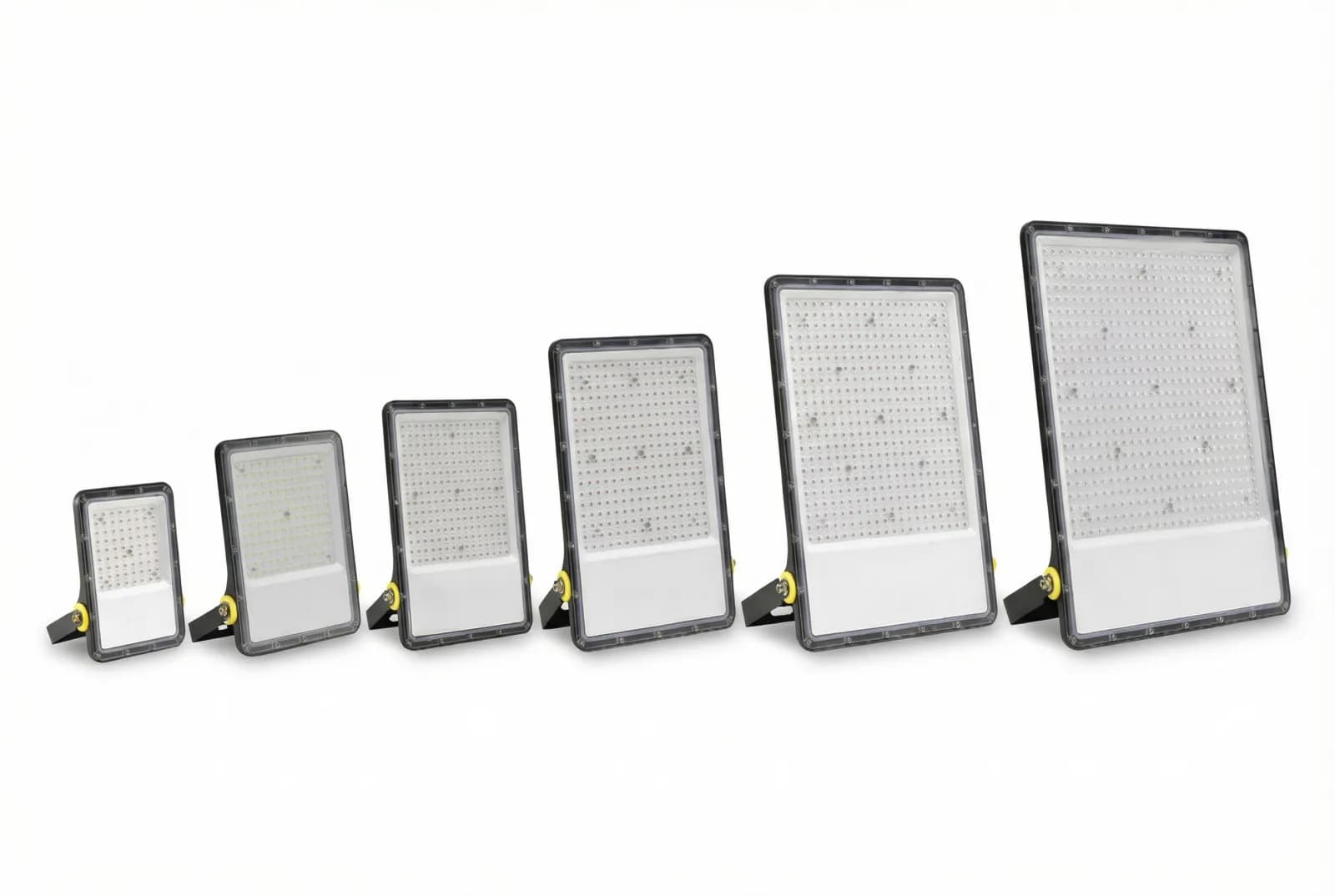
We manufacture two series covering the same 50-400W range at identical 150 lm/W efficiency. The difference is design philosophy.
BF-LFL-28 Series: Ultra-Slim (35mm)
From 50W (246x175mm) to 400W (510x370mm), every variant is just 35mm thick. Choose this when aesthetics, wind load, or tight clearance matter — facades, billboards, canopy mounts, coastal installations.
BF-LFL-29 Series: Modular Multi-Head
Stacks independent 100W modules: 200W uses two, 300W three, 400W four. Each module has its own LED array, driver connection, and thermal path. Choose this when long-term serviceability matters — on a 15-meter sports mast, replacing one module beats replacing the entire fixture. Also ideal when you want to scale from 200W to 400W on the same bracket.
| Factor | BF-LFL-28 Series (Ultra-Slim) | BF-LFL-29 Series (Modular) |
|---|---|---|
| Thickness | 35mm (all wattages) | 45-60mm (varies) |
| Wind load | Lower | Higher |
| Serviceability | Full fixture swap | Module-level swap |
| Best for | Facades, billboards, aesthetic installs | Stadiums, warehouses, sports fields |
Browse complete specs on our LED flood lights product page.
AC Flood Light vs Solar Flood Light
Choose AC when: you need sustained high brightness (200W+) for extended hours, the site has grid infrastructure, or applications demand constant full power — sports lighting, stadiums, high-security perimeters.
Choose solar when: grid power is unavailable or expensive to install, brightness needs are moderate (under 80W), or installation speed and zero operating cost outweigh upfront cost.
For a detailed comparison with real cost data, read our AC vs solar flood light analysis. If you are leaning toward solar, our solar flood light buying guide covers panel sizing, battery chemistry, and controller selection for off-grid flood lights specifically. Browse our solar flood light range for off-grid alternatives.
Quality Red Flags
Cheap drivers. If the supplier cannot name the driver brand, it is likely a $2-3 generic unit that will fail within months. A brand-name driver costs $8-15 more and lasts far longer.
Thin aluminum. If a 200W unit feels lightweight, the housing cannot manage thermal load. Our 200W BF-LFL-28 Series uses precisely calculated fin geometry across its full 390x270mm surface.
Inflated lumens. 200W at 150 lm/W = 30,000 lumens. If a competitor claims 50,000 from 200W, they are measuring bare chips or fabricating numbers. Ask for an integrating sphere report.
Self-declared certifications. "CE certified" without a test report number and lab name is meaningless. Request the Declaration of Conformity.
No surge protection. If the supplier cannot state the surge rating in kilovolts, assume it is inadequate.
For a deeper look at quality verification, read our 9-point quality checklist — the methodology applies equally to AC flood lights.
How to Evaluate a Supplier
Beyond fixture specifications, the manufacturer determines long-term project success:
- Can you provide the LED chip datasheet and driver specification? A legitimate manufacturer knows exactly what is inside their fixtures.
- What is your QC process? Look for 100% aging tests (every unit burns in for 24 hours), not sample-based testing.
- Can you provide project references? Ask for photos and contacts from installations similar to yours.
- What is your driver failure rate? If they do not track this, their quality system is immature. Ours: less than 0.1%.
- Do you accept third-party inspection? We welcome SGS, Bureau Veritas, and TUV inspectors at our Fujian facility at any production stage.
Next Steps
Send us your project type, site dimensions, and mounting height. Our engineering team responds within 24 hours with a photometric layout and recommended configuration from our BF-LFL-28 Series or BF-LFL-29 Series.
For off-grid projects, explore our commercial solar lighting solutions.