Your community needs a lit sports field. Players want to train after work. Schools need evening practice slots. Local leagues need game-quality illumination. The question every project manager faces: what type of lighting, how many fixtures, and how much will it cost?
We manufacture both AC-powered LED flood lights and solar lighting systems. We have no incentive to push one technology over the other — we profit either way. That puts us in a unique position to give you an honest answer about what works, what does not, and where each technology belongs in a sports field project.
The short answer: AC LED flood lights for the playing field. Solar for everything around it. This page explains why, shows you the exact configurations, and gives you real numbers.
Why Sports Field Lighting Is the Hardest Outdoor Lighting Problem
Sports fields are not parking lots or pathways. They demand lighting performance that pushes every technology to its limits.
Extreme Lumen Demand
A recreational basketball court requires 300+ lux across a 420 sqm surface. A football field requires 200+ lux across 6,400 sqm. For context, a well-lit parking lot needs only 10-20 lux. Sports fields need 15-30x the illumination density of any other outdoor application. This translates to 120,000-480,000 lumens that must run at full brightness for 4-6 consecutive hours every evening.
Uniformity Across the Entire Playing Surface
A bright center with dim corners is dangerous in sports. Players misjudge distances, lose track of the ball, and collide with each other in transition zones between bright and dark areas. International sports federations specify uniformity ratios of 2:1 or better (the darkest point must be at least half the brightness of the brightest point). Achieving this requires precise optical engineering, correct pole placement, and proper aiming angles.
Glare Control for Players and Spectators
Players on a basketball court look upward constantly. Football goalkeepers face light poles directly. Spectators sit at angles that catch poorly aimed fixtures head-on. Uncontrolled glare is not just uncomfortable — it is a safety hazard that impairs reaction time and depth perception. Proper sports lighting requires asymmetric optics, high mounting angles, and external glare shields designed specifically for athletic environments.
Long Continuous Operation
Unlike security lighting that can dim at midnight, sports fields need full brightness for the entire usage window — typically 6 PM to 11 PM, five to seven nights per week during season. There is no energy-saving dimming profile when a match is in progress. This continuous high-power demand is the fundamental reason solar struggles with the playing field itself.
Infrastructure for Large Open Sites
Sports complexes are large properties. The playing field, parking areas, access roads, pedestrian paths, and perimeter security zones are spread across several hectares. Running grid power to every corner means trenching cables across open ground at $15-30 per linear meter. A 500-meter cable run to reach a perimeter light costs $7,500-15,000 in trenching alone.
How We Solve It: Hybrid — AC for the Field, Solar for Everything Else
After designing lighting for sports facilities across 30+ countries, we have converged on a single principle: use each technology where it performs best.
The Playing Field: AC LED Flood Lights
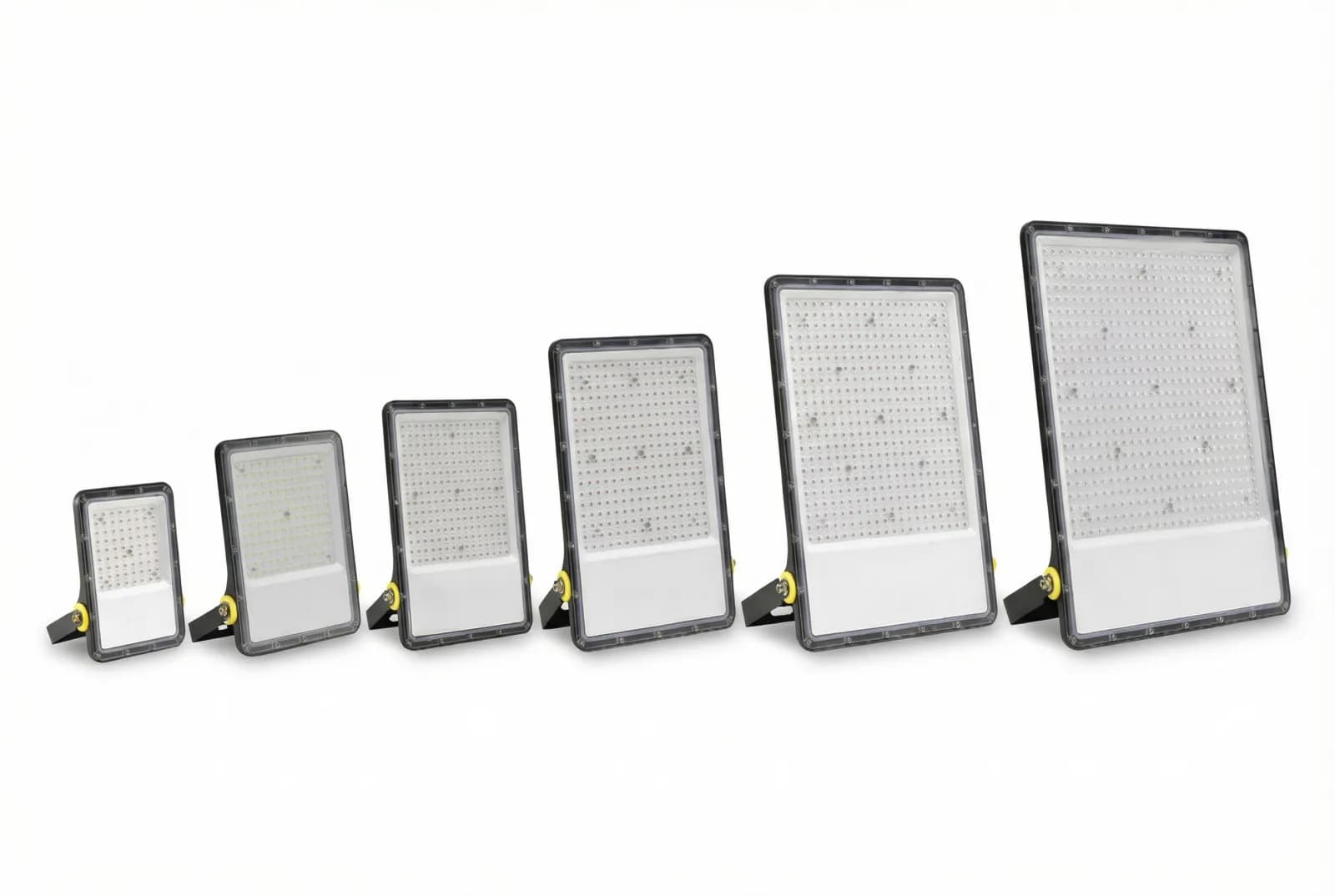
The field demands high-wattage fixtures (200-400W) running at full power for 4-6 hours. This is where our BF-LFL-28 Series LED flood lights excel:
- 200W / 300W / 400W options with 30,000 to 60,000 lumens per fixture
- 3030 LED chips for high luminous efficacy
- Asymmetric beam optics engineered for sports field throw patterns
- Ultra-slim housing (35mm profile) that reduces wind load on tall poles
- IP65 rated for all-weather outdoor operation
- long-service-life design — over 15 years at typical sports field usage rates
These fixtures mount on 10-15M galvanized steel poles with adjustable arm brackets, allowing precise aiming during commissioning.
The Surrounding Infrastructure: Solar
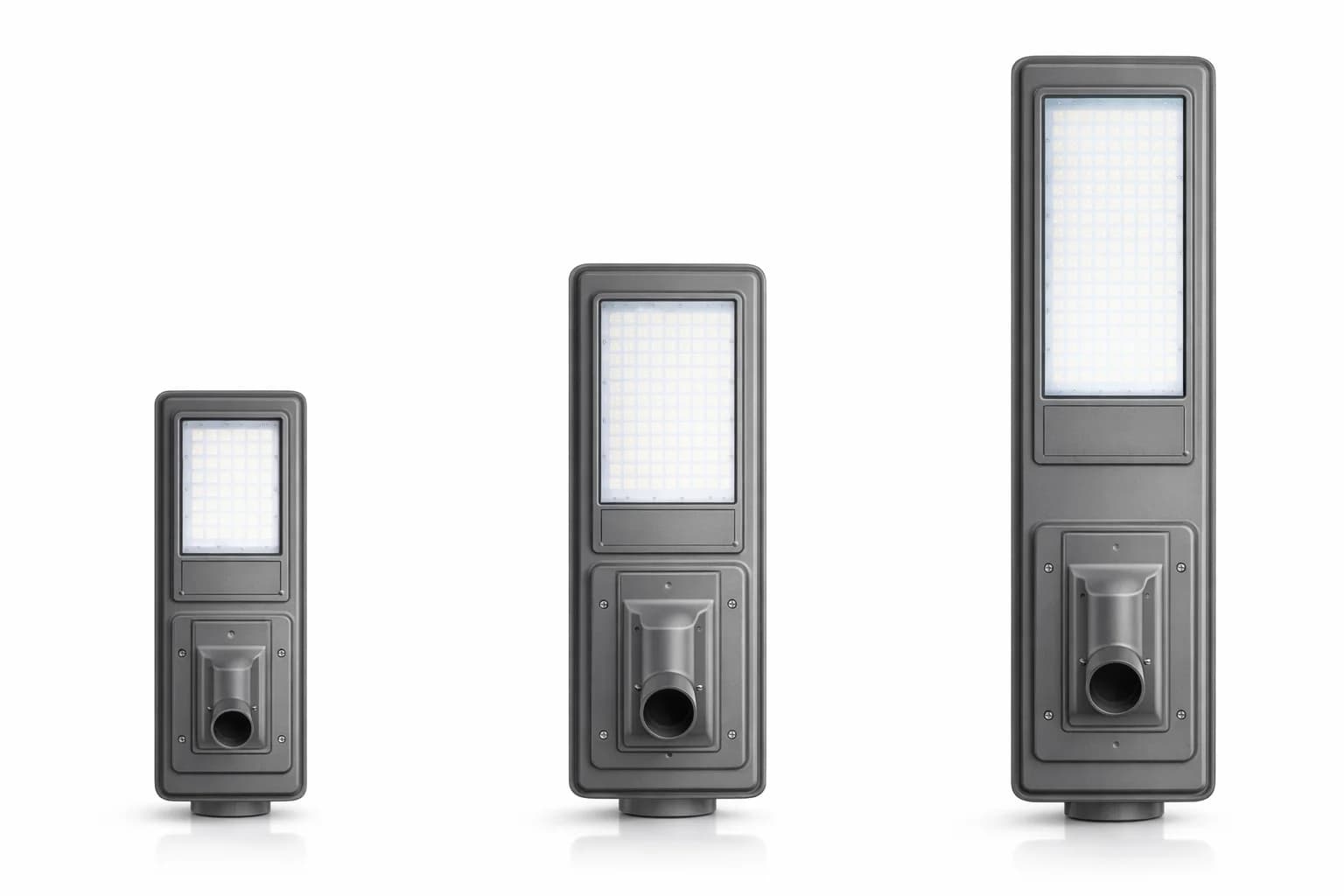
Access roads, parking lots, pedestrian paths, perimeter security, and entrance areas are classic solar applications. Independent solar supply, no trenching, and no need for continuous full-brightness output. This is where our solar street lights and solar flood lights eliminate trenching costs entirely.
- BF-SSL-22-120W for access roads and parking — 7,600 LM, 7-9M mounting height
- BF-SFL-27-100W for entrance signage and perimeter security
- LiFePO4 batteries with 3-5 rainy day autonomy
- intelligent charge controller with intelligent dimming profile
- Radar motion sensor for security-zone boost
Why Hybrid Wins
The hybrid approach captures the best economics of both technologies:
| Zone | Technology | Why |
|---|---|---|
| Playing field | AC LED flood | High lumen demand + long run hours = grid power is 5-10x cheaper than solar equivalent |
| Parking areas | Solar street light | Moderate lumen, independent poles, zero trenching across asphalt |
| Access roads | Solar street light | Linear layout over long distances, trenching cost prohibitive |
| Perimeter security | Solar flood light | Remote locations, motion-activated, no infrastructure |
| Entrance / signage | Solar flood light | High visibility area, self-contained, easy installation |
Result: You trench power cables only to the field poles (short distances from the electrical panel). Everything else runs on solar with zero wiring. This typically saves 30-50% on total project infrastructure cost compared to running grid power to every fixture on the property.
Recommended Configurations by Field Type
We have standardized three configurations based on the most common sports field projects. Each has been validated in real installations.
Configuration 1: Basketball / Tennis Court (28×15m / 24×11m)
| Parameter | Specification |
|---|---|
| Field Fixtures | 4× BF-LFL-28-200W — 30,000 LM each |
| Field Pole Height | 10M (4 corner poles) |
| Total Field Lumens | 120,000 LM |
| Achieved Lux | 300+ lux average (recreational/training standard) |
| Surrounding Fixtures | 4× BF-SSL-22-120W for path + parking |
| Surround Pole Height | 7-8M |
| Field Power Consumption | 800W total, ~4 kWh per evening (5-hour session) |
| Estimated Total Cost | $6,000 - $10,000 (fixtures + poles + installation) |
Configuration 2: Football / Soccer Field (100×64m)
| Parameter | Specification |
|---|---|
| Field Fixtures | 8× BF-LFL-28-400W — 60,000 LM each |
| Field Pole Height | 15M (3 per sideline + 1 per endline) |
| Total Field Lumens | 480,000 LM |
| Achieved Lux | 200+ lux average (recreational standard) |
| Surrounding Fixtures | 8× BF-SSL-22-120W for parking + perimeter |
| Surround Pole Height | 8-9M |
| Field Power Consumption | 3,200W total, ~16 kWh per evening (5-hour session) |
| Estimated Total Cost | $25,000 - $45,000 (fixtures + 15M poles + electrical + solar) |
Configuration 3: Multi-Use Recreational Area (Mixed Courts + Open Space)
| Parameter | Specification |
|---|---|
| Court Fixtures | 4× BF-LFL-28-200W for primary court |
| Open Area Fixtures | 2× BF-LFL-28-150W for multi-use zone |
| Field Pole Height | 10-12M |
| Surrounding Fixtures | 6× BF-SSL-22-120W + 2× BF-SFL-27-100W |
| Achieved Lux | 200-300 lux (courts) / 100-150 lux (open area) |
| Total Fixture Count | 6 AC floods + 8 solar units |
| Estimated Total Cost | $12,000 - $22,000 |
All field fixtures include adjustable mounting brackets for precise aiming. All solar units include LiFePO4 batteries with 3-5 rainy day autonomy.
Need a custom layout? Send us your site plan with field dimensions, and we can provide a DIALux photometric simulation on a per-project basis showing fixture positions, lux distribution map, uniformity ratio, and glare rating. Request a sports field lighting design.
When Solar Works and When Grid Power Is Better for Sports
We manufacture both AC LED flood lights and solar lighting systems. We sell both at similar margins. This section exists because we believe honest engineering advice builds more trust than overselling — and trust is what turns a one-time buyer into a long-term partner.
The Playing Field: AC Power Is Necessary
Here is the math that makes this unavoidable:
| Parameter | Basketball Court | Football Field |
|---|---|---|
| Fixtures needed | 4× 200W | 8× 400W |
| Total wattage | 800W | 3,200W |
| Hours per evening | 5 hours | 5 hours |
| Energy per night | 4 kWh | 16 kWh |
| Solar panel needed | ~2.5 kW | ~10 kW |
| Battery storage needed | ~6 kWh | ~25 kWh |
| Solar system cost | $4,000 - $8,000 | $15,000 - $25,000 |
| Grid connection cost | $500 - $2,000 | $1,000 - $4,000 |
| Cost ratio | Solar is 3-8× more | Solar is 5-10× more |
The solar panel area alone for a football field system would require approximately 50 sqm of panels — nearly the size of a tennis court. The battery bank would weigh over 200 kg and need a weatherproof enclosure. This is technically possible but economically irrational when a grid connection is available.
The Surrounding Infrastructure: Solar Is Ideal
Now flip the equation for the areas around the field:
| Parameter | Solar Street Light | Grid-Powered Equivalent |
|---|---|---|
| LED power per unit | 40W (BF-SSL-22-120W, 120W panel) | 40W |
| Hours per night | 10-12 (dusk to dawn) | 10-12 |
| Cable trenching | $0 | $15-30/meter × 50-200m per fixture |
| Electrical permits | None | Required |
| Ongoing electricity | $0 | $50-100/year per fixture |
| 5-year total per fixture | $500-700 | $1,500-5,000 |
For parking lots, access roads, and perimeter zones where fixtures are spread across large areas, solar eliminates the single largest cost: trenching cables across open ground. Each solar unit is independent — install the pole, mount the fixture, it works.
The Honest Recommendation
- Grid power available within 100m of the field? AC floods for the field, solar for surrounds. This is the optimal configuration for 90% of projects.
- Completely off-grid site with no power within 1 km? Consider a dedicated solar-plus-battery microgrid or generator-solar hybrid. Contact us for off-grid sports facility design.
- Budget-constrained community project? Start with AC floods on the field only. Add solar for surrounding infrastructure in phase 2 as budget allows.
We design the system that makes technical and financial sense for your specific site — not the system that maximizes our invoice.
AC LED Flood Light Specifications for Sports Fields
Our BF-LFL-28 Series is engineered for high-mast sports field applications. Key specifications:
| Model | Power | Lumens | Efficacy | Beam Angle | Weight | Dimensions |
|---|---|---|---|---|---|---|
| BF-LFL-28-200W | 200W | 30,000 LM | High-efficiency | 60°×120° asymmetric | 3.2 kg | 390×270×35 mm |
| BF-LFL-28-300W | 300W | 45,000 LM | High-efficiency | 60°×120° asymmetric | 4.5 kg | 464×323×35 mm |
| BF-LFL-28-400W | 400W | 60,000 LM | High-efficiency | 60°×120° asymmetric | 5.8 kg | 510×370×35 mm |
Common specs across BF-LFL-28 Series:
-
LED chip: 3030 SMD
-
Color temperature: 5000K / 5700K (daylight, optimal for sports)
-
Input voltage: AC 100-277V (universal)
-
IP rating: IP65
-
Housing: die-cast aluminum, ultra-slim 35mm profile
-
Mounting: adjustable U-bracket, ±90° tilt
-
Lifespan: long-service-life
-
Warranty: 3 years
Certifications: CE, IP65, RoHS. cULus/DLC testing available on request for North American projects.
For the complete AC LED flood light range including lower-wattage models, see: LED Flood Lights (50-400W).
Get Your Sports Field Lighting Design
Tell us your field type and site conditions, and we will deliver:
- Photometric layout — exact fixture positions, aiming angles, and pole locations on your site plan
- Lux distribution map — showing illumination level and uniformity ratio across the playing surface
- Glare analysis — GR (glare rating) calculation per viewing position for players and spectators
- Hybrid cost breakdown — AC field fixtures + solar surround fixtures + poles + installation estimate
- Energy cost projection — monthly electricity cost for field fixtures vs total-grid alternative
Ready to start?
- Send us your site plan with field dimensions for a custom photometric layout (response within 48 hours)